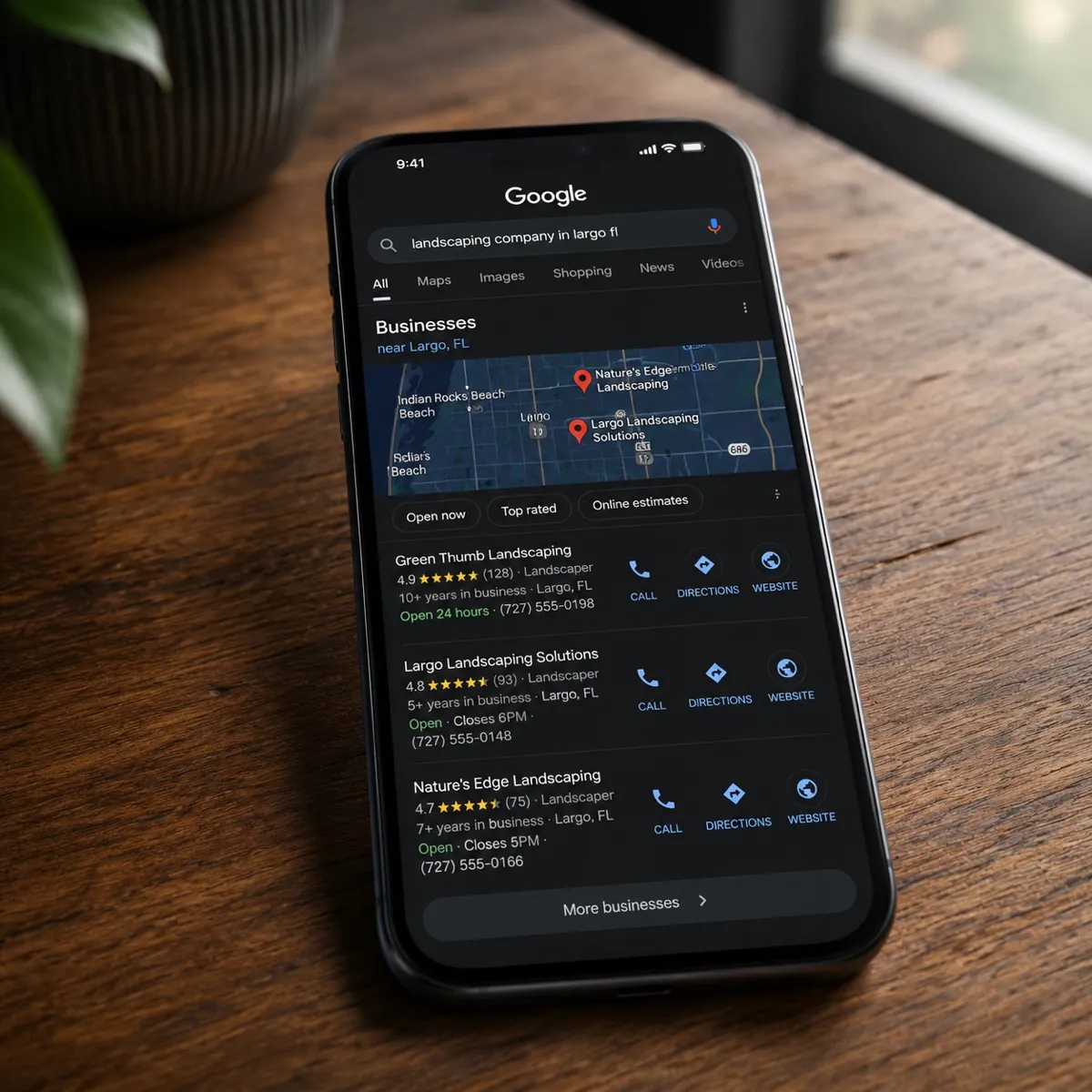
Ranking is not the win. Booked calls from the right homeowners, property managers, and commercial buyers are the win. Here is the local SEO system that actually supports that.
Quick answer: what local SEO should do for a lawn or landscape company
Local SEO should make it easy for nearby buyers to find your company, understand exactly what you do, trust that you can do the work, and take the next step. For lawn care and landscaping companies, that means your website, Google Business Profile, reviews, service pages, project proof, and follow-up all need to tell the same story.
The best local SEO strategy is not chasing every keyword with the word "lawn" in it. It is building a search presence around the jobs you actually want: weekly maintenance routes, fertilization programs, landscape design, patios, drainage, commercial maintenance, outdoor living, or whatever work creates the right kind of revenue.
Local SEO is not a ranking contest. It is a local trust system. If the traffic does not turn into qualified calls, the system is leaking.
Why the old "top 10 local SEO tips" approach is not enough anymore
Most lawn and landscape SEO advice sounds the same: claim your profile, add keywords, get reviews, write blogs. None of that is wrong. It is just too thin to win in a competitive market.
Google and AI answer tools need clarity. Buyers need proof. Your team needs leads that match the services you can actually sell and deliver. That means each page has to answer real buyer questions, show local relevance, and point people toward the right action.
A generic page that says "we offer lawn care and landscaping" does not do that. A page that explains your service, service area, process, project proof, seasonal timing, pricing factors, reviews, and next step has a much better shot.
The 10 local SEO moves that matter most
1. Build pages around the work you want more of
Start with business strategy, not keywords. Decide which services you want to grow, which service areas matter, and which customers are worth pursuing. Then build pages for those revenue lanes.
A lawn mowing route page should not read like a landscape design page. A commercial maintenance page should not read like a residential mulch page. Each page needs its own promise, proof, objections, photos, and call to action.
2. Align your Google Business Profile with your website
Your Google Business Profile should reinforce the same services and locations your website is targeting. Categories, services, business description, photos, posts, products, Q&A, hours, and reviews should all support the work you want to be known for.
If your website is pushing landscape design but your profile looks like a generic lawn mowing company, Google and buyers get mixed signals. Mixed signals are expensive.
3. Use service-area pages only when they are useful
City and service-area pages can work, but only when they say something real. A useful page explains the local service demand, shows nearby proof, addresses local conditions, and connects to the right service page.
Thin pages with the city name swapped out are not local SEO. They are digital litter with a contact form.
4. Put proof directly on the money pages
Do not hide all your credibility on one reviews page. Put relevant proof where buyers are making a decision. A hardscape page should show hardscape work. A lawn care page should show lawns, route consistency, reviews, and renewal signals.
Proof can include before-and-after photos, short project notes, review snippets, case studies, crew/process details, memberships, certifications, warranties, and service guarantees where they are true.
5. Link the site like a real growth system
Internal links should help people and search engines understand your business. Connect industry pages, service pages, blog posts, case studies, and calls to action in a way that reflects how buyers decide.
For example, a local SEO article should naturally point to local SEO services, website design, lawn care marketing, and landscaping marketing when those links help the reader take the next step. The service strategy is more specific in our lawn care SEO and landscaping SEO playbooks.
6. Ask for reviews that describe the actual job
A review that says "great company" is fine. A review that says "they redesigned our backyard, installed the patio, fixed the drainage, and communicated every step" is stronger.
You should never script reviews or pressure customers. But your review request can remind customers to mention the service, location, project type, and what stood out if they are comfortable sharing it.
7. Answer the questions buyers ask before they call
Good local SEO pages answer the questions sales teams hear every week: cost factors, timeline, seasonal availability, service-area fit, maintenance requirements, project process, warranty, and what happens after someone reaches out.
This helps people qualify themselves. It also gives Google and AI systems clean, extractable answers.
8. Clean up NAP and citation signals
Your name, address, phone number, website, hours, and core categories should be consistent across your major listings. This matters most when the business has moved, changed numbers, merged brands, opened new locations, or hidden its address.
Do not obsess over every tiny directory. Focus first on the sources real buyers and search systems are most likely to trust.
9. Track qualified leads, not vanity rankings
Rankings matter, but they are not the scoreboard. Track calls, forms, booked estimates, service requested, service area, lead source, close rate, and revenue quality.
If a page ranks but brings in renters outside your service area asking for one-time cheap mowing, that is not success. That is your website wasting your estimator's time.
10. Make the page easy for AI tools to understand
AI search does not replace local SEO. It rewards the parts of local SEO that should have mattered already: clear structure, direct answers, specific services, local context, author credibility, schema, and proof.
Use descriptive headings, answer-first sections, FAQs, internal links, original examples, and clean schema. Do not bury the useful part under 800 words of marketing fog.
A 30-day local SEO cleanup plan
Week 1: Pick the money services
Choose three to five services that deserve better search visibility. For each one, define the ideal buyer, service area, minimum job value, seasonal timing, and proof you can show.
Week 2: Fix the page and profile alignment
Update the core service pages and Google Business Profile so they reinforce the same services, categories, descriptions, photos, and calls to action.
Week 3: Add proof and FAQs
Add project photos, review excerpts, service-specific FAQs, pricing-factor explanations, process notes, and internal links. This is where most landscaping sites are painfully thin.
Week 4: Measure lead quality
Set up tracking so you can see which pages generate qualified calls and forms. Then review actual lead quality, not just impressions and clicks.
What to avoid
- Do not publish thin city pages: build location pages only when there is a real local angle and useful proof.
- Do not stuff keywords into awkward copy: buyers can smell it, and so can Google.
- Do not send every visitor to the homepage: high-intent searches deserve focused service pages.
- Do not ignore phone tracking: many lawn and landscape leads still call first.
- Do not separate SEO from sales: if the lead is not qualified, the ranking did not finish the job.
How this connects to real growth
Strong local SEO compounds because every useful asset supports the next one. A better service page helps Google understand the business. Better reviews support the service page. Better project proof improves conversion. Better tracking tells you what to improve next.
That is why the goal is not "more traffic." The goal is a search system that consistently brings in the kind of work your company wants more of.
Want to know where your local SEO is leaking?
We can look at your website, Google Business Profile, service pages, reviews, and lead path, then show you what is blocking qualified local demand.
Want this done for you? See our landscaping SEO service.
Frequently asked questions
What is local SEO for lawn care and landscaping companies?
Local SEO is the work that helps a lawn care or landscaping company show up for service-area searches in Google Search, Google Maps, and AI answer tools. It connects the website, Google Business Profile, reviews, service pages, location signals, and proof so buyers can find and trust the company.
What should a lawn care company optimize first?
Start with the services and locations that produce the best customers. Build or improve those service pages, align the Google Business Profile with them, add proof and reviews, and make the contact path easy.
Do landscaping companies need city pages?
Only when the page is useful and specific. A city page should explain the service, local conditions, proof, photos, reviews, and nearby work. Thin city pages with swapped place names are not a strategy.
How long does local SEO take for landscapers?
Local SEO usually compounds over months, not days. The timeline depends on market competition, website quality, Google Business Profile strength, reviews, service-page depth, and whether leads are tracked correctly.
How should AI search change local SEO content?
AI search makes clear answers, author signals, structured headings, schema, and operational specificity more important. The page should explain what the company does, where it works, who it serves, and why it is trustworthy in a way that can be extracted accurately.