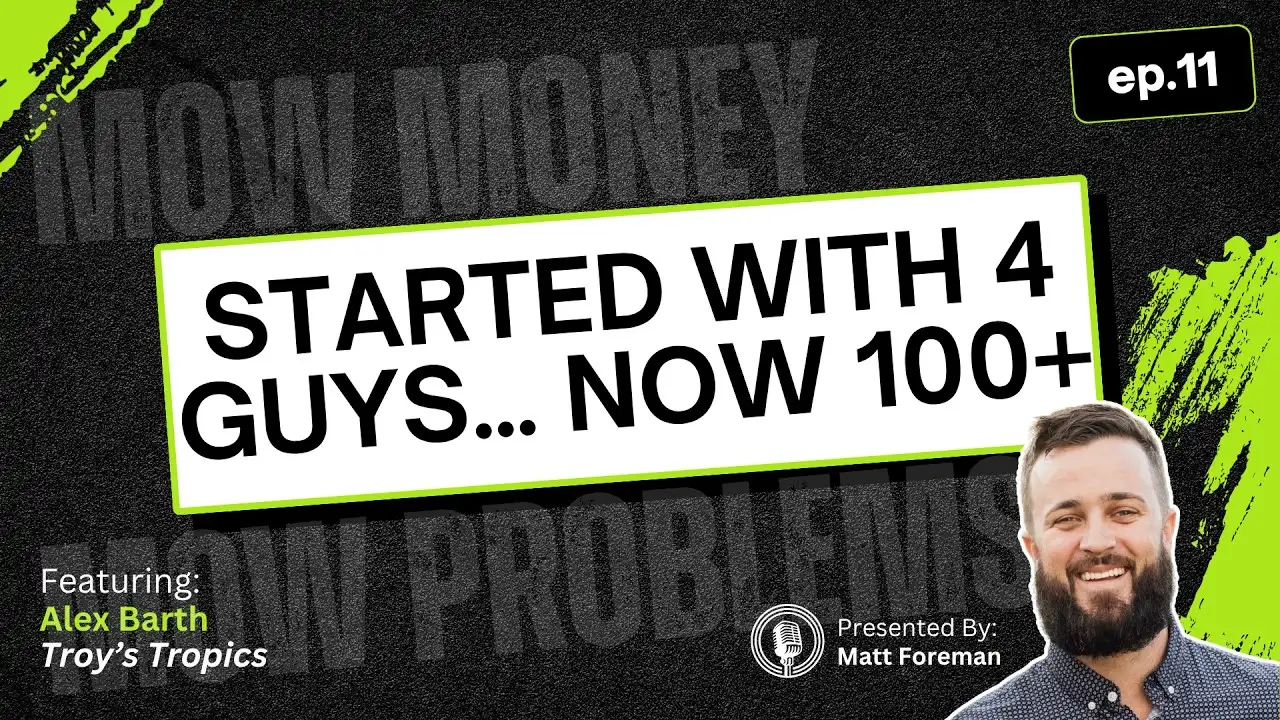
Alex Barth isn't the owner of Troy's Tropics, a nursery and landscaping company in Sarasota, FL, but he's the person who built its landscape division out of nothing. On episode 11 of the Mow Money, Mow Problems podcast, Alex told host Matt Foreman how a retail nursery he used to buy plants from turned into a company that now employs about 100 people across two nursery locations and a landscape division.
His story is less about one marketing trick than about stacking advantages that reinforce each other: a physical location that doubles as a design showroom, a maintenance crew that earns the next call for a bigger project, and a media presence built one local news segment at a time. Here is what he shared about how it came together.
Key takeaways
- A brick-and-mortar nursery sells landscaping jobs too. Alex says walking a prospect through past designs and introducing them to a consultant face to face is an advantage online-only landscapers can't match.
- Maintenance work is a pipeline for design-build, not just a revenue line. Troy's Tropics added a maintenance division about six years into the landscape division specifically because staying on a property keeps the company first in line for the next big job.
- Local news segments and social media reels do the same job from two directions. Both put the company in front of homeowners before those homeowners ever pick up the phone.
- The company grew from about 15 employees to about 100. That growth spans two nursery locations and a landscape division of roughly 28 to 30 people.
How did a small retail nursery grow a 28-to-30-person landscape division?
It started with Alex Barth saying yes to one conversation and one vehicle. Alex started with Troy's Tropics in 2014, buying plants there for his own company. He was, in his own words, "a workaholic working seven days a week trying to build the business." The owner approached him about starting a landscape division for the company, the two worked out terms, and Alex took the job. "At first it started real small," he said, "and then it exploded soon after."
The buildup was gradual. Alex started with his own vehicle and a trailer, added one dump truck, and worked with a team of about four people, closing jobs and working them himself while getting the company's name out as more than a nursery. Over the next year or two the company added truck after truck. Today the landscape division runs six to seven full dump trucks, trailers, tractors and loaders, with about 28 to 30 employees offering landscape design, irrigation, landscape lighting and hardscaping.
Alex's own numbers show the scale of that growth:
| Then | Now | |
|---|---|---|
| Employees (nursery and landscape combined) | About 15 | About 100 |
| Landscape division equipment | One vehicle, a trailer, one dump truck, a crew of four | Six to seven dump trucks, plus trailers, tractors and loaders |
| Landscape division services | Design and installs | Design, installs, lighting, irrigation, hardscaping, drainage and property maintenance |
Why does a physical location matter for a landscaping company?
Because it lets a prospect see finished work and talk to a real person before signing anything. Troy's Tropics keeps its landscape equipment, trucks and crews at its main location, and runs a landscape office at its larger retail and wholesale site where the public can walk in for design consults. "You can't put a price on having a physical brick-and-mortar location where the public can come in, talk to someone face-to-face, see designs that we've done previously, meet with designers, and meet with consultants," Alex said.
That same visibility feeds the company's reputation. Alex says people increasingly reach out because they already know Troy's Tropics, from work on a neighbor's yard or a house elsewhere in the community, and that customers return every few years to redo their landscaping. Friends and neighbors who see that work become new leads on their own.
How is Troy's Tropics using Instagram and Facebook to generate leads?
Through a mix of regular posting and paid boosting across every division, not just the landscape side. Alex says the company puts real effort into reels and stories because, as he put it, people want to see progress and what's going on in the business, including before-and-after photos of landscape jobs and real-time walkthroughs.
The company leaned into social media more heavily during COVID, and committed further when it expanded into wholesale in 2023, extending its reach beyond Sarasota. Alex credits part of the wholesale business's growth to that same effort. Matt pointed out during the conversation that this gives a company like Troy's Tropics an edge over big-box stores that also sell plants, since a franchise can't offer the same personal, neighborly feel, and Alex agreed.
How do you turn a local news segment into a marketing channel?
By offering yourself as a resource before anyone asks. Alex reached out to Sarasota's ABC 7 and pitched himself as a guest for its Suncoast View segment, offering to answer the gardening questions the public already has, about drought season, cold weather and hurricane season. Once he'd done a few segments, the relationship flipped. "Now they're just leaning on us...whenever there's anything plant related, they reach out," he said. "I don't necessarily need to reach out for them anymore."
His advice for other green industry owners: "closed mouths don't get fed." If no one knows an owner is available to help, they won't be the one who gets the call. As Alex put it, reaching out to a station and offering to help "does it end up with results? Sometimes not. But you don't know if you don't try."
Matt made a connection during the conversation worth repeating: a homeowner watching a local plant expert on TV is building trust with that company before they've ever met anyone from it, the same way a well-run social media account or a tidy nursery showroom does.
How did Troy's Tropics respond when Hurricane Milton hit Sarasota?
With a two-step response: cleanup first, then re-landscaping. Hurricane Milton struck the Sarasota area in October 2024. Alex says hurricane readiness starts with preparation at the nursery, and that the landscape division is large enough to pivot into cleanup work when a storm hits, removing debris and downed trees and getting properties to what he called "a neutral playing field."
Once that work was done, the company moved into re-landscaping: reassessing properties, checking and in some cases reinstalling irrigation, and repairing landscape lighting that storms had damaged. Alex says the goal is to leave a property looking better than it did before the hurricane, and that showing up for customers during a stressful time builds trust that carries into future work.
Why add a maintenance division when design-build has better margins?
Because staying on a property is what earns the next call. Troy's Tropics added its maintenance division about six years into the life of the landscape division. It started small: the company told clients it would handle everything except mowing and weeding, encouraging them to keep their existing lawn crew while Troy's Tropics took on more complex weeding, trimming and fertilizing. Alex eventually moved over to run the nursery side of the business, and a colleague took over the landscape division, added mowers, and grew the maintenance and property management side into what Alex called "quite explosive growth."
Alex is candid about the trade-off: "It's not a high margin in general in the maintenance of properties, but it opens doors." A customer who sees the same crew on their property, and on their neighbors' properties, every week is the first call when it's time for a redesign or a hardscape project, because the trust is already there.
How do you manage a team that grew from 15 employees to about 100?
With a deliberate focus on communication and a visible path for growth. Alex says the company stays involved with employees, encourages them, and tries to show them that a role as a laborer or a foreman isn't the ceiling. Troy's Tropics also relies heavily on Indeed to recruit, along with people who apply in person, and brings in many employees with no prior experience in the field.
New hires are paired with an experienced employee so the company can see where their strengths lie: sales, plant care, the register, or stocking and deliveries. Alex says some of the company's key employees have been there 20-plus years. He also pointed to a broader tailwind during COVID: Troy's Tropics closed for about a week, then reopened, and found that an influx of people moving to Florida created new demand from homebuyers setting up their properties, on top of more people turning to gardening while they were spending more time at home.
What's Alex Barth's advice for starting a landscaping company from nothing?
Start with a Facebook page and whatever vehicle you already own. Alex says the first step is building a Facebook page and sharing it through a personal account, since that's where a new business owner already has an audience of friends. The second is simply having a vehicle to do the work, however humble: Alex recalls a point when he had only a Honda Civic and was putting dead branches in the trunk and the backseat.
- Build a Facebook page and share it through a personal account before anything else.
- Use whatever vehicle is available rather than waiting for the right truck.
- Go door to door if there's no customer base yet, to put a name and a face in front of people.
- Take the time to do each job well, since word of mouth from one good job is what brings the next client.
Alex's framing: it's a step-by-step process, and owners shouldn't overcomplicate it. One job done well gets noticed by a neighbor, who asks who did the work, and the next client comes from there.
The operator takeaway
Alex Barth's version of growth at Troy's Tropics didn't come from one breakthrough channel. It came from stacking a physical location, a maintenance crew that stays on the property, a social media presence, and a media relationship that took years to build, so that each one feeds the others. For an owner starting from a Honda Civic and a trailer, the lesson is the same one Alex gives any new hire: put in the work, show up consistently, and the next opportunity tends to follow the last one done well.
Want your landscaping company's reputation to do more of the selling?
We build the marketing system that turns a strong local reputation into steady lead flow: a website that shows off real work, local SEO, and the follow-up that keeps past clients coming back for the next project.
Want this done for you? See our landscaping marketing.
Frequently asked questions
How can a landscaping company use a physical location as a marketing advantage?
Alex Barth of Troy's Tropics says a brick-and-mortar nursery lets prospects walk in, see finished landscape designs, and meet with designers and consultants face to face, building trust before any contract is signed.
How did Troy's Tropics grow its following on Instagram and Facebook?
Alex Barth says the company combines regular posting with paid boosting on reels and stories, showing before-and-after photos of landscape jobs and real-time walkthroughs, with a bigger push starting around 2023 when it expanded into wholesale.
How do you get a local news station to feature your landscaping business?
Alex Barth's approach was to reach out directly and offer himself as a resource for gardening segments. After a few appearances on a local Sarasota news program, the station began reaching out to him instead.
Why would a landscaping company add a maintenance division if the margins are lower?
Alex Barth says maintenance work keeps a crew on a property regularly, so when the client is ready for a bigger design or hardscape project, the company already on site is the first one they call.