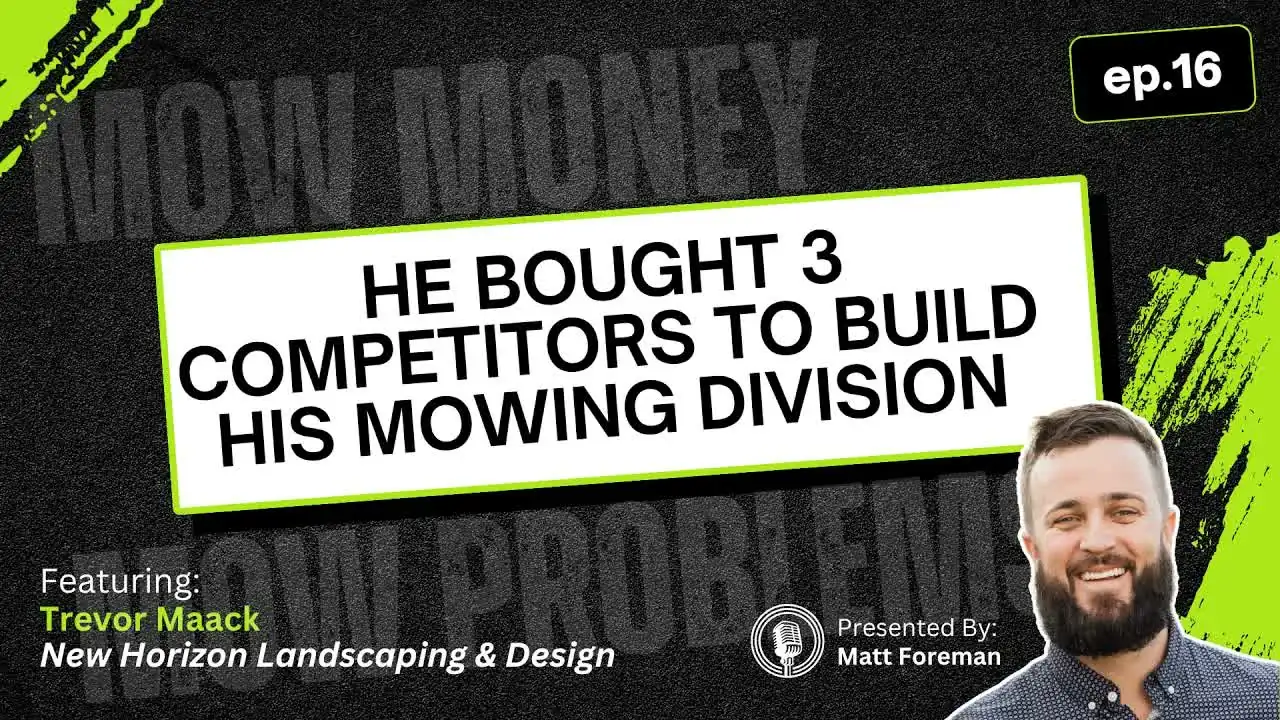
Trevor Maack started New Horizon Landscaping in Lincoln, NE in 1998 with a truck and a shovel. Nearly 30 years and three economic downturns later, he runs a full-service landscape company that is about 95% commercial, and most of its mowing accounts came from buying competitors rather than knocking on doors.
On episode 16 of the Mow Money, Mow Problems podcast, Trevor walked through how he evaluates and pays off an acquisition, how he keeps big commercial clients for years, why drainage is one of his biggest services in Midwest clay, and how certifications make his crews easier to sell.
Key takeaways
- Buying accounts can beat building them. Trevor has bought three mowing companies, and some accounts from the first purchase are still with him 17 or 18 years later.
- Price the deal to pay off in two years. He negotiates so a solid account list covers the purchase within two years, then he has to hold it a third.
- Commercial clients stay for the personal touch. Direct contact from the owner or a manager, holiday cards and moving loyal clients to the top of the list keep accounts for decades.
- Certified staff sell technical work. His managers are certified in drainage, erosion control and NCMA hardscape installation, on an annual education allowance he pays for.
How did a hardscape company end up 95% commercial?
One step at a time, following the work. Trevor grew up in soil conservation and earthmoving with his father, running dozers on field terraces and waterways, but wanted a more people-facing business. After earning a degree in marketing and management, he started New Horizon in hardscaping: retaining walls and paver patios.
Relationships with apartment complexes and home builders pulled the company into grading, which led to finishing landscapes for builders, which led to a softscape division. Maintenance came later and is still small by design, about 10 to 15% of revenue, mostly bed maintenance and turf care. Lincoln's mowing market is saturated and competitive on price, so mowing alone was never the plan.
A few years ago he dropped all but a handful of residential clients to focus on commercial. His reasons are operational: longer stays on each site, less drive time and fuel, and 12-month contracts that keep a core team of seven or eight people employed year-round.
Should a landscaping company buy its competitors?
For Trevor, it has been cheaper and faster than winning the same accounts one at a time. When he was new to lawn care, "no one really wanted to take a chance on somebody." Buying an existing company's accounts got him in the door. He has done it three times:
| Purchase | How it came about |
|---|---|
| First, about 17 or 18 years ago | An owner of a struggling business approached him; Trevor still has some of those accounts today |
| Second | A post he found, probably on Facebook |
| Third, in 2019 | A friend of a friend who knew he was looking; a larger company, with its employees and equipment |
His math is simple: negotiate a price that a decent account list can pay off in about two years. "I just have to maintain a third year," he says, so there's real risk in keeping the accounts. After that, the value comes from upselling services to accounts that keep buying or building properties.
He's candid about the growing pains. After the 2019 purchase, crews were working seven days a week and burning out, and payroll was "through the roof" until schedules were fixed. And "when you get a client list, you don't know exactly who's good and bad," so his team weeded out the poor fits and kept the good clients.
How do you keep commercial landscaping clients for years?
Make the relationship personal, and reward loyalty with priority. Some of New Horizon's commercial clients are national companies that keep building new facilities in Lincoln and ask New Horizon to maintain each one. Apartment complexes are different: Trevor says they tend to change staff about every three years, and the landscape vendor often changes with them, so relationships have to be rebuilt.
His approach to retention:
- Constant, personal contact from Trevor or one of his managers, not just an invoice.
- Small gestures of appreciation, like holiday cards to the owner of a property.
- Priority service. One large local client gives New Horizon the maintenance on every commercial property he buys. When he calls, "instead of putting him a month behind before we can get to him, he moves up to the top of the list."
Being attentive, Trevor says, is one of the biggest factors of all.
Why is drainage such a big landscaping service in the Midwest?
Because the soil gives water nowhere to go. In Lincoln's city limits, Trevor explains, the topsoil has been stripped and what's left is hardpan clay. When homeowners overwater, the water sits on the surface, so New Horizon installs a lot of drain tile.
He shared a fresh example from the day before the recording: a backyard with a constant wet spot and no obvious cause other than poor grading. When the crew opened the trench, it filled completely with water. The fix reduces sump pump discharge and lets the grass grow.
Selling that kind of work comes down to knowledge. "Knowledge is key," Trevor says, which is why his staff is certified in erosion control and drainage, and most of his managers have more than 10 years in the industry. They can explain the problem and the fix on the spot.
How do certifications help a landscaping crew sell and stay?
They make the team more credible and give good people a reason to stay. Every New Horizon manager is certified in drainage and erosion control, and in NCMA hardscape installation for pavers and retaining walls. Trevor still leads design and bids most jobs himself, but his managers can speak to the technical side.
- An annual education allowance each employee can spend on any green-industry education they choose.
- Paid certifications and testing, including required pesticide and fertilizer applicator certification.
- Paid winter seminars, as far away as Kansas City, MO, which staff are expected to attend when available, during the slow season.
Hiring is still the hardest part. New Horizon wants at least a month of prior experience even at the labor level, which shrinks the pool. Job boards work best for them, but Trevor estimates each hire now costs $75 to $150 to acquire.
How did New Horizon survive three economic downturns?
By shifting toward the work that was still there. The dot-com bust hit when New Horizon was three years old and only a few people, small enough to ride it out. The 2008 housing crash dried up the builder grading that had been the company's daily work, so Trevor shifted to landscaping, which also freed him from waiting on builders to pay. COVID turned out to be one of the company's better years, as homeowners who couldn't travel invested in their yards.
He also learned a hard marketing lesson along the way. Early on, he paid web developers a lot of money for websites that went nowhere, because the behind-the-scenes work, like properly tagging images, wasn't being done, so Google wasn't picking any of it up. Things turned around only when he found a marketing partner who taught him how the process actually works.
The operator takeaway
After almost 30 years, Trevor is working on the business instead of in it: his 28-year-old cell number still rings him directly, so he's moving the company to an automated phone system that routes calls to the right manager, and to electronic payroll. His story is a reminder that growth doesn't have to come from scratch. Buy accounts when the math works, keep clients with a personal touch, and invest in the people who make the technical work sellable.
Want your website to finally pull its weight?
We build websites and local SEO the right way, behind the scenes included, so landscaping companies get found for the work they want: drainage, hardscape, commercial maintenance and more.
Want this done for you? See our landscaping marketing.
Frequently asked questions
How does Trevor Maack decide whether to buy a landscaping company?
He looks for a price that a decent account list can pay off in about two years, knowing he has to keep the accounts for a third year. He then weeds out poor-fit clients and grows value by upselling services to accounts that keep adding properties.
Why did New Horizon Landscaping go mostly commercial?
Commercial work means longer stays on each site, less drive time and fuel, and 12-month contracts that keep a core team employed year-round. Trevor dropped all but a few residential clients and is now about 95% commercial.
Why do Midwest yards need drainage work?
In Lincoln, NE, Trevor explains, much of the topsoil has been stripped, leaving hardpan clay. Water from overwatering sits on the surface instead of soaking in, so drain tile is one of New Horizon's most common services.
How can a landscaping company keep good employees?
New Horizon gives each employee an annual education allowance, pays for certifications and testing, and pays staff to attend winter industry seminars. Trevor sees continued education as an investment that also makes his team more credible with clients.