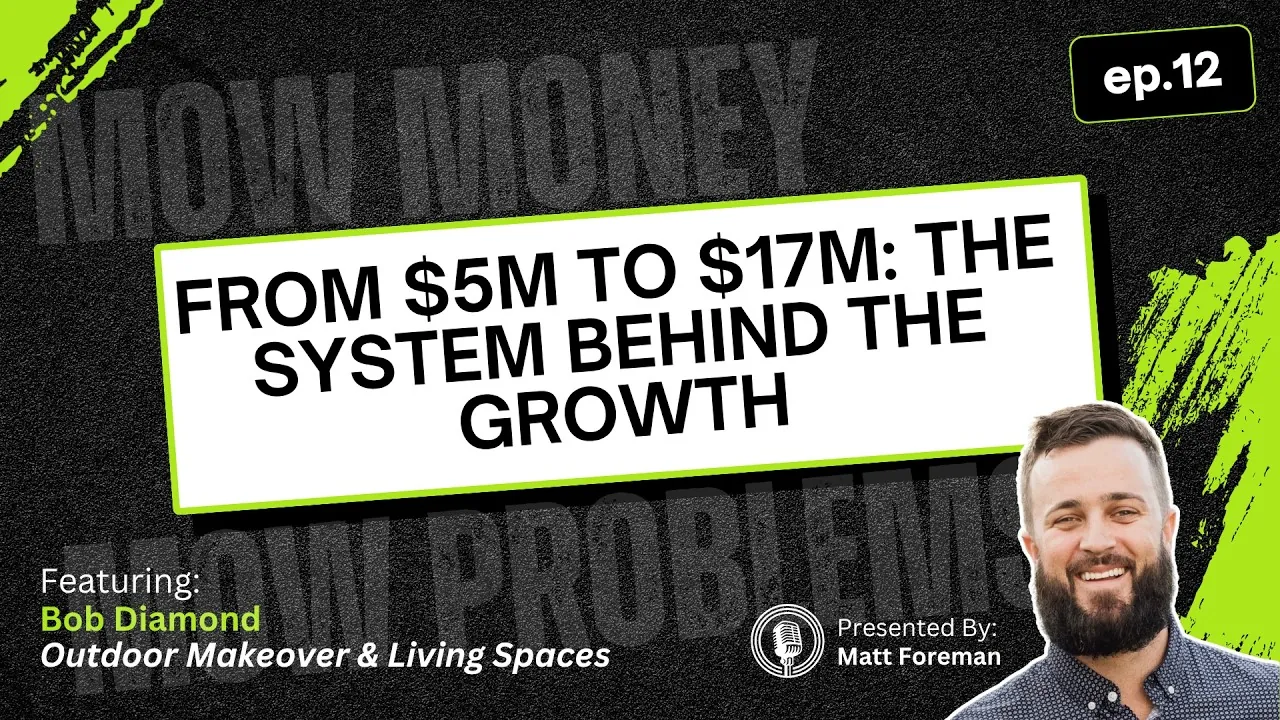
On episode 12 of the Mow Money, Mow Problems podcast, I sat down with Bob Diamond of Outdoor Makeover & Living Spaces. His design-build story is one of the clearest examples of how a green-industry company moves beyond commodity work and starts selling vision, planning, and a complete transformation instead of labor hours.
Design-build landscaping lets a company sell a finished outdoor space, not a list of services. That shift changes everything about how the business has to market itself.
Bob's story is a useful example of what it actually takes to market that kind of company. The lesson is not simply "do bigger projects." The lesson is to build a brand, website, proof system, and sales process that help homeowners understand why a complete outdoor living partner is worth trusting.
Design-build growth requires a bigger promise
Many landscaping companies describe what they install. Design-build companies have to describe what they create. That difference matters because buyers are making a more emotional and more expensive decision.
A homeowner considering a backyard transformation is thinking about hosting, privacy, shade, family time, curb appeal, resale value, maintenance, drainage, lighting, and long-term usability. The company has to show that it can connect all of those moving pieces into one plan.
A focused green-industry marketing strategy helps design-build companies turn that complexity into a clear promise buyers can understand.
Lesson 1: Position the company as the guide
Design-build buyers often know the feeling they want, but not the exact scope. They may not know whether they need a patio, retaining wall, planting plan, lighting, drainage, outdoor kitchen, fire feature, or phased installation.
That creates an opportunity for the company to become the guide. The marketing should explain how the team takes a homeowner from rough idea to finished outdoor space.
Strong websites for lawn and landscape companies make this guidance visible through process sections, project stories, service pages, and consultation CTAs.
Lesson 2: Project galleries should tell a story
For design-build companies, project photos are not just proof that the work looks good. They are a sales tool that shows how the company thinks.
The best galleries show complete environments: the relationship between hardscape, planting, lighting, grading, drainage, seating, circulation, and focal points. They help the buyer see the company as a planner, not only an installer.
Each featured project should answer a few quiet questions. What problem did the homeowner have? What was transformed? What details made the space better? Why should a similar buyer trust this company?
Lesson 3: Local SEO should match high-value services
Design-build companies often serve several search intents. Some people search for landscape design. Others search for outdoor living spaces, backyard makeovers, patio builders, retaining walls, outdoor kitchens, drainage, or landscape lighting.
Local SEO for landscaping companies should organize those intents into clear pages. The company should be discoverable for specific services while still reinforcing the larger design-build story.
That structure helps attract better-fit leads because buyers can find the exact thing they care about, then see that the company has the experience to manage the bigger picture.
Lesson 4: Reviews need to prove trust through complexity
Bigger outdoor living projects involve more decisions, more coordination, and more chances for uncertainty. Reviews are powerful because they show how the company behaves during the project, not only how the project looks afterward.
A strong reputation management system should help collect reviews that mention communication, planning, creativity, problem solving, cleanliness, timeline, and follow-through.
Those signals matter for premium buyers. They want to know the company can handle both the creative side and the operational side.
Lesson 5: The sales process should educate before it sells
Design-build leads usually need education. They may be comparing rough bids that are not actually comparable. They may not understand why design, materials, drainage, lighting, or sequencing affect the budget.
Good marketing can help before the sales conversation ever starts. Blog posts, project pages, FAQs, videos, and nurture emails can explain how to think about scope, timeline, phasing, and investment.
That education makes the sale easier because the buyer arrives with better expectations and more trust in the company's process.
Lesson 6: Follow-up turns big ideas into real projects
Outdoor living projects can sit in a homeowner's mind for months before they become real. A prospect might request information, wait for the right season, review finances, talk with family, or compare options.
That is why lead nurturing and follow-up matter. A good follow-up system keeps the conversation alive with project inspiration, planning tips, phasing ideas, and helpful reminders.
For design-build companies, the fortune is often in the follow-up. The best projects do not always close on the first contact.
The operator takeaway
Bob Diamond's Outdoor Makeover & Living Spaces story shows that design-build growth depends on making the company's value easy to see. Buyers need to understand the vision, trust the process, and believe the team can handle the details.
For landscaping companies, that means aligning the website, local SEO, project galleries, reviews, service pages, process messaging, and follow-up system. When those pieces work together, a company can attract more of the projects it actually wants.
Turn your design-build work into clear demand
If you run a design-build or outdoor living company, let us look at how your website, local SEO, project proof, reviews, and follow-up work together to attract the projects you actually want. It only takes a quick call to map it out.
Want this done for you? See our outdoor living marketing page.
Frequently asked questions
What can landscaping companies learn from Bob Diamond's Outdoor Makeover & Living Spaces story?
The main lesson is that design-build growth requires a clear brand promise, strong project proof, service-specific local SEO, customer trust signals, and a sales process that guides homeowners through complex decisions.
How should design-build landscape companies market themselves?
They should market the full transformation, not just individual services. That means showing finished outdoor spaces, explaining the process, building service pages for high-value searches, and using reviews and project stories to prove trust.
Why are project galleries important for outdoor living companies?
Project galleries show taste, planning, craftsmanship, and the ability to coordinate multiple elements into one finished space. They help buyers imagine what is possible on their own property.
How can local SEO help a design-build landscape company?
Local SEO helps the company rank for searches tied to high-value services such as landscape design, outdoor living, patios, retaining walls, outdoor kitchens, drainage, and lighting.
Episode transcript
Read the full transcript
Your company's never going to thrive if your goal is to just take care of the customer. You have to put a system in place first and say, "This is the system for which I'm going to take care of the customer." We always joke and say, "Heavy is the head that wears the crown." Welcome back everybody to the Mow Money, Mow Problems podcast. A podcast dedicated to the trials, triumphs, and insights of green industry business owners and their employees. I'm your host, Matt Foreman, and today we have Bob Diamond with us, uh, general manager of Outdoor Makeover and living spaces out in the Atlanta area. Bob's got over 30 years in the green industry, and today he's helping run a company that focuses on high-end outdoor living, everything from landscaping, hardscaping, pools, outdoor kitchens, and full backyard transformations.
Bob, honor to have you on here today. Thank you for being here. >> Pleasure. Thank you. >> All right, so you are the general manager. I would love to know because I'm I'm always so excited to speak to general managers of companies because you get a choice to make to either jump onto a company, start your own, do whatever you you've chose to become a part of this company and really help make it to what it is today. How did how did this journey work for you?
Like where did you start and how did you end up where you are today? >> Wow. So I owned my own company here for 18 years and eventually I worked on the manufacturing side and distribution side and the owner of the company Naveiv was one of my clients. So I I worked pretty closely with him and built a relationship and eventually the two of us decided to uh join forces uh and that was uh little short of six years ago. >> Okay. Awesome. So it was just right time, right place, right opportunity. >> And was when so when you joined it was Outdoor Makeover.
Was it the business it is today? Did things change from when you started to where at where it's at now? >> It's definitely evolved. I believe we were at about 5 to 6 million when I started. Now we're running. Last year we completed uh 15 million.
We'll hit 17 this year. And we've added we've added product lines whereas we were mostly a a landscape hardcape Outdoor Makeover five plus years ago. Now we we've added lines over the years. We've added the expertise in pools and in uh porches, anything on the exterior of the home at this point. And so that's come over time.
We've added the lines to try and uh give the customer an opportunity to have one company turnkey do the entire project. >> That's awesome. So what would if if there's any kind of like one lever or maybe it's a multiple levers what would you say that you would attribute that substantial growth to I mean from 5 million I mean to 15 many plateaus along the way that I see other owners hitting obviously you seem to have blasted through those. What what were the things that you would attribute that growth to? >> Uh our team talent to be honest with you we had to define we had to define who our customer was first. We did that. But but everyone can do that if they're focused.
Everyone can define exactly who their customer is and who they're going after. But we had to define who our team was going to be. We had to define what what type of talent they needed to bring to the table before we would hire them. We had to define what what value there was, you know, and how we would determine when we added a team member what their previous experience was. I will tell you that we have a ton of employees on our staff who have owned their own companies in the past and they've they've experienced the highs, they've experienced the lows.
I think they have a different perspective because they they don't just see it from someone who's worked their way up the ranks from an hourly position into a superintendent position or a manager position. These people have actually they've stayed up at night. They've worked on Sunday to do accounting. They know what it's like to run a business, so they can appreciate the things that they don't have to deal with. And I think they can trust other people to handle things that are not in their lane.
So the definitely number one thing would be adding the right team. >> So easier said than done I would imagine. How are you uh sourcing these great employees and and how do you make sure you retain them? >> You know, anybody can interview well. Anybody can have great experience in our industry. That doesn't mean they're a fit for our company. And that's just the honest truth.
Some of them may have all the talent in the world, but they're just not the right fit for us. For us, they have to be they have to have hustle. And I don't mean they need to be able to work fast. I mean they need to have hustle to be able to figure out how to get the job done. When no one's looking, when it's 6:00, the last day of the month, they have to have that internal hustle, that internal drive to to to be able to make the decisions to get the job done.
People, we've had plenty of great quality people, very intelligent, great people come through the door. traditionally somewhere around the 60 to 75 day mark we see whether they're a fit or not and and you you can't necessarily see that day one. So we we are not afraid to when we see that they have all the intangibles. Uh we're not afraid to bring someone in, invest in training them, set them up for success, give them the opportunity, but we definitely keep training and monitoring them because we're going to see somewhere in that 75 to 90day mark, we're going to see the light bulb go off and we're going to see them just slip right into the team and and it's going to all make sense to them. And we have to give them that time in order to to see who who who works it out and who's a good fit and who's not. And I think that uh one of the things that we had to overcome that I think other people struggle with is forgiving ourselves when we decide 60 days in 90 days in this is not the right fit.
Sometimes I think as managers as owners we keep people because we have a hard time agreeing that we failed. And so for us it's success for us to be able to get to the 90day mark and evaluate. We give them a probation period for that first 90 days and we're open with them upfront and say this isn't going to be for everyone. You may not like this. You may choose to leave, you know, 75 days in.
But we find that the people who make it 90 days in our company make it a good long time. >> Awesome. And so how about retention afterwards? Uh because obviously like everybody wants high level talent and I would imagine that when people are seeing people working for your company that there's the assumption that okay they have high level talent. Like what are you guys doing to make sure that you're retaining that? >> Well, I'd love to say opportunity. There is opportunity but there's opportunity everywhere.
If you really honestly have the hustle and the experience, you can go anywhere and succeed. I think a list of things. One is everybody at our company has a seat at the table. We run a uh EOS traction platform. So everyone has a 1-hour meeting.
You know, it is literally 59 minutes and 59 seconds a week. So that everyone from the delivery driver to the CEO of the company, we all have insight. Everyone has a voice. We're sharing those those notes and and those perspectives on a weekly basis. Once a month we meet, once a quarter we meet.
We have a quite a bit of input that we allow them to have a seat at the table. And if if you're a superintendent and you're making 100 grand, 120 grand and they're giving you a voice and a seat at the table, why would you leave? So for us, yes, >> it's hard to find the right people and make sure that they're the right ones to fit our team. But the ones that fit our team, the ones that thrive, the ones that make it here past a year, there's no reason for them to leave and go elsewhere. What is it that they're chasing? and they're not chasing more money because we make sure that we're we're paying at the top of of the competitions line.
We're giving them a voice most of the time. That's what they want is they want an opportunity to to speak up and be a part of the decision-m and they want their voice to be heard on how things could be done better. If we treat them right, there's no reason for them to leave. >> Yeah. Um, so you guys run on EOS and for those that don't know, that's entrepreneurial operating system. Is that something that was introduced while you were there?
Was that already in place? Like what's been your experience with that specifically? I mean, cuz it's always interesting to me when I see green industry companies running on that and and every single one that I do see just it seems so successful. I like I would love to pound the drum on everybody at some point considering it. So, this is the second company I've ran an EOS platform and I I I agree with you wholeheartedly.
If they're not running an EOS, they should be. EOS is just an incredible system to be able to allow each employee. You know, there has been an argument before as to whether the EOS for was for management to manage the employees or whether it was for the employees to evaluate their performance. We as a company believe that the EOS platform is set up for the employees to thrive. So the employees report, we we identify what their primary five KPRs KPIs are.
We allow them on a weekly basis on the call. You know, we start the call with how everybody's weekend went. You know, we want to have that interaction. In a day and age where most of our employees are out in the field in 28 different directions, you know, you lose that personal connection of not being around the water cooler. So, we use the EOS meeting to invest in each other personally, find out how everything's going in their personal life.
It might be about a baby being born. Sometimes it might be about a a movie on Netflix, but that's their connection time. And then from there we go into the KPIs and they report their KPIs. They put them in the system the day before. They report them the morning of.
The KPIs are either green for ontarget or they're red for offtarget for the previous week. I don't need them to put those in for me. I already know where they stand for the previous week. I can see it all in our computer system that we use. Putting them in the system for them to be able to take a one hour away from their week and say, "How did I really perform last week?
What do I need to shoot? I need to catch up on this. I really let that drop last week. I was on vacation. This is what I need to do to get caught up.
Whatever that may look like, whether it's for the week, whether it's for the month, whether it's for the quarter, that's that's how we use the EOS platform. If they're upset, you know, they could be upset with something as simple as I'm having a hard time logging into the portal to change my insurance benefits because we had a baby. We have a system in place where they mention it as a, you know, right there on that EOS. We we bring that up as a as an ids and we literally we we get them the resources and get that resolved for them. So our goal is for the employees to use that one hour to build blocks with each other and then communicate what they need from us, what roadblocks they have to remove for them for them to be able to get on track and get their job done.
And then as management, we roll those those those notes up to the leadership call each week and we evaluate our team. and then on a monthly basis we look through those notes. So I might have an employee complain about the portal on a sales call and then three weeks later we think it's been fixed and then we hear the same thing on a design call. At that point we all of a sudden know okay we got a problem. We got a pattern here where it's showing up multiple times. It is not resolved and then we identify is this a person problem or is this a system problem and then we know what systems to go after.
So that's kind of how we use our EOS. Obviously, we use the blocks the uh the rock section for for quarterly rocks. So, it could be KPIs that they're evaluating for the previous week, but they could also use it for a 3-month window on what their goals are. When it comes time for bonuses, when it comes time for reviews, reviews at our company are ridiculously easy. They're more of a catchup because they already know exactly how they performed because they themselves have been reporting it every single week. >> Got to love it.
You guys are running EOS Pure. It sounds great. Like you're you're doing an amazing job. >> Running at heart. Yeah. How many employees do you have? >> So, we have 28 inside that are working on the projects and then another 60 to 62 in the field doing the installation work.
Those 62 are not on the EOS calls. >> Sure. >> Yeah. But I mean, you can imagine I mean, anybody listening to this that has a team that's probably substantially smaller than what Outdoor Makeover is running right now, you could probably find yourself in over your head just trying to manage those employees. And so this is just a really good insight on how to not just manage multiple employees, but listen to them and and know where those issues are. And and I love the idea of employees holding themselves accountable with I mean something as easy as that visual scorecard for what those KPIs are. So yeah, once you once you hit a certain threshold, I mean, it just it just makes so much sense to run EOS.
It's going to be probably one of the best things that any company does once they once they hit that level of needing that not just management but the intentionality with their team. >> Yeah. Yeah. You can't say they didn't listen to me because we're literally listening to them. And we have a controlled environment where they can say anything they they want to say. They can say I don't like the way we're getting deliveries done.
I don't like the way that we're following up on the completion letters. I don't like the QR code. whatever whatever issue they run into, we have a defined moment every single week where we go over it and they'll through the week we we have an executive assistant, her name's Andy, and throughout the week, if they have something come up that they think, "Oh, I should bring that up on on the L10 call." They'll actually text her throughout the week, six days a week, and they'll say, "Hey, add an ids for such and such." And the reason we do that is, you know, they may on Tuesday have an idea. That's great idea. Hey, we need to change the templates for a fireplace. It's not including this.
But by Monday, the next week, will they really remember it? So, we we want them in real time with absolutely no headache. We want them to be able to say, "Here's an idea. Let's bring it up on on that call." >> Yeah. It's awesome.
Yeah. And so, totally get the seat at the table thing. Yeah. I mean, they would have to know that they're probably not going to get this level of support and and and the ears that they're going to be getting at another company. So yeah, you guys, I can already tell, just do an amazing job of taking care and listening to your employees, which is always very important and again really hard to do as you scale up, too.
So I want to talk a little bit about your operation. So do you guys have minimums on projects? >> We do. 20,000. >> Okay. 20,000. Um and and you guys are also charging for consultations, right? >> We do. Yeah. So we have we have three entry levels.
Uh we're we're we're really not charging for the consultation. We're charging for the design work that goes along with it. And of course, if they hire us, it gets credited towards the job. But what we're trying to do, two things. One is we're trying to eliminate the tire kickers who just wanted a free design.
And two is we're trying to make sure that there's skin in the game on on both sides. If you have an engineer, a permit officer, and three designers working on every single project, you don't want to have 40% of those beans who were planning on just getting a design from you and then having their lawn guys do the install on the weekend. That's what we're trying to avoid. >> Gotcha. And so obviously big projects. What is it that you typically see that makes a homeowner feel comfortable in spending that amount of money?
Like are you still seeing people that are getting sticker shocked with the pricing? And if so, do you have to like talk them through and help them understand? Because obviously a substantial amount of money uh for a project. >> Yeah, that's a great question that we talk about a lot at our company. Here's what I would tell you. When they call us, they've already decided that they want to do the project.
They most likely don't understand how much it's going to cost yet, but they know what they want to do. Um, so our sales team is really all designers, and our sales team is not set up to follow an aggressive sales process. It's set up to follow a very strong listening method. Listen to what the customers tell you they want. Listen to the husband.
Listen to the wife. Listen to the kids. Evaluate what they want. Evaluate what they have. Get all of the measurements.
Get all of the details of the prop. Ask them what their budget is. Find out the value of the home. Take videos. Take pictures.
Get the topography of the back of the house. And then from that point, it gets submitted to the design team. Every Monday morning, myself, the design team, and our permit officer get together for half a day on Monday, and uh we go through every single design that's been submitted. We evaluate. Okay, here are the videos saying this is what they want to do.
Here's the base map with all the measurements. We have the permit officer on that call because she will literally as the video is going on, she will be verifying, okay, that address is outside of the Chattahuchi corridor. Yes, you can do that. or no, there's a variance going through the backyard. You're not going to be able to do what they've requested, but maybe we can do this instead. So, we always tell our customers, if you want a random quote, sure, we we do in fact have uh an AI chatbot that we can actually give them a budgetary number that will get them in the range of what their project will cost right there at the very first initial meeting.
It takes us less than 10 minutes to give them a an estimate. Now that that range is a 20% high or 20% low. So the customer we tell them this is for you to talk about budget is not accurate numbers yet. Um so we'll give them the range on what they're looking at based off what they've asked for. Sometimes they'll say this is my budget.
Tell me what you can achieve with this and you know we we just have to listen to what they're asking for. But the design team will confirm what is allowed to be done. The customer could ask us for a pool and it not be allowed in that property. We don't want to be the the the the company that just goes out there and gives them a quote and then we find out after they sign up, after they give us a deposit, we find out six months later through permitting that we're not allowed to do that work there. And I don't think that the customers are very happy if they get that experience.
So our customers are told at the very beginning before we even come out, yes, we will happily give you a quote. Yes, we will happily give you a design. It could be 2D, it could be 3D, it could be virtual. we we will give you those options, but we're going to verify that what you're asking for is allowed to be done at your property before we even give you the design because we're not going to waste your time or ours. So, we we take that step. It's it's worked incredibly well.
I would say that we used to have three to five a month designs that we would spend hours on creating and then not able to do. In Atlanta, in in certain parts of Dicab County in Atlanta, it can be tough. You got to you got to make sure that there's you're you're allowed to do what they're asking for. So that's all part of our qualifying process. >> So part of your qualifying process that you mentioned was that you get the value of the house. Why why do you do that? >> Value of the house before we even send an employee out there. >> Why is that? >> We have we have metrics that tell us what our ideal customer is.
We we we know how much the house should be worth. We know how much income the the the couple, whether it's single or whether they're a married couple. We know how much income they should make. We know how much the home should be worth. And we also know our success rate because of the services that we use to communicate with them while we're doing the project.
We know that we're better served if they're in an industry that is high on technology, corporate industry. You could find a a 70-year-old retired gentleman who has the money and wants the service, but he may not necessarily enjoy the software that we're using through the process. So, we find that our ideal customer, I'm not saying we eliminate the others, but our ideal customer, we know how much they make, we know where they live, we know how much income is coming in, we know what they do for a living, and we target them. >> How do how do you target them? though a sales team of six people working in in marketing on a daily basis to be honest with you we're targeting them you know in five years ago we would have targeted them with Google clicks we would have targeted them three years ago we would have targeted them with a web page today is the day you know there was there was SEO there was reverse SEO today it seems like uh AI is obviously the the wave of the future so we we study greatly how how the uh search engines for AI generate the the information. For instance, how much of their information are they pulling from Google? Not much because Google's a competitor.
Where and how much of that of that information are they pulling? And we spend great time investing in in putting it there so that when they Google something in our territory that's within our scope of work, we want to organically come up at, you know, at the top of that list. >> Gotcha. Are you um So that that would be more inbound. they're they're searching for somebody that offers a particular service and obviously you are the ones that hope to show up. Are you doing anything to um go after them like be a little bit more like hey even if they didn't search are are you doing any sort of um let's say front-facing ads let's say on meta or like throwing out mailers or anything like that? Uh I would imagine probably not cold calling or anything like that but are you doing flyers?
So, we have done postcards, we do social media meta. Meta definitely we've done in the past. We do home shows. We do Comcast commercials here in the Atlanta area. We do billboards.
We do a little bit of all of the above. And uh we use the same EOS platform and we have that marketing meeting every single week and they actually break down the team breaks down and evaluates. Here are the list of 18 different items that we're spending marketing money on. How did it perform last week? Now, marketing is tough because with a with a with an $800,000 project, that could take a year to land.
So, you can't just simplify it and say, "What's my closing rate?" Obviously, they're using all kinds of metrics to to be able to evaluate the quantity of calls, the quantity of calls that generated into a qualified lead, the quantity of calls that generated into a paid lead. you know, they're they're actually they're reviewing all of that every single week. >> Yeah. And so what is what does no look like? Saying no to a a prospect look like for you. I mean, is that a common thing? Obviously, like you have your parameters, so the minimums, and I'm sure that there's a lot of filtration that happens before somebody even starts talking to you, but do you ever make it through a process and just end up saying we're just not going to be the right fit for you?
Like, what does that look like? >> We do, and it's as simple as that. It's thank you so much for calling us and we're really grateful, but it sounds like we're not the right partner for you. >> Yeah. >> Is that is that something that you've had to hone in over time? Obviously, like at your scale now, I'm sure you've got those processes figured out, but I'm trying to think for for for the the landscapers that are a little bit smaller that want to maybe introduce a minimum, but the jobs that the small jobs still continue to trickle through and they're like, "Ah, it could be some good money in here or maybe just enough money." How how and when would you recommend you start setting those lines in the sand? start saying no to to certain things so that you can accept bigger ones, especially if the bigger ones aren't necessarily coming in probably at the the rate that they're coming in for you guys. >> So, even at our rate, honestly, you you have 16 different crews that we run 5 days a week, 52 weeks a year, there are weeks like Fourth of July that get really rough. We would love to fudge the rules and say, "Well, let's just take this $7,000 job. Let's just take this $5,000 job.
It gives us something to do because Mr. Jones house, we're waiting on the inspector to come back out and approve our electrical inspection before we can proceed forward. I think with a smaller company, it's actually easier than with a larger company. And I I've been a part of both over the last 36 years. But with a large company, I have that many more families depending on me to eat.
And every single day that we keep them on board and that we don't have them producing and and generating profit for us, that quickly eats into our numbers very quickly. So I would tell you that the bigger you get, the more of a dance and the more of, you know, sometimes you feel like you're running an orchestra. It's actually harder, not easier. The smaller ones, you know, you look at it and say, "Oh, it's not as profitable, but it'll keep my crew going." Well, that's true. Until something goes wrong and then it could be catastrophic.
So, to me, when you set your minimums, you have to stand by them even if it's painful because otherwise there are so many opportunities to lose your shirt. There are so many opportunities to go upside down. There's so many opportun opportunities of of lost income because you were doing something at a slim margin instead of doing something at a profit. So, you got to you got to pick your lines. You got to work your tail off.
And you got to be willing to uh have those bad days, too. It's okay. >> Yeah. Um, kind of getting to the just the subject matter of things getting slowing down a bit. Not not in terms of like available work at any given moment, but being in Atlanta, I know you're you're a little bit more south than a lot of our like let's say our northern clients are. What do winters look like for you?
Are they like do you still do you guys still work through the winter? Are you just focusing on booking? Do you offer a different type of service during the winter? >> No, it's it's year round for us. We do have January, second half of January, first half of February does slow down dramatically for us. And then the month of July slows down dramatically for us.
July because of the extreme heat, the end of January and beginning of February because it's just the time of year it's cold, it's snowy, sometimes it's rainy, customers just aren't wanting to be involved with the projects. Now we carry at any given point in time we have 2 million to 4 million in the permitting process and we can do construction year round. So with the exception of a rain day here or there no we do have the the the luxury of working year round. I will say that month though at the end of January and the beginning of February we use that for our training. So we try not to force them into additional training the rest of the year.
We try and respect their time and give them back every penny of time that they can have for the busy season. We try not to have any changes at our company from St. Patrick's Day to July 4th because that's really our busiest season. But in January and February, you'll find us training, heavy training. You'll find the sales guys in the showroom working as a team for two or three days at a time, redoing templates, revising.
Hey, was that template okay last year? Hey, we didn't have enough bags of concrete for that footer, whatever that may look like. Breaking it in, putting it back together. Sandler training for sales training, operational training, training to certify people in how to build pools, maybe new people who've joined that don't have experience in pools that we want to get them trained during that time. So, we use that month as a training season. >> Gotcha.
Okay. And so, um I would imagine you guys have everything dialed in in terms of preparing for those slow seasons. I know a lot of people like even with the seasonality of knowing that hey winter could probably be pretty slow. Uh sometimes it's it's tough to try to maintain your crews and and you don't want to just say okay like we'll hire you dur like back during the the busier seasons. So if you can kind of think back cuz I know you've obviously had tons of experience in in the space for a long time.
What would you say to to somebody that is trying to make it through a winter, retain their crews, but like the phone's not ringing? >> I would say you don't want to retain a crew at your own detriment of the company. Um, I would I would say to you that the number one focus is protecting the company. And if that means that you have to lay someone off, it's a tough decision, but you your responsibility is to the best of the company first. The owner of our company would openly tell you if he was sitting on this call with us right now that I evaluate everything as what's best for the company. It's not about what's best for any employee, myself included, because my responsibility is the company.
So yes, it could be difficult for a smaller company. You may have to lay some people off. If you don't want to lay them off more, that would be my answer to you. You know, if you're not in a place where you can do some of the lines that we can do in the winter, it's why we added construction. you can construct things in the in the cold, but if you're not in in a place, if you're in Alaska or you're in a place where you can't do that, Michigan, well, do some some snow removal. There's plenty of there's plenty of lines that could be added to make sure that you take your your loyal cornerstone pieces and keep them busy and keep them employed year round.
You may just have to rethink your business model. But you got to organize your business model and you got to plan your business model first. And I I would tell you that the biggest hurdle that we >> No, go ahead. >> Sorry. >> I I was just gonna say I mean the sometimes that could almost be perceived as selfish, but I think it genuinely is a very selfless act to put the company first because as you mentioned earlier, you got a lot of mouths to feed. And if if there's one thing that's just pulling people down and if it's that one extra salary, you're making that decision for the business, for the people of the business, um and and and yeah, the betterment of it. And sure, maybe today it it does hurt that one individual, but you're not seeing what's downstream and the repercussions of potentially keeping them versus letting that one person go.
So, a move like that really is it's it's forward thinking. It is a selfless decision. It's not like, hey, I'm going to line my pockets more because I'm letting somebody go. It's preserving the opportunity that this business has created for many, many others. So, um, yeah, that's that's just what I I didn't mean to interrupt, though.
Sorry. >> No, that's okay. I you know, when you're talking about the men and women who are running these companies successfully, we all want to take care of the customer first. And as business leaders, we think our employees are our customer. So, we're going to we're going to count those those employees as our customer. I want to take care of my customer.
I get it. We want to take care of the customer at every level. But your company is never going to thrive if your goal is to just take care of the customer. You have to put a system in place first and say this is the system for which I'm going to take care of the customer. whether it's the end user, whether it's the employee, whether it's the families of the employee. If you don't have a system in place to take care of those people, then you're really just kind of sort of working really hard and hoping it's enough and that's just not enough in business.
If you want to grow, that's just not good enough. You have to have a system in place. And sometimes decisions have to be made in systems that aren't popular. You we always joke and say, "Heavy is the head that wears the crown." We're not making decisions to hurt anybody. We handpicked these people.
We we sit with their families and we celebrate, you know, different moments in their life. Sometimes decisions are made that are hard decisions. But if you have a system in place, you don't have to make a decision by gut. You make the decision based off of the system you have in place. >> Yeah. So Bob, you're you're great at obviously executing this vision.
Where where did you spend your time learning this? Like are you parts of other communities? Like are you part of like any kind of like peer group? How are you learning to do what you do and run a company this way? >> Education, you know, it's constant education. I will tell you that if if anyone listening to this call hasn't done any lean six sigma training, if anyone on this call hasn't read anything about the EOS platforms, they they definitely should.
It will, you know, it will change their way that they look at their business model, it'll change the way that they they work dayto-day. Honestly, I would say continued education. I think that about five years ago, I recognized that all of these equity firms were coming in and buying up landscape companies. And I thought to myself, okay, so they think they're going to come in and buy a familyrun successful business that the customers love. And they obviously they they see that they can come in and turn that into more money and generate more money and make money out of it and sell it 5 years later, 3 years later, whatever their plan is.
And so my question personally was what is it that they see and how is it that they think they're going to do that? And so we spent quite a bit of time saying, okay, what what are they doing? And and ultimately what I what I came to the conclusion on is that they they would find a great company with a great customer base and a great team. They didn't want to have to go in and build a new team. They wanted a good team.
And they would go in and say, "All right, you guys are doing a good job, but you don't really have a system and you're not you're not using any lean principles. And if we could come in and just use the same crew and the same customers and implement our system, we could we could turn our ROI times 3% if not higher within 3 years. And then we could turn around and sell our percentage. And that that that was intriguing. We said, "Well, wait a minute.
I don't want to sell my company and of course it's not my company to sell, but if they're seeing that they can triple their ROI, why not learn how they're doing it so that we could do it here?" And so that that's exactly what we've we've spent time learning is what is it that they think they're going to do. Now, some of the principles that I have seen from some of these systems I didn't agree with because I think that they they're too hard on the employees and they end up turning employees over. But I think that there's an apex in which there's a probably 75 to 80% of what they're doing is incredibly good. And so we have we have watched them and we have studied them from a distance not because we wanted to join them but instead because we wanted to compete against them. And so I would say that's that's where you know our plan has come from.
The second part is we went in and said the system that I've been using in Atlanta, Georgia for 36 years hasn't changed and now it's time to change it. We want to do it different. So that's a lot of the things that we do instead of doing it the way that everybody else does it. We we are doing it we're doing it with lean principles. We're doing it with common sense.
We're doing it with best practices. And then we're holding ourselves accountable to a system and saying, "Yeah, if you got to give something away to the customer to do the right thing, don't even ask. Just just do it. That's okay. But if you're doing a normal job, please follow the system.
Follow follow what we've built and it will guide them to the right profit margin on time, on budget, and a happy customer." >> Awesome. So Bob, you are a grill master word on the street. So how much are you involved in the outdoor kitchen features that that are are getting pitched? >> Not much. Not much at all. >> No. You know, we've got a couple of guys that joined our team.
One in particular who owned his own company just installing outdoor kitchens. And to be honest with you, he's is creative enough at it that they don't need my involvement in it. >> Okay. All right. Well, if if anything, is there any like outdoor kitchen feature that's maybe overrated right now that everybody's asking for or maybe something that's underrated that you'd be like, "Everybody should have something like this." You know, I see a lot of people putting plet smokers and plet grills into outdoor kitchens under a pergola. And I keep telling them, "Guys, if this isn't in a covered structure, you are going to hate this." And uh oh, I'll put a cover over it.
And and and each time I think to myself, yeah, but the damp moisture in the air alone is going to it's going to make those pellets turn into concrete and you're not going to be able to use this thing a year, a year and a half from now. The number one thing that I would say is, you know, make sure you put the equipment in the right place. You some of this equipment is okay under a pergola, but it wouldn't it wouldn't be my recommendation. I'd certainly have a solid structure over my outdoor kitchen. I wouldn't use a pergola.
And I say that as I I tell you we have plenty of customers who do both. But I would have a solid structure with with vents because otherwise those those those smokers it's not if it's when those those pellets are going to turn into concrete because they had too much moisture content and they're going to have to redo the drive shaft. So I I just don't necessarily think those belong there. >> Gotcha. Okay. So this is probably going to be a loaded question.
Um you've been in the industry for well over 30 years now. something homeowners consistently get wrong about outdoor projects that you wish that they understood before they started considering moving forward with a project. Is there something that you see that happens often? Drainage every day. They want the sexy project above ground, but they don't want to invest the money in the things that they need to fix before they do those items. And so you have a $100,000 project and they want to get it down to 75 and uh they leave the sexy above ground items, but they remove the drainage problems and then a year later they're having to pay us to come in and do the drainage and redo some of the project because we had to rip it up to do the drainage.
If they've got a at least in Atlanta, Georgia where you know obviously we have put a lot of homes in a tight area. If uh if there's a drainage need, first of all, customers don't understand how pricing should be for drainage. So, drainage should be one of your highest ROI items. And second of all, drainage is the most important thing we should be doing at these homes most of the time. And I think that the competition just takes the order from the customer and says, "Okay, I'll do whatever you want." And they don't really pay attention.
And then a year later, they're getting the phone call that what they built is ruined because of drainage. Do you guys lean into the drainage part if if anybody has any push back or I I know you said like a lot of companies just do what the owners say, but like are you very adamant like will you move forward on a project if they say no to it? We will, but it'll be documented in the proposal with clarity so that when they and look, I'm no better. My daughter could come to me and say she told me about something 3 months ago and I have no recollection of it at all. But could you imagine a year later a homeowner not remembering that we tried to sell them a drainage correction and that they said no because of the budget.
You know, oh, I thought you ended up including it at the last minute. So, I would tell you that you have to document the things on the proposal. Hey, here's the proposal that I've suggested. You've asked me to remove these three things. I'm putting these three things to the side.
And here's the proposal that you've asked me to build. Here's an asterisk. It does not address the drainage concerns and that is not included in the scope of this work. Whether it's drainage, whether it's a roof over an outdoor kitchen so that they don't have problems with their pellet grill, you know, down the road. It's okay for us to educate them.
It's okay for a customer to decide to do something different. It's okay. We just have to make sure we protect ourselves and communicate that on the front end. And then at that point, not only when they sign the contract did they sign a contract saying that we were purposely leaving that out at their request, but when we go to do the pre-construction meeting with the homeowner, we go over it again. And at that pre-construction meeting, go we go through it in great detail.
We have them sign a form. We do a video and we we reiterate it multiple times so that a year from now if they have forgotten, there is documentation for them to go, "Oh, yeah. Yeah, I remember. They told me." >> Yeah. Cool.
Well, Bob, thank you for sharing so much of your wisdom. Obviously, um I feel like we barely scratched the surface of things, but still, there was so much great stuff here. Like, honestly, you just made it almost simplified on how to run a $15 million plus company. So, thank you for sharing all that. If you wouldn't mind, can you go ahead and tell everybody all about Outdoor Makeover and Living Spaces?
Who you are, what you do, where you do it at? >> Absolutely. So, Outdoor Makeover and Living Spaces is based out of Metro Atlanta, Georgia. And uh we cover anything on the exterior of the home, but we specialize in a living space. And that means anything to do with that living space, drainage, lighting, patios, entertainment space for the kids, entertainment space for the adults, and it covers uh it might be a a pool or it might be a two-layered pool with a hot tub. We cover anything that they ask for with the exception perhaps of of small things like pine straw and flowers.
You know, we're looking at larger projects and our goal is to be the largest residential high-end residential provider for construction here in in metro Atlanta and maybe someday moving forward we'll expand that to another market. >> Right. Well, Bob, thank you everyone. That is a wrap on this episode of the Mow Money, Mow Problems podcast. So, huge thank you to Bob uh with Outdoor Makeover and Living Spaces for coming on breaking down what really goes into high-end outdoor projects and running a high-end large company. So, if you got anything out of this episode, do us a favor and go ahead and share with someone else in the green industry.
Leave a review, comment, do all the stuff below. Um, but thank you again, Bob, for taking the time to be here. It was really great getting to meet you, learn a little bit more about you, the company, and I really hope we get a chance to follow up on this. Thank you, Matt. >> All right.
Transcript is auto-generated from the episode audio and lightly formatted, so wording may vary slightly.