Buying a landscaping company is not the same as growing one from scratch. The business already has a reputation, customers, employees, systems, and a market position. That can be a huge advantage, but only if the new operator understands what is worth preserving and what needs to improve.
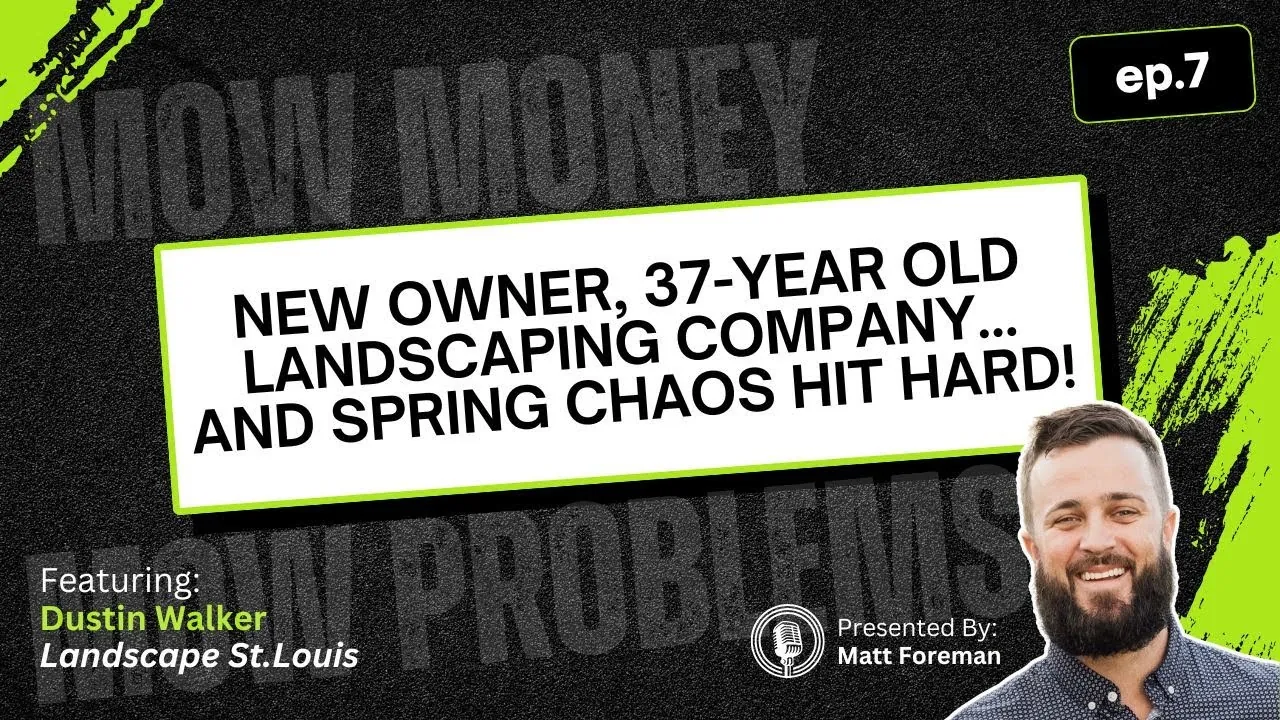
On episode 7 of the Mow Money, Mow Problems podcast, we sat down with Dustin Walker of Landscape St. Louis, MO to talk through what acquisition-led growth actually looks like in the green industry. His story is a useful look at why the smartest path after a transition is not reckless change. It is learning the business, protecting trust, tightening systems, and making the company's value easier for the market to understand.
An acquired company hands you trust on day one. The fastest way to lose it is to treat the business like a blank slate and overhaul everything at once.
Acquisition growth starts with respect for what already works
When an operator takes over an established landscaping company, the temptation is to immediately overhaul everything. New branding, new offers, new software, new processes, new sales expectations. Some of that may be needed. But moving too fast can damage the very thing that made the company worth buying.
The better approach is patient but active. Learn why customers stay. Learn what employees know. Learn where the company already has trust. Then improve the parts that are holding growth back.
That is where a thoughtful green-industry marketing strategy becomes useful. It helps turn an established company's strengths into clearer positioning, stronger demand, and better-fit opportunities.
Lesson 1: Preserve the reputation before you push for scale
An acquired landscaping company often comes with years of earned trust. That trust may live in long-term customer relationships, local word-of-mouth, reviews, project photos, team knowledge, and the way the brand is recognized in the market.
Before chasing more leads, operators need to protect that foundation. The market needs to feel continuity. Existing clients need confidence that the service quality will hold. Team members need to understand the direction. New prospects need to see a company that is stable, not scattered.
Reputation management is part of that transition. It makes existing trust more visible and gives future customers more reasons to believe the company is still the right choice.
Lesson 2: Turn premium work into clear positioning
Landscape St. Louis, MO operates in a market where high-end residential buyers care about quality, taste, trust, and service experience. That kind of work needs more than a basic list of services. It needs a brand and website that communicate judgment.
For landscaping companies with premium services, the website should make the company's standards obvious. Buyers should see the type of work the company wants more of, the level of detail it brings, and the reasons it is a safer choice for larger projects or ongoing care.
Strong websites for lawn and landscape companies help premium operators show the difference between "we do landscaping" and "we are the right company for this property."
Lesson 3: Local SEO should support the new growth direction
After an acquisition, the business may have a stronger growth vision than the old website reflects. The company might want more design-build projects, more garden care, more maintenance contracts, more drainage work, or more estate-style service relationships.
That shift needs to show up in search. Local SEO for landscaping companies should be aligned with the work the operator actually wants to grow. Service pages, internal links, Google Business Profile updates, reviews, and blog content should all point toward the new priorities.
If the SEO strategy only reflects the old version of the business, growth stalls. If it reflects the future direction, the company can use its history as a launchpad.
Lesson 4: Systems matter more after a transition
Acquisition puts pressure on systems. Every unclear process becomes more visible when leadership changes. Scheduling, estimating, communication, handoffs, crew standards, follow-up, and customer expectations all need to be understood and improved carefully.
Marketing can create interest, but systems convert that interest into stable growth. A company that cannot respond quickly, quote clearly, and deliver consistently will waste the attention it earns.
That is why lead nurturing matters. It helps keep opportunities organized during the exact moments when a growing or transitioning business cannot afford avoidable leaks.
Lesson 5: Use content to explain the company's standard
High-trust landscaping companies should not rely only on before-and-after photos. Content can help prospects understand how the company thinks. It can explain the design process, maintenance standards, seasonal care, plant selection, project planning, drainage considerations, and what makes a property easier to manage over time.
That kind of content does two jobs. It supports SEO, and it pre-educates the buyer. By the time a prospect reaches out, they already have a better sense of the company's value.
Lesson 6: Growth should make the business easier to choose
After an acquisition, the operator's job is not just to grow revenue. It is to make the company easier to understand, easier to trust, and easier to hire. That means the brand, website, reviews, content, photos, calls-to-action, and follow-up all need to reduce friction.
When those pieces line up, the company can grow without losing the trust that made it valuable in the first place.
The operator takeaway
Dustin Walker's Landscape St. Louis, MO story is a reminder that acquisition is not a shortcut around hard work. It is a different kind of hard work. The operator inherits trust, but also inherits complexity.
The winning move is to protect what made the company valuable, improve what limits the next stage, and build marketing that makes the company's standard obvious to the right buyers.
Make your company easier to choose
If you have taken over an established green-industry company, we help clarify the story and turn it into stronger websites, local SEO, reputation systems, and follow-up. Let us look at where your marketing can support the direction you are growing toward.
Want this done for you? See our landscaping marketing page.
Frequently asked questions
What can landscaping companies learn from Dustin Walker's Landscape St. Louis story?
The biggest lesson is that acquisition-led growth works best when the operator protects existing trust, learns the business, improves systems, and updates marketing around the company's strongest future opportunities.
Why is reputation important after buying a landscaping company?
Reputation gives the new owner a foundation to build from. Existing reviews, customer relationships, project history, and local trust help reduce buyer doubt during and after the transition.
How should a landscaping company update its marketing after an acquisition?
The company should clarify its positioning, update service pages, show proof of quality, strengthen local SEO, and make the website reflect the direction the business is moving.
Why does local SEO matter for an established landscaping company?
Local SEO helps connect the company's strongest services with the searches buyers are already making. For an established company, it can turn history and trust into more consistent demand.
Episode transcript
Read the full transcript
Welcome back to the Mow Money, Mow Problems podcast. The podcast dedicated to the trials, triumphs, and insights of green industry business owners. I'm your host, Matt Foreman, and today we have with us Dustin Walker of Landscape St. Louis in, you guessed it, St. Louis, Missouri, and I'm excited to have you here. >> Hey Matt, thanks.
I'm glad to be here. It's always a pleasure to get to connect with you and um yeah, we're happy to do this thing today. >> Absolutely. All right. So, um, again, this is just we're just gonna be chatting. I I'm I'm very interested in your story.
Uh, because, um, you have a very wellestablished landscaping business that seems like it's been around for a while and you're very young. So, I wanted to hear a little bit about like how you got into the green industry, how you got into Landscape St. Louis. Yeah, I appreciate that. Well, I age really well, so [laughter] the 30 >> I know you're like 60 70, right? >> Yeah, that's exactly right.
Right on the money there. Uh, so skincare routine every single day. Um, >> these are the takeaways we want. >> That's right. No, look, great question. Um, I I come from a really unique experience based on this industry.
I think most landscape professionals who own a business, they they typically have been part of almost every role and they start a company themselves, right? It's kind of that's the classic story you hear and it's a really great story. I love hearing it myself. Um some part of me has a bit of envy with that because they get so much robust understanding of it. Um and mine is just so dissimilar.
Um I started off owning a photography media agency back in Los Angeles uh California and had a really great uh experience there. My whole background was photography. So, I spent a lot of time shooting different subjects over my career. I went from red carpet Hollywood events to or head shot for actors because I was desperate for money at the time. Um, so I lowered my my value a little bit there, which was great.
It was good money. Uh, and then I went all the way up into interior design, architecture, and branding for for different companies. Um, and did some really fun work along the way. Uh so to you know we could go really long into this journey. It was about 10 years running this um which was really fun.
I had photographers under my banner after a certain time. We were servicing from LA up to Seattle all the way over to Colorado. Um working for some really cool brands like Airbnb and Home Depot. Awesome stuff. Um and I found myself in a position where I just didn't have enough leadership experience to continue managing people.
And while I had what what I think was a natural ability to do it, I didn't have some tools in my belt. And so I decided to um well, my wife and I decided to move to St. Louis. And that kind of pushed a decision on the business of like, okay, maybe it's time to close this chapter and start something new. So I did.
I moved into um the corporate world and worked for a very large commercial real estate data and analytics company called CoStar Group and they own a ton of subsidiaries. Uh the main consumerf facing one of that is uh apartments.com and did some really fun stuff there. They put me as the manager of operations for media and I at any given stage I had um about 30 40 photographers under my belt all across the country. I enacted some big initiative initiatives with like thousands of freelancers managing all of that. Super fun stuff.
But what they did for me was leadership. And they gave me so many tools and they put me through so many different programs and gave me the opportunity to be um taught by some really impressive people, some mentors. And it just it was everything I was looking for in that world. And then what I found was big big corporate bureaucracy um comes with a lot of red tape and that kind of crushes a leader's integrity if you if you have such a thing. And I was being really pulled in my heartstrings of how what I was directed to do to be successful in my role opposed to what I would do myself and what choices I would make myself.
So I got to a point with them where I really respected the company. They were great, but I reached a stopping point and I was like, I I I think I could do things differently and they might pan out to be better. I won't ever know until I take that leap. So I went on a bit of a journey and I spent a year looking for a business and I really didn't know what industry I wanted to be a part of. It was really up in the air uh which was super exciting.
I looked at a pleather of businesses and anyone out there thinking they want to do something and you just want money storage units great. The the profits are insane. Um >> great reality TV shows too. >> I mean love all about it. Sunday afternoon team. Uh so [laughter] I went through I got close with a couple businesses throughout that year.
Some were pressure washing companies that were for mobile fleets um for trucks. It was really unique businesses, but I kept coming back to what would make me proud at the end of the day of a long day's work and and what would I come home and feel like I contributed something to my community? And I kept coming back to landscaping. And so I'll I'll cut back a little bit longer. When I was a kid, my dad, he was a very successful finance businessman.
Um, took a lot of companies public. He dealt with a lot of mergers and acquisitions. Lucky for me, during this position of my life. Um, but he was also in his alternate life a landscaper and we spent my childhood building his property um, my my childhood home. And there was a lot of pride to that.
Of course, there was times of my childhood where I was like, stuff this. I just want to go party with my mates. Um, but there was some impact to that that lasted longer than my childhood that you reflect back on. You're like, there was something beautiful here. And so as I then entered my adulthood, I worked on all my yards myself.
I built things, patios, um, decks, walkways, paths, you know, all these little things, plantings. Um, come to find out pretty terribly now that I owned this business. Uh, did things really wrong, but that's why we leave it to the professionals sometimes. Uh so land landscaping was something sentimental to me in my heart and um so I found Landscape St. Louis and I met the previous owner Ron uh Geter and Mary Alice Getker and they were just wonderful human beings and we just clicked straight away and it took about 6 months and here we are. >> Amazing.
So you went in with the intention like you met them with the intention of hey I'm interested in acquiring this business. I was pretty gung-ho and I was pretty intentional with my conversation. I think my first thing I said to them is like, "Look, I have a list of 10 things I like about your business." And I kind of went through that list with them and I said, "So, I don't know the things I don't like yet and I really want to have an honest conversation and I want to know some of your pain points you've experienced over the last couple decades that you've been running this." And so, we just had a really honest conversation. Well, so I'm really interested what um if any like what were those things that you didn't know that you didn't like yet if any time and material there are no contracts um which some would argue is pretty great and there are benefits to it. There's certainly the upside and I and and it comes in handy.
What struggles with that is forecasting um reliability. um you have to be extremely flexible in your schedule because of time and material. It's like yes, I've got recurring clients and we do have that but with that said there are people that come out of the woodworks current maintenance clients that just say hey I also need XYZ now and so without having like this contractual basis of like hey we're here it there's money left on the table and then on top of that you just kind of get screwed a little bit with your forecasting and scheduling. So it comes with some downs. I am moving towards trying to get everyone contractual. It won't be 100% but it could potentially be 85. >> Gotcha.
So with um with them stepping down and actually how long how long was um Landscape St. Louis in business prior to you coming? >> 37 years. >> Okay. So very established in the area. Was there any like issues? I I know you said you didn't have contracts, so um maybe no like recurring clients, um like a maintenance program or anything like that.
Um but was there any kind of issues with Oh, we're here because we love the previous owners like anything like that or has that transition been pretty smooth like without any kind of like loss? >> Yeah, that was basically my first six months. Uh okay. >> Is is exactly that. Um so we do have recurring clients. So, we do have like people who we service weekly, bi-weekly, monthly, quarterly. We have all those.
It's just a handshake and a headnot of we know you're coming. >> Um, which was really ambiguous for me as a new owner. I didn't get the guidance I was hoping for >> with how to kind of manage that, especially being brand new. So, yeah, >> I I let a lot of people down in the beginning and neglected certain clients not understanding how that rhythm worked. That's interesting, especially knowing that you yourself went through the the the the pain and struggle of uh corporate and obviously like you're here trying to run a successful business, but you know that it it does require um personability. Um you got to be uh face to face at necessary times.
So um >> yeah. So so sorry to interrupt. Um you say you were saying like first 6 months you were going through that what changed? >> Yeah but you you hit the nail on the head. It's such a personal thing right like and especially the the small business he created it was such a personal experience. Ron was the face of the business.
He was >> the driver to the business. Everyone wanted Ronald Gond geter because of his incredible architectural designs. Um he was incredible and and he's created such a legacy here. So what massive shoes to fill. Um, and what was an easy transition for me is to let people know I'm oh, I'm not I'm not Ron and I'm not trying to fill his shoes.
I'm a whole new entity into this business to drive a different satisfaction on your end that this company hasn't seen before. I'm like, now we're going to we've got someone here who's been with Ron for over a decade who's going to be remaining as our landscape designer. That person fills his shoes in that category. What I do is bring organizational success. >> And so I really lint into that side. not trying to say I will be Ron because no one could ever be Ron. He was an incredible guy.
Um and so I just offered it a different value. And so explaining that to and also being fresh to the industry, I didn't want to falsely advertise who I was. And so I made a really in an intentional decision to tell the clients, hey, I'm new to the industry. I actually never been inside the landscaping industry before. I'm really excited to learn.
I've spent a lot of time learning so far. I've come this far. I have tons further to go. I hope you'll help me along the way. My whole team is on board with giving me advice.
I'm leaning into them as their expertise. And I think that went a long way with building that trust cuz it's not like I'm trying to sell them. I'm not trying to fool them. I'm just being honest. I'm someone who's really excited about the place that I just acquired and and what I get to do to improve their daily lives and their landscapes. >> I love it.
Yeah. I mean, what a kind of let your own guard down, show your vulnerabilities, but also show your care. Um, and also letting >> Ron's legacy live on. Um, because as you mentioned, he built a great business. Um, that you're >> very proud to invest in and now be a part of as well.
So, um, and with that, I mean, that's got to be a lot of shared, uh, just kind of focus with you and, um, existing and past clients. So, um, so how has that been though in in terms of like obviously Okay, so because you're doing so many things at once right now. you are you're you're you're buying a business, you're learning the business, you're learning the industry, um you're learning how to juggle customers, you're learning how to get customers, and you're doing a lot of stuff like now, like right away. How has that how's how's that been just juggling all that? >> Well, I'll I'll start and great question and I'll start with this. Um lean on the people you have in place to help you. >> Great. And and I think that's such a critical piece to it is like why do you have people help you if you're not going to trust them to do so?
And and so I'm I'm a big believer in that. I don't like micromanaging. I'm I'm saying I need help and I'm I'm vulnerable and honest enough to admit when I need it. So I'm not trying to be here and say I know how to do this. I'm going to go attack it.
I'm going to ask people's opinions, right? And so I I I think one of my first meetings with my landscape designer was like, hey, what is some great places to get educated in this industry because I'm going online and finding thousands of places I could really go and the first place I did go was NALP and they were a great resource before I even took over. I took over their landscape management course and huge because just knowing key verbiage in the industry so I didn't sound like such a fool. [laughter] >> Guilty. guilty. As a digital marketer, I have to know like the actual landscaping lawn care lingo. So, I'm right there with you. >> Yeah.
So, that was key. Um, look, some clients are skeptical of me still as well. And I I didn't mention that before. I haven't lost anyone, but I certainly have skepticism out there with some really long-standing clients who adored Ron and as they should have. Um, and I kind of owned that and say you should be skeptical, but don't trust me on my words.
Just let me prove to you and just give me a go. And so all of them have given me that opportunity of just to give me a go this year and say, look, if I just give you a disservice this year, I will understand you leaving. Just give it a go. So with everything else said, like you mentioned, how do I juggle it all, right? >> It's a neverending battle, but I think the most important thing to do is have focus priorities. It's like I could pick any part of my day and say, "I've got 20 things I want to work on right now." >> It's [laughter] really difficult and overwhelming.
And sure, I could just go into a ball in the side of the room and cry and say, "What am I doing?" But, um, it's it's really important just to have focus times, right? So, it's like my calendar is is everything to me. I my team knows that. They think it's quite disgusting because not a second of it is unfilled. And that's the only way I operate because it takes all the stress out of my head of things that I know is overwhelming me and things I need to be working on and continuing education and focusing on that funnel and saying, "Oh, I need to go get sales today." It's like, let's just squeeze that into a regimented place so that I can see what's feasible in a given day cuz I'm one person.
I'm a family man. I'm I've got two kids, a wife, so I've got all that outside. episode. It's just about funneling it correctly and knowing that you won't get your full task done that day. And that's okay. I'm going to funnel all the things that weren't the priority of the day into the next day.
And if I don't get them done the next day, it's going to keep going. But I will eventually get there. >> Yeah. Well, um, that makes me appreciate your time even more. I already appreciate it. But thanks for finding that little second in in the calendar for this podcast. >> Hey, for you I'll find many seconds. >> I appreciate it.
I appreciate it. Yeah. So, um, as a new father myself, um, your time gets cut in less than half. So, now you're also throwing that in. Um, where So, okay.
So, at at this point, if I'm getting my timelines right, you're a new dad or newish dad >> and now and then you're doing all of this, then you're doing the leap of faith in the business. I love that. I mean I it's wow scary but I mean what I mean you're obviously very future thinking and very thoughtful and and I'm sure you're putting your family family ahead and like hey you're building this legacy for your family. So, um, but yeah, how is that? How how is like how are you juggling a personal life outside of business?
Because I mean obviously business is very important, pays the bills, but um your sanity really um is is just as if not even more important than all of that. So, how how do you do that? How do you manage your time like that? Um does does your family get a calendar or is it just open free? >> Yeah. Um let's so I think starting the family of three and a half years ago that was the trial by fire of growth in something new that helped me prepare for something like this right >> cuz >> as most people who are new to being a parent that is the hardest development of your life of understanding how your new rhythm works.
It's not like this smooth transition. It's like >> we're done. Uh you're that life is over and here's your new life. whether you signed up or not. It's difficult and it's challenging and there's all these things you weren't really understanding that was going to happen and it's frustrating and it's exhausting but it's so rewarding >> and so it's like that reward over Baron's all the rest of it but man >> so Ron gave me some great advice coming in cuz I was very concerned about that. But I was already for co-star I was traveling 75% of the year and that's another indicator why I want to leave because I missed my daughter's kind of first life first year of life and so many milestones.
I'm like that's not why I live. I'm like I live for my family. They are my why. Um like most people and so he gave me some great advice. I asked him Ron what did you do all these years when you were raising a family and how did you manage that work life balance?
He kind of said to me there is no work life balance there's work life integration >> and I was fascinated by that topic and I was like okay tell me more about that and he kind of dived into it and he's like >> so wise I wisdom already >> it was so wise I was like >> oh I have never thought of it in that side of operations so I'm like let's dive in. So we dove in and it was really bring them into the funnel. Make them part of that work culture. Make your employees see your family and who you are outside of the the the boss, you know, the leader of the company. Have them understand you on a human level.
That's going to create a lot of different understanding of you as a person, which is great. And then on the other side, my wife and kids come for lunches with me at the office. They'll do pop-up visits where they'll just rock up. They could just pop through that door any moment. it's possible. >> Um, it brings me so much joy when that happens. I could be having one of those tough moments, then hear my daughter just scream out, "Daddy," >> and it just, you know, that feeling, it just breaks everything. >> I do.
I love it. >> Nothing else matters in that moment. So, I think integrating them into work, but then also reminding yourself that >> to my point before, there's a never- ending funnel of things I need to do. those things will always be there, but the thing that will always be a constant in my life is my family. >> Great. >> So, making sure to prioritize them. So, on weekends and and also my wife, right? Like she's a stay-at-home mom, man. I'll argue that that's a more exhausting thing than I'm doing right now.
So, uh I when I have to be the full-time parent on weekends, like for a full weekend if she goes away on like a I give her like girls weekend saying you need some break, man. I'm beat >> to another level. Like I love the weekend. It was awesome. >> Beat [laughter] and I'm like you do this 24/7. Like you are stronger than I imagined.
So, I think giving your wife those breaks and knowing like you need some time off like they don't get PTO as a stay-at-home mom. Right. >> Right. There's no like I'm going to put in my time. It's like do I have to approve that? Like [laughter] so there's this weird dynamic shift of like >> I don't I'm not your boss but you shouldn't have to ask me for that time but we also have to both >> be in alignment with that.
So >> a lot of development, a lot of growth. I think that whole structure of balancing is a day-to-day ambition. >> Um, it never ends. It's one of those things you're always going to be criticizing yourself on and saying, "I can do better." Just like the business, I'm always criticizing, saying, "I could be I could be doing more. I could be doing more." >> Sure. >> Giving yourself some grace and saying, "I'm doing enough and I'm trying really hard and that's good for right now. And I'm just if I just keep that mentality every single day.
I'm trying to be the best version of myself for every area of my life. That's all anyone can ask of you. >> I love it. Super business owner, super dad, super husband. You're crushing it, man. So, um All right.
So, I want to know you. So, you've been in the business for a while. You obviously you've been in the industry for a while. You've I'm sure it's not all been um roses and sunshine. what um if any anything comes to mind like what's been a a struggle whether it's like an ongoing one or any one particular thing that happened um and and it could be a continuous struggle or it could be something that you resolved like what is something that kind of surprised you even beyond the like oh I didn't know what I didn't know >> yeah great um spring whoa that's that's a heavy quick shoot of uh of of ramping up in business So, um, before we dive into spring, for everybody listening, I would love to know because it spring is different everywhere in the US. >> Um, so what is spring like the the like the the climate, everything uh in the St. Louis area and when does when does spring officially start?
Obviously, we got our spring solstice days, but like when do you consider spring for the business? >> Really March 1st. Okay. >> It's kind of like when spring's really starting to to come about. So, spring in St. Lewis, it means everything start starting to grow again, >> which means everything needs to start being manicured. >> We need to start getting the funnel in. It means we've got to go do spring cleanups and get those wrapped up.
It means we've got seasonal color to plant during spring and we have a very short window to do so. And all your clients want it really at that start of the window so they get the full um life expectancy of those plants. So, [laughter] and then on top of that, you've got your regular consistent clients. you've got to continue maintaining. Then you've also got all your new jobs coming in for design build. So with all of that and without having any schedule.
So let me cut back. The previous owner would whip out the schedule the night before the day. >> And so that was kind of the way this business operated >> for someone super strategic >> was like my nightmare. >> And they did and they did that I'm I'm assuming 30 plus years. >> 30 plus years. So like easy for him, >> right? Clockwork. >> So week two coming into the business, I said, "Let me take over the schedule. Is that cool?
Can I just can I own this piece of it and you just help me guide of like what the work tickets are?" And so I took over immediately. I was like, "Oh, my brain won't function." Um, [laughter] but I made the comment before of time and material is ambiguous and I didn't know who needed to be scheduled. We were also all paper, so there's no digital source of data that I can go look up. It's I've got to go to every individual client folder and go through their season and say where was this? What did they do last year?
What did they do the year before? >> And so that was also a very time consuming task. My office manager is only here two times a a week because she's 27 years with the business grown with it and so she's you know closer to the retirement stage. >> Mhm. >> So I didn't have that backbone to be like you can just be my workhorse doing these busy tasks. I had to do it. >> Yeah. So, I neglected a ton of clients during the spring >> without without knowing it. And I'll never forget, I get a phone call from um a very good client who's been with us a long time.
And he goes and and let me cut to I was kind of told it's okay to skip some clients week to week because of the busy season. Like, oh, cool. I trust that. Didn't trust that. [laughter] Sounds right. Um, so I got a call and he's he was poed, man. >> He was disappointed and he's just like, is this how the new regime's going to go? >> And I'm just like, >> and you know, you have a decision to make in those moments of like, do I just push that blame somewhere else or do I just own every piece of it and say, I'm going to be better for you tomorrow.
I promise you. >> And just own it and say, let's move on together successfully. And that's kind of the position I took. And yeah, I made mistakes through that time, but it's like how do we hurt all those mistakes and how do we become better because of it? And so, while all of that came in one big conundrum of a scheduling nightmare and how do you keep everyone consistent, next year I'm going to make more mistakes, but I have a much better plan. >> Great. >> So, so great opportunity for growth in spring. It was just really one of those high impactful moments of intensity yet I learned so much by f by jumping into the fire. >> Um but again I want to state that my team in place.
So we that was one of the things I said to the owner when I met him is what I like about the business. We have a crew lead who's been here 30 years. We have another crew lead 27 years. We have the office manager 27. We've got an operations manager 15.
We have crew members who've been here 20 years, 10, 15 years. >> I love hearing this. I don't hear this often. So, that's great. >> No, it's very unique and rare in this industry. So, I was like, there's something special here. And that that means something special with the clients because of the way they've stayed and it must be good clientele and customers.
And then it also means there must be a great culture involved inside of this company. And so, that was really the biggest highlight for me as well as the property location. Property is in a great spot. Metro St. Louis, we're 15 minutes from every client.
Um, so having that team so well understanding the business when I'm so fresh, man, I just leaned on them >> and just said, "What what would you do in my shoes today? What did you do in the past?" Like, >> how would you direct me today? And I really empowered them to have that thought and they never really got that opportunity before me cuz the owner was so capable. So, I thought they I think they really enjoyed having that involvement. And and that's kind of like the position we're taking now is like, do you have stake in the game?
Yes, you have absolute stake in the ability for us to grow and to move forward and make great decisions together. I love it. So, yeah. And and I'm sure I'm sure your team now um I'm sure they absolutely love getting to flex their their knowledge and experience. I mean, it's I'm sure they always have, but now they're like, "Let me show you." So, how >> how has that been?
So, I mean, it's obviously one thing to like take over a business and retain relationships with customers. How has it with the employees? Like, how how has that been? Obviously, you have to come in there with um with like being humbled right away. Um but and and obviously you're a very liable likable guy, so I'm sure that it wasn't hard for everybody to like you as well, but how has that how has that been?
Has um and I think you've answered it before. I mean, you're you're leaning on your team. >> Yeah. Well, I pretty much fired them all at this point. >> Good. >> Just a great decision. Um, don't look back. No. [laughter] >> Um, yeah, another great question.
Look, that was probably my biggest fear coming in here is will they adapt to me? Will they accept me? Will I mean, this has got to be a tight-knit circle, right? Like this is like a family. Them people being this long together in a career, >> that's insanity. like you've got to be like brothers and sisters and at this point.
So coming in I'm like that really made me nervous. So >> I had this great speech I rehearsed my day one. >> I I prepped for it. I was like I'm going to crush this. And I think no one remembered a thing at this point because I got asked the same questions over and over that I answered in the interview u in the speech. So it was really important for me to again lead by my actions and not by my words. >> And so I think during that time there was again just like my our customer base there was so much skepticism of me.
This young kid for one cuz most of our uh staff was of an older generation than I am. And so like this young kid's coming in he doesn't know our industry. He thinks he can do what we do. He thinks he can lead us. Like there's absolutely that's absolute bollocks.
And you know, I kind of leaned in with him and said, "Yeah, I agree." Like I I don't think any of that yet. I mean, we're going we're going to get there together, but currently we're not there. And so, again, just leaning into that vulnerability of humility, right? And my my whole philosophy of leadership is I lead to serve. Like, I'm here to serve you to do your best work possible.
I need to support you so you can be the best you can be. And that's really what I lent into the beginning and also learning from them. And so we have the guy who's 30 30 years with the business, Jeff Coats. He's an incredible guy, wealth of knowledge of our client sites, our clients particulars, and then just horiculture in itself. He's an very impressive guy.
He was like my compass in the beginning. And I remember the second day I met him, he looked at me, he's like, you know, I don't really believe anything you said yesterday. [laughter] And and here's I just want to ask you point blank. What are your intentions? Are you trying to fire us all? Are you trying to like change the whole company?
What are you trying to do here? >> I loved how honest he was. >> Yeah. >> And going from a white collar job with like people who are sneaky and slimy and say things but then do others, it was exhausting and I'm just not that person. And so having someone just so blunt with me, I just kind of cracked up laughing a little bit and was like, "Let's get into it, man." >> Yeah. I found my spot. I found my industry, >> my people. Um, exactly. >> So, we we had a great chat and I ended it with the same thing, you know, the same thing I just said.
It's like, don't trust my words, trust my actions. So, it was really important to be with the crews those first several months. >> I was in the field more times of the week than not. um doing the work alongside them, learning from them, understanding the exhaustion each task has um as well as understanding the timing each task has, right? And then how do you do the task and what are the side variables? Is there a huge slope that makes this same task so much more difficult at this client's property? Um, I would have them every time I went to a new job site, I'd meet the owner and have a good conversation and then from there I would um walk the property with uh the crew lead.
So I normally some of the owners wanted to walk me around, but typically I wanted to the crew lead to show me and tell me what have we done here? What have we made an impact on? And where are our focus areas? And so we went through that whole rhythm and and that just really helped establish camaraderie between us as well as just kind of like humbling myself and saying you're the expert here. Let me understand where you've been so I can get closer to where you are today. >> Love it.
Yep. That's um that that's how you got to lead. I mean especially when you're you're dealing with a new crew. Um and and instant respect I'm sure um received. Now, obviously, not everything's going to be 100% right away, but um now that you've kind of established a crew, they know who you are, they know like your heart behind it.
Um that's that's that's that's going to be huge. So, I it and it seems like >> almost a very similar approach between both customers and your employees. You're just being very open, honest. Um you're not coming in here uh lying about who you are, lying about your past experiences. Um and and >> you're leading with flexibility, too, which is sometimes a tough thing because a lot of leaders want to be rigid.
It's my way or the highway. And so, um that approach, especially when acquiring a business, um it's I can't think of a more perfect approach with that. >> So, >> but I will say that I will say to that point, I'm I'm starting to change a little bit. >> Okay. >> And so, now that >> you are changing or you're changing into the business? I'm changing into more of a hey, I've got a I've seen how we do this. >> That doesn't work. >> Good >> and here and here's why and this is what we're going to do. Trust me and let's trial it out there because I promise you it's going to drive some better results and have more impact to our customer. And so I'm starting at this point.
This is where I'm now really starting to take a little more lead and saying I've absorbed. I've understood. I think we can do things a little differently and just trust me on the journey on this one. So whether that's bringing in technology, whether that's changing how we operate, whether that's building sliding operating gates, automated gates in our yard so that we don't have to worry about closing and opening and so we can exit another route or it's just and what I'm thinking about is like where can we be in 10 years and how do we need to act to get there today >> and so which where we were kind of thinking you know the previous owner was at retirement so he wasn't thinking that way for a long time >> and so it changes the whole ability of how we navigate our dayto-day. And I really respect my team because I'm making some pretty impactful changes to them.
And it's going to be really hard, but they're trusting me on this and I'm empowering them just to have a say in it as well. Like don't just blindly follow. Ask me questions. Poke it. Say there's there's a gap here and this is what you're not thinking about. like I still don't know everything and it's going to take me I I'll never know everything.
No one can. So I always want someone to I always appreciate when people just don't blindly follow and say you know what you're not thinking of you know or have you considered this like all those things are so we've got blinders up all the time. Every single person does and so if you just remove those blinders and ask for that 360 feedback because great ideas come from everywhere. Super helpful. But I'm certainly being a little more >> I think I know.
Yeah. And um I think we've talked about this previously, but um I mean that's the EOS approach. You get to be a visionary um and and and lead the company. And it's not to say that anybody's less important in the operations and fulfillment, but there needs to be a leader at the helm, the one that's also thinking beyond just the hey, we got these tasks for today. It's well no, we got these things for the future.
And so that's um yeah, you obviously have to um you have to get rid of your ignorance in uh that was caused by never being in this industry. You're obviously learning it now. So now you can come in here with an expert opinion, now lived it, now experienced it and then also take your wisdom that was that came from outside of the industry as well. So >> yeah, >> and and the best eyes the the best eyes on a business are fresh eyes. I like to encourage every new every new employee, hey, poke some point some things out that we're not doing well or you think it should be done differently because you have no, oh, this is just because how we do it.
We do this because >> and so I love that mentality of someone new. And so I've kind of had that and I'm still in that phase kind of, you know, and so I'm slowly falling into well, we just do that. It was like our gate situation. There's a back gate to our property that goes to the street we exit on. It's way more conducive, but we never did it because it's not a sliding gate and we can't close it when the crews leave because it's a main street.
But I'm like, well, what if we just bought a sliding gate remotes? So, >> simple solution changes 10 minutes of our load in load out every day. >> That's awesome. Yeah. And it's I mean that compounds a ton over time. So, >> it does. >> Um, okay.
So, I'm I'm also very interested in um how you stay connected. So, you and I got introduced um because of a mutual friend with Nate Moses over at Precision Landscape Management in a completely different state over in South Carolina. >> So, what are you doing right now? Obviously, you said you joined uh NALP, but um what are you doing to stay connected to others in the industry, um mentors, um other peers like that? Is there anything that you're involved with? And uh and uh I know you mentioned earlier that you were at an event or you went to an event.
Was that related to that or have you been to any events related to the industry? >> Yeah. Hey, another another good one. So, I think that's really important as a as an owner and being connected in the industry and learning from others. That's a rare thing about this industry specifically. >> Everyone's so willing to share there. There's no trade secrets.
It's like, oh, you're there. listen, this is what we did when we operated like that and here are some of the mistakes we made. They're so freeing of their of their advice and wisdom. I've never experienced that in any other industry. So, I'm so thankful to be a part of this industry for that reason alone. Um, so Nate and I met because he became my mentor through net.
So, I they put out a email and after I signed up and said, "Hey, we're doing a mentorship program. Would you like to sign up?" I'm like, "Absolutely." Unfortunately, I did sign up as a mentor. [laughter] And so of like zero years experience, I have like listed me and I'm like, "Oh, I'm going to lead someone terribly." So, [laughter] so I quickly reached out, they switched that up and then my first pick was Nate. Um, I got to read his profile, understand what he had done, and he is just a remarkable guy. >> He is. >> Um, what a what an absolute bloody legend. uh so freeing of his advice, so willing giving of his time. Him and I meet every two weeks. We have a bi-weekly standing standup meeting.
We go through I kind of present a ton of questions. In the beginning, it was a little more flexible. It's now become really regimented. This is a year-long mentorship. Um he has been critical to a lot of the decisions that I felt confident making. >> Um so Nate, you're listening, you're an absolute legend.
Couldn't do this without you. Um and then of course, yeah, it's like other things, right? but it's an industry event. Um, so I just we just started implementing Aspire software. Um, it's a great end toend landscape solution. It's like having a data analyst inside of your company.
This was one of those things that we needed to inject into this place before we got too big so it wasn't such a headache. Um, and to do it so that we had a better understanding of the business dayto-day and how to make great decisions, informed decisions, right? Educated decisions. So they had their conference Ignite this week. I was actually there all week in Anaheim, California.
Um, great event. I got to meet Marty Grunder, which was super cool. Got to sit down with him and have a quick chat. His podcast was like the Bible to me when I started. It was just every week listening to what's his next advice, who's on his show next, uh, just a great wealth of information and a great history in this industry that, you know, so tapping into things like that, not being afraid to just to say, "Hey, I'm new to this.
Mhm. >> I've been I I heard about you. I I reached out through this platform or whatever it is. Even just a cold reach out, a direct message to someone and say, "Hey, I really respect what you're doing out there. I'm new. If at all possible, could I steal 30 minutes of your time one day?" And so I've done a lot of that where I've just called reached out to companies that I admire out in the industry out of my state um because there's probably a little competitiveness inside of the state naturally um competing for the same clients.
So, and everyone's been super gracious. They've been gracious with their time. They've been gracious with their advice. A and they've just been really, really wonderful. So, just not being afraid to take that leap.
And again, humbling yourself and saying, I need that advice. I need that mentorship. I need someone who's been proven and who's made some of the mistakes. So, maybe I can avoid some of them. You won't avoid them all, but if I can minimize some of them.
So, I'd say go to the industry events, apply for all the awards you can get in this industry just to accredit make some accreditation. Um whether it means something or not, it's just it's some some badge of honor. And it also, you know, we we won bronze at um NALP awards of excellence this year for best maintained yard. And I mentioned it to my team, they don't know. I submitted it.
I told them which property. man, the light up on their faces of like I'm being recognized for the work that I've done. I was like, "Oh, I didn't realize it was going to do that." And I'm like, "Well, that's more impactful now." >> Sure. >> So, and congrats. >> Um, thanks. I appreciate it. I'm I'm stoked. It's great.
It was a great And we only submitted one. Most companies submit like five or six. We I was like, >> I was like, I only had time to photograph one. So, I was like, man, I got to get into this. So, like the day before the entries were closed, [laughter] so it wasn't as neat as it could have been, >> but um yeah, just put yourself out there. >> Mhm. >> That's the best advice I can give anyone. >> Yeah, honestly, and I I think as any business owner, um obviously um we are in the digital marketing space.
Yes. for the green industry. But I I attribute so much of our company's success to my peers, my mentors, the people that have paved the way uh ahead of me um that I got to learn and I mean avoid years of mistakes that they they are so openly sharing on how to avoid how to build a successful um agency. And so, yeah, I'm I'm sure no matter the industry that you're in, um, there is a community out there for you and you have to you have to really be plugged in. You you have to get into that. Um, otherwise, >> to our point, you're going to make mistakes that people have made for decades, and you can avoid those, and you and you really bring yourself up to speed very quickly.
Um and and and I think one of the amazing things about this especially and and I you're not this way. I I try to feel like I'm not this way. Um but some people like can get prideful. And so this is a quick way to humble yourself and say like, you know what, look at all these companies. I think I'm running something so great, but look at how good these other companies are.
And that'll humble you real quick. I always thought like, man, we run a we run a really sharp agency. We do a lot of really good things. And then I'll see some of these other big players and I'm like, >> "Yeah, >> teach me everything you know." So, >> uh, that's that's exactly what happened this week at Ignite. I'm going out there, I'm like feeling really good about the moves we've made in this company.
I'm like, "Oh, yeah. We're doing things. We're growing. We're we're we're winning." >> And I went there, I'm like, "Oh, we are tiny." >> Wow. >> Uh, we have so far to go. And I'm like, "What a great place to be, though." you know, like it's like how much opportunity I have ahead of us.
Like >> it's so exciting. >> It's so exciting. It's just the the the the ceiling is not capped. >> It's it's endless right now. So, but it was again like you said, humbling is anything. >> Yeah. But it is I mean it's humbling, but exactly that. It's so exciting because you're like I could get there someday.
Like how cool. like I'm loving my business and where we're at right now and there's so much hope that things can get better and there's there's so many more new things. It it it really does kind of get rid of a plateau mentality like okay this is as good as it's going to get. It's like no there's always there's always like that next thing which really keeps keeps business exciting, keeps the industry exciting. um not just for yourself but for your employees, for your customers and everybody that's kind of within your purview. So, um, yeah, just just staying up to date, um, connecting with peers, dropping any potential pride you might have, um, staying connected, um, and yeah, I mean, and then and and try to find somebody like a Nate Moses, uh, that is so gracious with their time, their wisdom, their knowledge, their experiences. Um, because there are a lot of people out there that just love to share, love to give, love to mentor.
Um, and and it just it it can change your life. Not just your business, but it can change your life. So, yes, >> you're you're you're spot on. And that's exactly right. Like, find your people because people are there there are those people that are just willing to give and it's like but then you run into that conundrum of like what do I get back? >> Mhm. >> Right?
Like how do I give back? And I think it's just passing the baton forward and just saying like when I get enough experience, I'm going to sign up to be that mentor. I'm going to I'm going to do something for someone like myself because he's not doing it for me. He's doing it for the people who helped him, >> right? And so it's just about keep sharing it forward. >> Yep.
Well, um I I actually had a bunch of other questions, but we are kind of getting close on time. So, um I I definitely will be wanting to have you back on um so that we can [clears throat] get into things because I have questions and I think this might be perfect for a follow-up because one of my questions that I know a lot of people um have a hard time answering even people that have been in the business for so long is how do you survive winter? Um and and obviously this is this varies based off of where you're at, the services that you offer, um the size of your company. Um, are you continuing to offer services throughout the winter? Are you not?
Um, I think that in itself, I mean, that can be a 30 to 45 minute conversation just in that. Um, so I would love to and and this kind of gives everybody more of an incentive to tune back in. Um, I would love to kind of pick your brain on that >> potentially after winter passes and you come out of that and like what are your new learnings from from this past winter? Um because I mean again it it does depend on where you're at. Like a winter here in the swamps of Florida, I mean are going to be very different than those up in Maine.
So yeah. Um uh but yeah, I I would love to follow up. Love to get you back on here. Um and it's it's been awesome talking to you. Um Dustin, you're an amazing guy.
Um an amazing leader, business owner, husband, father. Um, and so I'm I'm very honored to have you on here being part of this um and and and getting to work alongside you. >> Uh, well, thanks Matt. It's um it's a pleasure to work with you and you you guys have just crushed it for me. I mean, just having that funnel right now. We're getting calls.
We've got systems in place. Gosh, my website looks pretty. [laughter] >> I mean, it makes it easy when you have a a photographer um at the helm. So, yeah. >> But it's it's not just that. It's so functional right now. So, man, you guys have gifted us so much. every all the employees we launched it to them and they're just like whoa really like it was pretty dated. >> But no, thank you for having me on, man.
Like this was a treat. I'm sorry I ramble a little bit. I have so much >> Oh, no rambling at all. All like just such good content. I'm I'm sure everybody listening to this is is is there's so many takeaways.
So, no, definitely did not ramble at all. >> Well, I can't wait for part two. And uh >> yeah, because if you asked me winter now, I said we'll figure it out. I've got I've got plans, but they may all shadow, so >> well, we we will we will check back in with you, see how it went. I'm sure it's going to go great. Um and I'm sure you're going to learn a lot of stuff. >> No, I will.
I'm sure of that. >> Great. Well, Dustin, again, thank you for your time. Thanks for being on here. Thanks for chatting with me. Thanks for sharing so much.
Um if if you want to check out Dustin and everything that they're doing, um you can check them out on their website. So, Landscape St. Louis, you can Google them. some amazing keywords in their business name. I will say from a marketing perspective, I'm like, "Yes, Landscape St. Louis.
Let's go." Um, so check out their website. Uh, check out the check out the amazing photography that Dustin does. Um, but just follow along what they're doing because obviously Dustin is tracking this company in in in a great direction. Um, and obviously through his own experiences, but amazing team, mentorship, staying connected. It's where everybody should be at.
So Dustin and his company are definitely going to be sort of a north star for a lot of people. So I highly recommend just following along with them. So Dustin, again, thank you for your time, man. And I'm excited for the next time. >> Thanks, Mac. Glad to be here. >> You got it.
Transcript is auto-generated from the episode audio and lightly formatted, so wording may vary slightly.