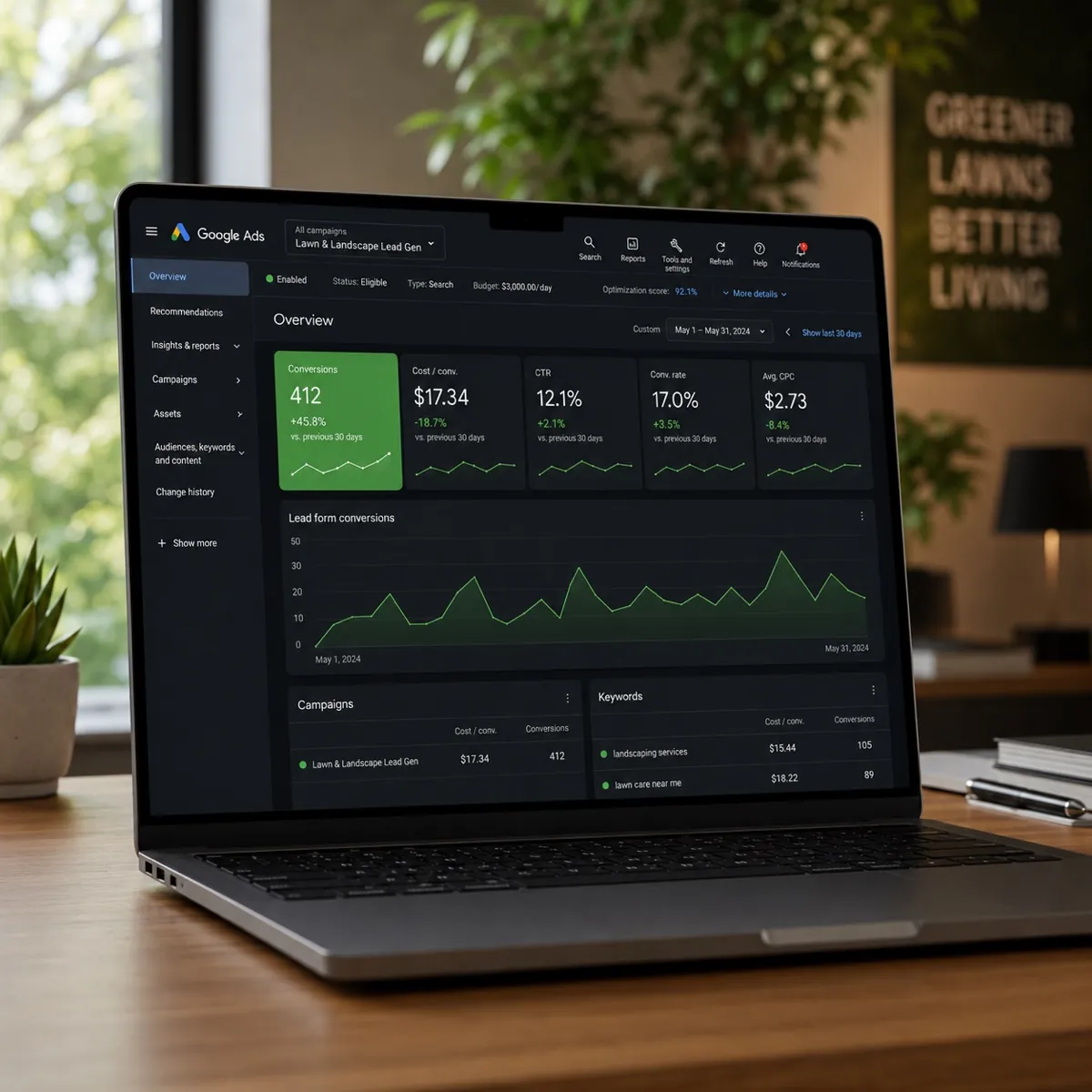
PPC can fill the calendar fast, but it can also burn through budget with bad leads. The difference is not magic keywords. It is tracking, targeting, landing pages, follow-up, and disciplined campaign control.
Quick answer: how PPC should generate lawn care leads
PPC should put your lawn care or landscaping company in front of high-intent buyers, send them to a page that matches the service they searched for, and track whether the click became a qualified booked estimate. If you only measure clicks, form fills, or cheap lead volume, you will make bad budget decisions.
The strongest campaigns are built around specific services, service areas, seasonality, landing pages, call tracking, conversion quality, and fast follow-up. The weakest campaigns chase broad traffic and hope the CRM sorts it out later.
Do not ask PPC to fix a weak offer, slow follow-up, or a homepage that does not sell the service. Paid traffic only makes those leaks more obvious.
What has to be in place before you scale PPC
Before you increase spend, make sure the campaign can tell the difference between activity and progress. A lawn care PPC account needs a clear measurement system, not just ads running.
- Conversion tracking: Track calls, forms, booked estimates, and qualified lead outcomes. Google's own conversion guidance starts with defining valuable actions, then measuring them correctly.
- Call tracking: Lawn and landscape leads still call. If calls are not tracked, the campaign data is half blind.
- Landing pages: The ad should point to a focused service page or landing page, not a generic homepage.
- CRM handoff: New leads should enter a pipeline with response rules, owner assignment, follow-up, and status tracking.
- Lead-quality feedback: Mark leads as qualified, not qualified, won, lost, out of area, wrong service, or too small.
- Budget discipline: Spend enough to learn, but do not scale before the account is producing real booked estimates.
Pick the services worth buying leads for
Not every service deserves the same paid search budget. If a click costs real money, the service needs enough margin, urgency, and close potential to justify the spend.
Good PPC candidates
High-intent services such as lawn care programs, fertilization, weed control, landscape design, drainage, irrigation repair, patios, commercial maintenance, and emergency or seasonal services can work when the landing page and offer match the search.
Riskier PPC candidates
Low-ticket one-time mowing, tiny cleanup jobs, broad "landscaping" searches, DIY advice searches, job-seeker searches, and out-of-area searches can waste money quickly. These are not always bad keywords, but they need tight targeting and negative keyword control.
The practical move is to separate campaigns by service intent. Do not let weekly mowing, landscape design, commercial maintenance, and hardscape leads fight for the same budget and landing page.
Keyword strategy for lawn care PPC
Keyword strategy should reflect how buyers search when they are close to hiring. It should also block searches that are never going to become revenue.
Use service and intent combinations
Build around terms that combine the service, the local modifier, and the hiring intent. Examples include "lawn fertilization company near me," "landscape design contractor," "commercial lawn maintenance," "irrigation repair," or "patio installer near me." The exact terms will change by market and service mix.
Control broad match with data
Broad match can find new demand, but it needs conversion tracking, negative keywords, and regular search term review. Without those, it can turn a lawn care budget into a very expensive research project.
Build negative keyword lists early
Google defines negative keywords as terms that prevent ads from showing on certain searches. For lawn care companies, likely negatives can include jobs, careers, salary, DIY, free, cheap when it conflicts with your positioning, equipment, mower parts, seed advice, and out-of-area place names.
Review search terms weekly at the start. The account will tell you exactly where the waste is if you bother to look.
Ad copy that filters, not just attracts
Good PPC copy does not just increase click-through rate. It attracts the right buyer and filters out the wrong one.
- Name the service clearly: lawn care program, weed control, landscape design, commercial maintenance, irrigation repair, drainage, or hardscape installation.
- Use local proof: service area, years in market, project type, reviews, or specific neighborhoods when accurate.
- Signal fit: residential, commercial, recurring maintenance, design-build, premium work, or minimum project type.
- Set the next step: call, request estimate, schedule consultation, or get a quote.
- Match the landing page: the promise in the ad needs to show up immediately on the page.
Responsive search ads use multiple headlines and descriptions so Google Ads can test combinations. That makes asset quality important. Feed the system clear, specific messages instead of a pile of vague variations.
Landing pages matter more than most PPC tweaks
If the ad is specific and the page is generic, the campaign is already leaking. A lawn care PPC landing page should answer the buyer's next questions without making them hunt.
What the page needs
Put the service, area, proof, process, photos, reviews, FAQs, and call to action above the noise. Explain who the service is for, what happens after the form is submitted, and what makes the company worth contacting.
What the page should avoid
Do not send every ad to the homepage. Do not bury the form. Do not use stock-photo filler when real crew, lawn, project, and review proof would work harder. Do not make people guess whether you serve their area.
Paid search magnifies the quality of the website. A slow, vague, untrusted page will make even a technically clean campaign look worse than it is.
Budgeting and bidding without lighting money on fire
Small lawn care PPC budgets can work when the target is narrow. They fail when they are spread across too many services, towns, and campaign types.
Budget around the learning requirement
If the budget cannot produce enough leads to judge quality, the account will drift on weak data. Start with the best service and best market. Expand after the campaign proves it can generate qualified opportunities.
Use Smart Bidding only when the data is clean
Google's Smart Bidding documentation explains that bid strategies optimize around conversion goals. That is powerful only if the conversion goals are real. If every form fill is counted equally, the system may chase cheap junk leads.
Watch cost per booked estimate
Cost per lead is useful, but cost per booked estimate is better. Cost per sold job and revenue quality are better still. PPC should be judged against the work it creates, not the spreadsheet vanity metric that looks nicest.
A 30-day PPC cleanup plan
Week 1: Fix tracking and lead definitions
Confirm form tracking, call tracking, CRM source tracking, and conversion goals. Define what counts as a qualified lawn care or landscaping lead.
Week 2: Tighten services, geography, and negatives
Focus the campaign on the services and locations worth paying for. Add negative keywords from search term data and sales-team feedback.
Week 3: Rebuild landing page alignment
Match each major campaign to a relevant service page or landing page with proof, clear calls to action, and service-area clarity.
Week 4: Optimize around booked estimates
Review lead quality, booked estimates, close rate, and revenue. Cut spend where the search intent is wrong. Increase spend only where the account is producing the work you actually want.
Bottom line
PPC is not just a traffic channel. For a lawn care or landscaping company, it is a paid lead system. The system only works when the campaign, landing page, CRM, and sales response are connected.
Get the tracking right. Aim at services worth buying. Use clear landing pages. Follow up fast. Then let the campaign earn more budget.
Want to know if PPC can work in your market?
We can review your services, market, landing pages, tracking, and lead follow-up, then show you where paid search would help and where it would waste spend.
Want this done for you? See our Google Ads for lawn care service.
Frequently asked questions
Does PPC work for lawn care companies?
PPC can work for lawn care companies when the campaign has enough budget, clean conversion tracking, specific service targeting, strong landing pages, negative keywords, fast follow-up, and a way to measure booked estimates instead of only clicks or form fills.
What should a lawn care company track before running PPC?
Track calls, forms, booked estimates, service requested, service area, lead source, close rate, cost per booked estimate, and revenue quality. Clicks and impressions are not enough to judge whether PPC is profitable.
How much should a lawn care company spend on Google Ads?
The right budget depends on market size, services, competition, seasonality, conversion rate, close rate, and target cost per booked job. A budget that is too small to generate enough conversion data can make campaign decisions unreliable.
Should landscapers send PPC traffic to the homepage?
Usually no. High-intent PPC traffic should land on focused service pages or landing pages that match the ad, explain the service, show proof, answer objections, and make the next step easy.
What PPC mistakes waste budget for lawn care companies?
Common budget leaks include broad targeting, weak negative keywords, poor conversion tracking, slow response time, generic ad copy, thin landing pages, sending all traffic to the homepage, and optimizing for cheap leads instead of qualified booked estimates.