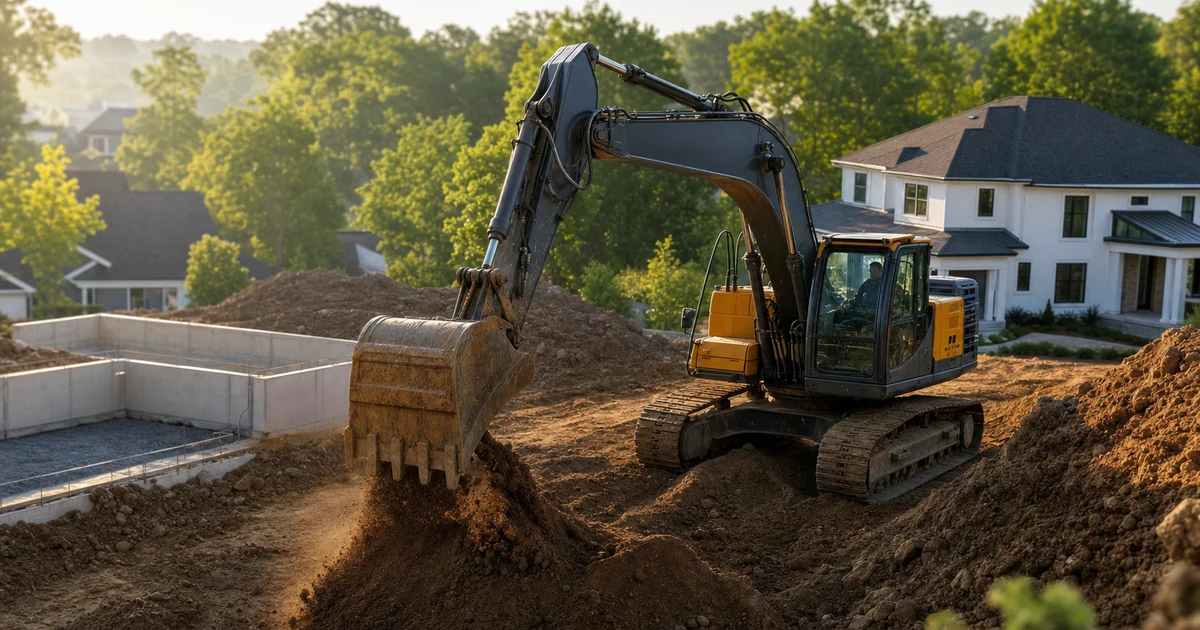
Excavation marketing is how a site-prep contractor keeps expensive equipment working, turning local search, reviews, and bid relationships into a steady pipeline from both homeowners and general contractors. Moving the dirt is the easy part. Keeping the iron working is the hard part. A machine costs nearly the same whether it is digging or sitting, so an idle stretch with payments still due is the real danger. In this post I want to walk through how we think about marketing for excavation, and why the way most agencies do it leaves half your pipeline empty.
Why does excavation marketing need two engines?
Because your work comes from two completely different buyers, and they are found and won in opposite ways.
On one side is the homeowner who searches for an excavation contractor because the yard floods or the site needs grading. On the other side is the general contractor who hires off a bid list, works through plan rooms, and cares about prequalification and bonding.
A single blurred campaign serves neither. So we build two paths: one for homeowners and one for builders and GCs.
- The homeowner path turns "my yard floods" into the drainage and grading job it really is.
- The builder path supports the relationship sale, the plan room, and the prequalification process instead of treating commercial buyers like impulse clicks.
You can see how we frame the two-engine approach on our excavation marketing page.
Why doesn't generic marketing work for excavation?
Generic marketing fails excavation contractors because it runs one campaign for a business that has two different buyers, and it works off a calendar that is often backwards.
A generalist agency imports a spring-summer busy season that does not match how your work actually arrives. In the Sun Belt that calendar is often reversed. And generic copy tends to promise a flood of instant leads and "we start tomorrow" service that ignores permits and 811 locates.
Here is the difference in plain terms:
- A generalist builds one blurred campaign. We run two engines pointed at two buyers.
- A generalist uses a generic spring-summer calendar. We market to your real region and dig season.
- A generalist promises a flood of leads that do not fit. We optimize for a few close-able, high-value jobs.
- A generalist treats commercial buyers like clicks. We understand the bid, plan rooms, and bonding.
We only work in the green industry, which is why the messaging lands faster and skips the expensive learning curves that come with a generalist figuring your trade out on your dime.
How do we market to the way excavation jobs actually arrive?
We market to the real pipeline, which is gated by ground conditions, permits, and 811 locates, not to a four-season consumer calendar.
Work is won job by job, and sales tend to slip the moment a big job starts and the crew gets heads-down. That is the exact moment the pipeline goes quiet and the next idle stretch begins to form. So the goal is to keep the pipeline filling during the busy stretch, not just when the schedule opens up.
Match the calendar to the region
Up North, we market around dig season. In the Sun Belt, we run a beat-the-wet-season push plus a rainy-day drainage angle. Same trade, opposite calendars, and the marketing has to know the difference.
Speak the buyer's language
Homeowners rarely search for the technical service. They search for the problem. We turn that problem language into the grading, drainage, trenching, or site prep job it really is, so the right work comes in the door.
What does the excavation marketing system look like?
It looks like one connected machine, not five vendors who do not talk to each other. Website, SEO, ads, reviews, and follow-up, built to work together and run by a single team that owns the result.
Most contractors end up juggling a website person, an SEO person, an ads person, a reviews tool, and a CRM, none of them coordinated. We build and run the whole system so every piece points at the same goal.
- A website that turns the first click into the next booked estimate, built fast and mobile-first.
- Local SEO that gets you found first when a homeowner searches for an excavation contractor in the markets you serve.
- Google Ads and Local Services Ads that capture the homeowner ready to hire now.
- Reputation management and CRM that turn happy clients into proof and capture every lead with automated follow-up.
Nearly every homeowner checks you out online before they ever call. They are sizing you up across search, the map pack, ads, and reviews all at once. Winning that takes every piece working together, which is exactly what one partner running the machine delivers.
Where excavation marketing fits alongside related trades
Excavation rarely lives on an island. The same project-based, trust-first approach carries over to adjacent trades, and many of the contractors we work with run more than one service line.
If your work overlaps with clearing a site before the dig, our approach to land clearing marketing uses the same project-based demand and local authority wedge. If you also handle high-ticket installs and drainfield work, the way we approach septic installation marketing is built to win on trust and proof.
The common thread is that these are big-ticket, project-based jobs where a few close-able, high-value wins matter more than a pile of cheap leads. That is the standard we calibrate every campaign to.
Find out where your SEO is leaking in a 20-minute strategy call
If your landscaping company is getting traffic but not enough qualified leads, let us look at the whole path: what people search, what page they land on, what it says, and what happens after they reach out.
Want this done for you? See our excavation SEO service.
Frequently asked questions
What is excavation marketing?
Excavation marketing is how a site-prep contractor keeps expensive equipment working by turning local search, reviews, and bid relationships into a steady pipeline. It has to serve two buyers, the homeowner and the general contractor, because they are found and won in opposite ways.
Why do excavation contractors need two marketing paths?
Because the homeowner fixing a flooded yard and the GC bidding a job buy in completely different ways. One searches online for a problem, the other hires off a bid list, so a single blurred message serves neither.
Why does a generic agency struggle with excavation?
A generalist runs one campaign for two buyers, uses a generic spring-summer calendar that is often backwards, and writes copy that ignores permits and 811 locates. That is why we only work in the green industry.
How do I get started with excavation marketing?
Book a free strategy call and we will map which services would move the needle fastest for your pipeline. There is no pressure, just a plan for keeping the iron working.