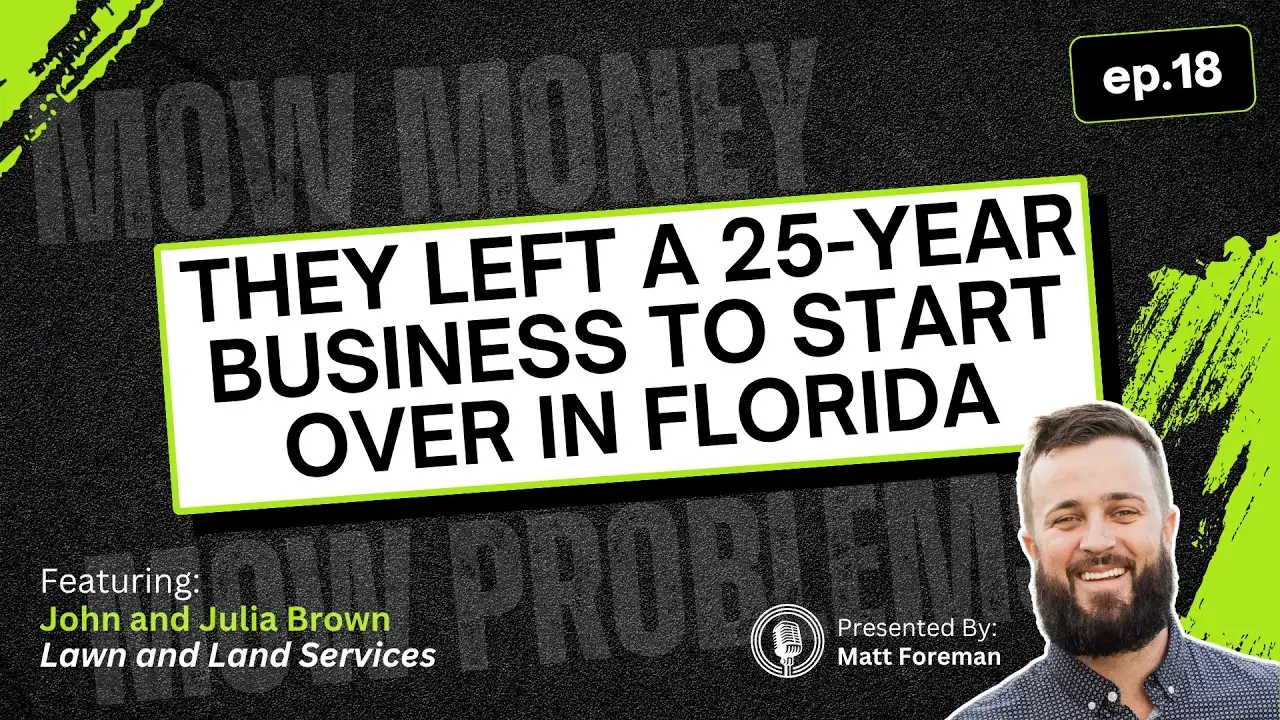
John and Julia Brown spent more than 25 years building a landscaping business in Connecticut before deciding to start over in Port Charlotte, FL, launching Lawn and Land Services fresh rather than carrying the old company south. On episode 18 of the Mow Money, Mow Problems podcast, the husband-and-wife team talked about what happens when a company's two biggest assets, its name recognition and its referral network, do not make the move with it.
Their answer was to rebuild from zero: a tight scope of promises, a first break that came down to luck and timing, and eventually a digital presence they had never needed up north. It is a playbook for any green industry owner thinking about relocating, or simply trying to win trust in a market that does not already know their name.
Key takeaways
- Reputation does not transfer across state lines. Twenty-five years of name recognition in Connecticut meant nothing in Florida; John and Julia Brown had to rebuild trust from zero.
- Lawn care can be the foot in the door for bigger work. Lawn and Land Services uses recurring mowing contracts to open the door to landscaping installs and commercial maintenance work.
- Under-commit and over-perform builds commercial relationships. John's rule for winning repeat business and referrals without looking pushy on day one.
- A fast website is not the same as a real online presence. Their first attempt, an AI tool that promised a website in "36 minutes," fell short, which pushed them toward a fuller digital presence.
What happens to 25 years of reputation when you move to a new state?
It does not come with you. John grew up working on a farm in Connecticut and grew that hands-on experience into a landscaping business over more than 25 years. When he and Julia decided to relocate to Florida for the climate, they chose not to simply transplant the old company. The Connecticut business had passed through a couple of different owners before John, so rather than carry that history south, the Browns launched Lawn and Land Services as a fresh start they could build together. "Let's start fresh," is how John put it, and both of them were "up for the challenge."
The roles split cleanly from day one. John is out in the field running crews and doing the work; Julia runs the office, the phone and the scheduling. John sums up the arrangement simply: Julia is "the office boss."
How do you build trust in a market where nobody knows your name?
A good work ethic and a tight scope of promises. John's rule is to stay inside what the company actually knows how to do well rather than "over committing to something that you don't have knowledge in." Florida added a second obstacle: a lot of homeowners there have already been burned by "fly-by-night companies" that took their money and did poor work, so new arrivals start from behind, not from zero. John's read from being out in the field is that people are "slow to warm up to you" until a contractor has put together a consistent track record.
That same caution is why John says "one of the biggest things is actually finding a really good marketing company" once the word-of-mouth network they relied on for 25 years was gone.
How did the Browns land their first jobs in Florida?
A lucky break, through family, that consistency then turned into a foothold. John's parents happened to relocate to the town next to the Browns a few weeks ahead of them. A contractor doing other work at the parents' house had a number of accounts, mainly lawn care, that he no longer had time to service and was looking to hand off. That contractor's leftover accounts became the Browns' first Florida clients.
From there, the plan was to let the work speak for itself. Lawn care was the way in: it put the Browns' crew on a property on a regular schedule, which is the access point for the other services they wanted to grow into.
Why use lawn care as a foot in the door for bigger landscaping work?
Because the margins on mowing are thin, but the access it buys is not. Up north, the Browns built commercial relationships with clients who wanted a one-stop shop: a single phone call for a property manager who needed everything handled to a consistent standard. In Florida, they are working to rebuild that same positioning, describing the goal as becoming an "all-in-one type landscape property maintenance company" rather than a mowing crew that occasionally gets asked to do more.
The two feed each other. Once the Browns are already on a property doing lawn care, the work itself becomes the pitch for everything else they offer. A client who already sees a professional, reliable crew every week is more likely to call that same crew for an installation or a larger landscaping project than to search for a stranger.
How do you upsell a commercial account without looking pushy?
Do the job you were hired for first, then let additional work come to the surface on its own. John's approach: get the estimate approved, do the work, and let the client see the quality before bringing up anything else. Going in on day one trying to sell a property manager on services beyond what they asked for feels, in his words, "a little bit pushy," like "trying to upsell before you're even in the door."
The principle he leans on for keeping commercial accounts long term is to "under commit and over perform." Commercial clients tend to lock in for years once they trust a vendor, so consistently doing more than promised, rather than promising more than you can do, is what gets a company noticed for the next piece of work. John's favorite kind of account reflects the same idea: taking over a shopping center where the landscaping has gone neglected, an "eyesore," and showing a property owner that a crew "made it beautiful again."
What's the trade-off between commercial and residential landscaping accounts?
Commercial work generally pays more because of scale, but it demands the staffing and equipment to match. John says commercial clients bring in more revenue than residential ones nine times out of ten, simply because the properties and budgets are bigger. The catch is that a company has to be adequately staffed and equipped to service a large account correctly before taking it on.
The Browns' Connecticut relationships show how far that can extend. A couple of shopping centers they maintained eventually asked them to take on asphalt seal coating, to the point that John invested in his own seal coating equipment rather than watch clients shop the work elsewhere. He brought that equipment to Florida and is now building demand for it in a market where, he says, residential driveways are rarely asphalt, while commercial parking lots and HOA common ways often are.
Why didn't word of mouth work anymore after the move?
Because Florida is a market of transplants, not a town where everybody already knows everybody. In Connecticut, the Browns' referral network grew inside a community where families had often been rooted for generations. Florida, by contrast, is full of people who, like the Browns, just arrived from somewhere else, so nobody carries that built-in network of trust. Julia summed up their pre-move digital presence bluntly: "If it wasn't on Instagram, it didn't happen," and they weren't really doing that either. Their marketing up north was almost entirely physical: John's trucks on the road and the occasional mailer or flyer.
What did a 36-minute AI website teach them about digital marketing?
That speed is not the same as quality. When the Browns first opened in Florida, John wanted something online so new commercial accounts had somewhere to look. He tried an AI website builder that promised, in his words, "we'll build your website in 36 minutes and it'll look beautiful." His verdict afterward: "I think they did it in 36 minutes. The second half wasn't quite there."
That, combined with having no Google Business Profile, pushed the Browns toward a real digital strategy instead of a shortcut:
| Marketing channel | Connecticut | Florida |
|---|---|---|
| Primary driver | 25 years of word of mouth and trucks on the road | A rebuilt online presence, starting from zero |
| Online presence | None beyond occasional Instagram posts | Google Business Profile and an updated website |
| Physical marketing | Mailers, flyers, visible work | Wrapped trucks and trailers, with signage back in the plan |
John still values the physical side: wrapped trucks and trailers are, in his words, "a rolling billboard." A website built in 36 minutes was not a substitute for either the physical presence or a real digital strategy.
How do you adapt a landscaping business to a brand new climate?
By staying observant on every property and leaning on new tools to close knowledge gaps fast. Moving from Connecticut's plant palette to Florida's tropical species meant John learned new plants and growing conditions largely on the job, watching how established landscapes performed through a drought season and a rainy season. He also uses an AI plant and insect identification app, which he jokingly calls "my cheater app," saying "I can take a picture of anything from plants to insects to anything" and the results are "pretty spot-on."
The Browns also test new approaches, like concrete curbing, a popular look in Florida that is uncommon up north because of frost damage, on their own property first. As John puts it, explaining why: "I never want to be the plumber with the leaky pipe."
The operator takeaway
John and Julia Brown's story is a reminder that a strong reputation is local until proven otherwise. Twenty-five years of trust in Connecticut did not transfer an inch to Florida; the Browns had to earn it again with a tight scope of promises, consistent work, and eventually a real digital presence to replace the word-of-mouth network they left behind. Lawn and Land Services now reaches north to Sarasota, FL and south past Fort Myers, FL from its Port Charlotte, FL base, built the same way it started there: one job, and one relationship, at a time.
Starting over, or starting from behind, in a new market?
We build the marketing system that helps lawn care companies get found by the right clients: a website that converts, a Google Business Profile that works, and reviews and follow-up that build trust fast.
Want this done for you? See our lawn care marketing.
Frequently asked questions
How do you build trust for a landscaping business in a brand new market?
John and Julia Brown rebuilt trust in Florida on a good work ethic, never overcommitting beyond their expertise, and letting the finished work speak for itself. Once that track record started, they also added a Google Business Profile and a marketing partner, since word of mouth alone did not transfer across state lines.
Why use lawn care contracts to win larger landscaping jobs?
At Lawn and Land Services, a lawn care contract is a lower-margin foot in the door that puts a crew on the property on a regular schedule. That recurring visibility is where trust builds and where upsells to landscaping installs and other services tend to surface on their own.
What is the under-commit and over-perform principle?
It means delivering more than what was promised rather than overselling on day one. John Brown uses it to build commercial relationships: get approved for the scope asked for, do that work well, and let any additional opportunities come up once the client has seen the quality firsthand.
Is a quick AI-built website enough for a landscaping company?
Not in John and Julia Brown's experience. An AI tool promised a website built in 36 minutes, but they found the result fell short once they looked past the surface, which pushed them toward a fuller digital presence, including a Google Business Profile and ongoing marketing support.