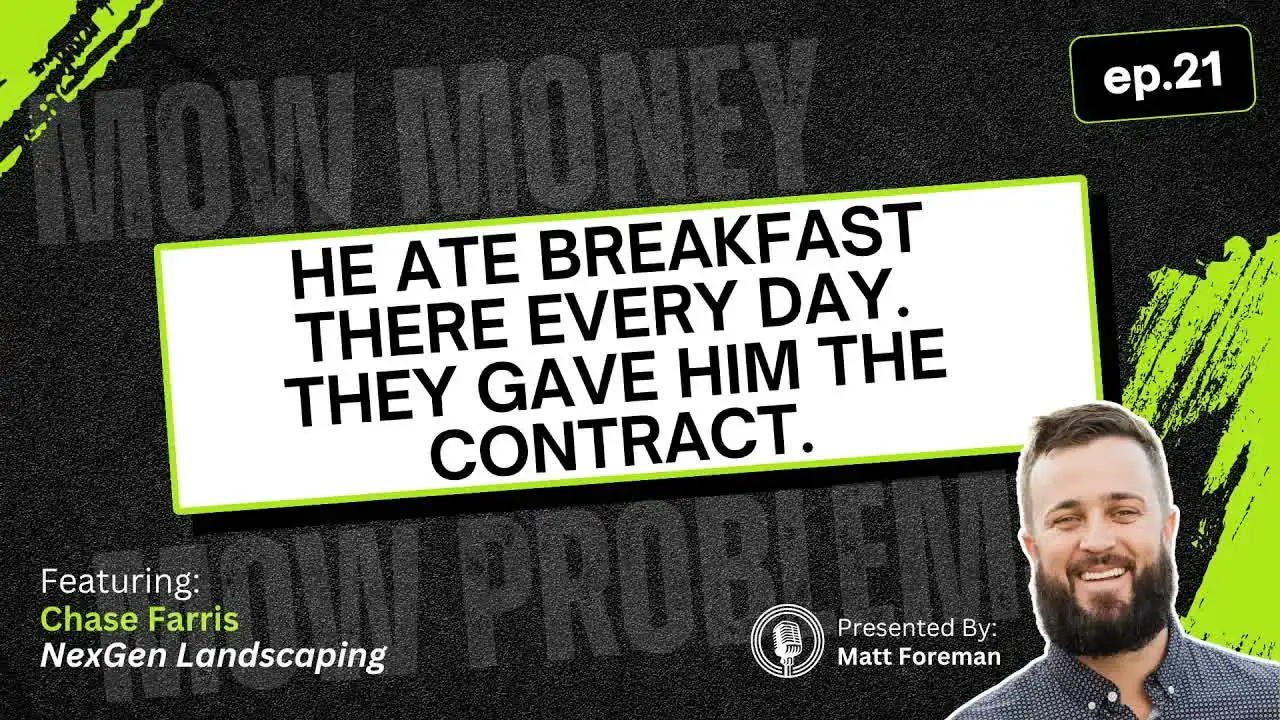
Chase Farris is a third-generation landscaper who started NexGen Landscaping in the Tempe, AZ area while still in college, and decided on day one that it would be a commercial landscaping company, before it had a single commercial client. On episode 21 of the Mow Money, Mow Problems podcast, he explained how that bet paid off.
His story is a practical playbook for any landscaper who wants commercial and HOA work: how he won the first account, what commercial property managers say their current landscaper gets wrong, why he built recurring revenue before chasing installs, and how he keeps crews safe in 120-degree heat.
Key takeaways
- Pick your niche before the market hands you one. Chase turned down residential maintenance requests to stay focused on commercial, even when he had no commercial clients yet.
- Ask prospects what their current landscaper gets wrong. Nine times out of ten, the answer was communication.
- Build recurring revenue first. He kept debt, bills and payroll below monthly maintenance revenue before taking on install work.
- Trust turns into time-and-materials work. Photos of everything and clear line items eventually let clients say "go get it done."
How do you land your first commercial landscaping account?
Show up consistently where the decision makers are, then do the work right. Chase grew up riding around with his grandfather, who owned a large commercial landscaping company, and worked his way up from crew member to crew leader, field supervisor, account manager and director of field operations before starting NexGen.
When he started, a few residential customers asked him to maintain their properties. He said no: "Actually, we're going full commercial." He got his contractor's license in the first year, and then the first commercial account came from somewhere unexpected. Chase and his crew ate breakfast at the same restaurant every morning before their jobs, and the owners said, in Chase's words, "You're here eating breakfast every day. You might as well do the landscaping." NexGen still services four of that client's properties today, including a new facility it built in Scottsdale, AZ.
From there the company grew to about one new commercial property a month, through a mix of channels:
- A simple website and Google Business Profile, with more SEO and online reviews added each year.
- Social media posts that were often just a photo of the truck in front of the building they serviced that day.
- Relationships: a client found through a fishing group he belonged to, and a mentor whose job minimum was higher than any job NexGen had, and who passed the smaller jobs to NexGen.
Referrals come with a responsibility. When someone feeds you work, Chase says, you never want them hearing that you didn't call back or didn't show up on time.
What do commercial clients say their landscaper gets wrong?
Communication. On every property walk, Chase asked prospective clients the same question: what are you looking for in a new landscaper that your current vendor isn't providing? "Nine times out of 10, it would be communication."
So NexGen made responsiveness the standard. In the early days, Chase would shut off the blower on his back to take a call, put the visit on his calendar and tell the client when he'd be out that day. Property managers don't want to sit around waiting for a text or call back, and answering fast was something a small company could win on immediately.
Why choose commercial landscaping over residential?
Because it scales on standards. Chase lays out several reasons:
- Consistent programs. Homeowners understandably want things done their own way. Commercial work lets NexGen run every property on industry standards, including the sustainable landscape management practices it's certified in through the Arizona Landscape Contractors Association.
- Business-hours relationships. Commercial clients call during the workday, not in the evenings or on holidays.
- Focus. He still gets residential requests every day, but as he puts it, is it fair to a large commercial client if he's off working on a house when that property needs attention?
He describes the goal for every account the same way: make the property manager's job easier, not add to their burden.
Why build recurring revenue before chasing installs?
So you always know what's coming in next month. His grandfather's company focused on installs. Chase went the other way: he turned down new-build install requests early on to build monthly recurring maintenance revenue, and kept "our debt and our bills and our payroll below the monthly reoccurring revenue."
He avoided loans on purpose, because "the payment rolls around every 30 days." The early years were lean: one truck with no air conditioning and about 300,000 miles on it, and the first riding mower bought out of a self-storage unit because the company didn't have the credit to finance nicer equipment. Today, enhancements, tree care and irrigation repairs for existing clients have pushed revenue above the maintenance base, and when that first client asked NexGen to build their new facility, the company finally had the team and resources to take it on.
Asked for the most underrated service in the industry, his answer was the same idea: "The number one thing is monthly reoccurring revenue, 100%." A managed account opens the door to pre-emergent, irrigation repair, tree care and enhancements.
How do you keep a crew safe in 120-degree heat?
Schedule around the heat and treat hydration as a two-day job. Summer in Maricopa County runs 115 to 120 degrees, and Chase notes that a parking lot island can read 140 to 150 degrees in the middle of summer. His crew rules:
| Practice | How NexGen does it |
|---|---|
| Hours | About 5:00 a.m. to 1:30 p.m. in midsummer, which commercial properties allow |
| Clothing | Long sleeves, sun hats and neck protection, to guard against skin cancer as well as heat |
| Hydration | Electrolytes during the day, and hydrating the day before, not the morning of |
| Pace | A steady pace with shade breaks, instead of going all out in the morning |
The desert has its own calendar, too: spring and summer flowers, then fall and winter flowers, scalping Bermuda grass and overseeding with perennial rye once temperatures drop to about 65 degrees, and a plant rejuvenation calendar that cuts back specific plants in specific months. That's why he asks new clients to "let us get through all the seasons" before judging the work.
How do you keep good landscaping employees?
Pay well, invest early and care about their goals. When NexGen only had 32 hours of work a week for its first employee, Chase still paid him for 40 every week so he wouldn't leave for a full-time job elsewhere. Today some people at the company make more than Chase does, because their roles are the ones the company needs to grow.
He also tells new hires that this might not be their forever job, and that's fine: "While you're here, let's have fun. Let's do it right." He'd like to help each person toward their own goals, whether that's buying a home or something else entirely.
Day to day, he keeps everyone on the fundamentals with checklists on the crews' work tickets: shrubs pruned back behind the curb line and below window sills, weeds out, trash picked up, everything blown out and the curb line clean. On the office side, the fundamentals are estimating, invoicing, scheduling and communication.
The operator takeaway
Chase Farris's story shows that commercial landscaping rewards focus and patience. Choose the niche early, answer the phone faster than anyone else, build monthly recurring revenue before chasing big installs, and earn enough trust that clients stop asking for an estimate and start saying, in his words, "time material, go get it done."
Want more of the clients you actually want?
We build marketing around the work you're best at, so the right commercial and residential clients find you: a website that converts, local SEO, reviews and fast follow-up.
Want this done for you? See our landscaping marketing.
Frequently asked questions
How did NexGen Landscaping land its first commercial account?
Chase Farris's crew ate breakfast at the same restaurant every morning before work, and the owners eventually asked NexGen to take over their landscaping. NexGen still services four of that client's properties, including a new facility it built in Scottsdale, AZ.
What do commercial property managers want from a landscaper?
When Chase asked prospects what their current landscaper wasn't providing, nine times out of ten the answer was communication. Answering calls quickly and keeping clients informed is one of the easiest ways for a landscaping company to win commercial work.
Should a new landscaping company focus on maintenance or installs?
Chase built monthly recurring maintenance revenue first and kept debt, bills and payroll below it, turning down install requests until the company had the team and resources to take them on without risking its cash flow.
How do landscaping crews work safely in extreme heat?
NexGen starts around 5:00 a.m. and finishes about 1:30 p.m. in midsummer, keeps crews in long sleeves and sun protection, provides electrolytes, asks crew members to hydrate the day before, and sets a steady pace with shade breaks.