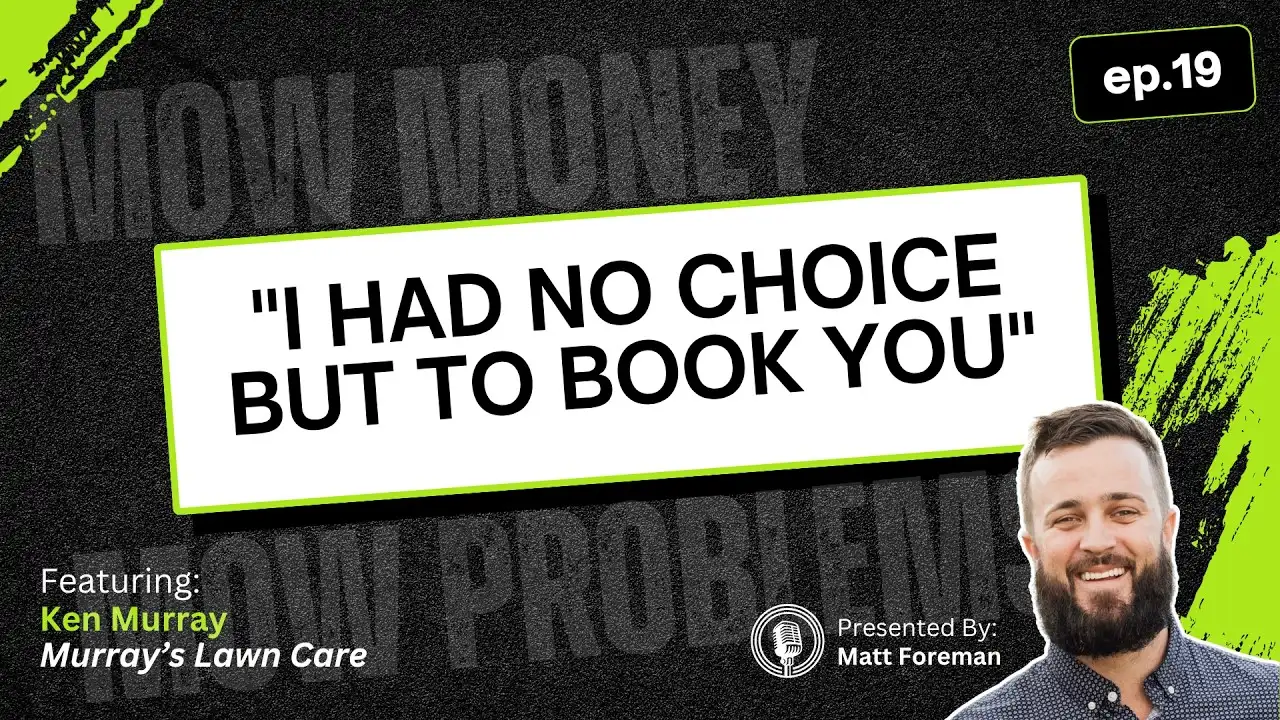
Ken Murray started Murray's Lawn Care in Minneapolis, MN two years ago with a push mower, a weed whacker, a blower, and no background in the green industry. On episode 19 of the Mow Money, Mow Problems podcast, he told host Matt Foreman how daily Facebook videos became his biggest source of new business, outperforming the Facebook ads he also tried.
Murray runs the company alone: estimates, mowing, customer communication and marketing all land on him. His story is less about a clever growth hack and more about what a one-person operation can do with a phone camera, a free editing app, and the willingness to raise a price once the proof backed it up.
Key takeaways
- Daily organic video outperformed every paid channel Ken tried, including Facebook ads. He posted to every platform at first, dropped the ones that weren't working, and now shows up for Minneapolis lawn care searches on the strength of his organic posts.
- One underpriced job taught him to price with confidence. A $40, nearly four-hour mow led directly to the nerve to charge almost $100 an hour on his next big client.
- A free app was the only editing tool he needed. CapCut, not Adobe or DaVinci Resolve, runs his entire content system.
- Adding a second service covered the slow stretch. Picking up junk removal brought in a new client within days, without relying on mowing alone.
How did Ken Murray land his first lawn care clients with no reputation yet?
By walking the neighborhood and posting the same flyer online. With no track record to point to, Murray started with business cards and door hangers: "I walked the neighborhood with my lawnmower and was knocking on doors."
The lead that actually stuck came from Facebook, not a driveway. He posted one of his flyers there, and "it was just uphill from there, and they just kept coming and coming." Early on he built a mixed book of business: one-time mows, recurring clients, and a real estate contract covering 15 properties that he calls "very huge for me."
What was the biggest early bottleneck, and how did Ken Murray push through it?
Not equipment or cash, but fear and self-doubt about running his own business. Murray says he already knew he was a hard worker with strong customer service instincts, but "when it came to my own business I didn't have that same confidence until I kept pushing." Learning the trade and learning how to run a company at the same time doubled the difficulty.
He leaned on a business degree program and what he calls "my best friend": YouTube. His takeaway for anyone starting out: "We all have potential. We just have to find it."
Why did organic Facebook content beat paid ads for Murray's Lawn Care?
Consistency built trust that a paid ad never could, and Ken's own results proved it. He tried posting daily on every platform he could think of, including Instagram, TikTok and YouTube, before narrowing his focus: "the most growth that I got and the more traffic I got was from Facebook." He also ran Facebook ads, but found steady organic posting worked better for him.
The clearest proof came from a customer who told him directly what happened when they searched for a provider. In Ken's telling: "I don't know what you did to the Facebook algorithm, but you crushed it... When I typed in Minneapolis lawn care, I seen so many of your posts, your videos, your pictures... I had no choice but to book with you."
What is Ken Murray's daily content system, and what does he edit it with?
He goes live on Facebook while he works, then turns that same job into two different videos afterward. He shoots the whole visit, then cuts it two ways: "I have a before and after video and then I have a fast-paced video, like a satisfying video." The appeal of the fast-paced cut is simple: "Something that took me 5 hours, you're watching in 2 to 3 minutes."
He edits everything in CapCut, after testing pricier options first: "I tried all the expensive ones, Adobe, DaVinci... CapCut is, it works for me. It's simple." His bar for how easy it is to learn: "if you teach a 7-year-old, they can do it."
How did a $40, four-hour mowing job teach Ken Murray to price with confidence?
By showing him exactly what underpricing costs once a property turns out worse than it looked. A new customer told him her usual guy charged about $40, and Murray agreed to match it. The lawn was covered in crabgrass. The job took him close to four hours, and even with a tip from the client, "it wasn't worth it. And I think it ended up taking me like almost 4 hours."
Separately, a different client gave him the chance to charge what the work was actually worth, and he was afraid to ask for it. He did anyway: "I was able to charge her almost 100 bucks an hour, and I never in my life charged that much, and she went with it. She was happy." The result, in his words: "I realized I'm more powerful than I think I am."
| Job | Quoted rate | Time on site | What it taught him |
|---|---|---|---|
| The lowball mow (matched a prior provider's old rate) | $40 flat | Almost 4 hours | Price the lawn in front of you, not a stranger's old rate |
| The job he was afraid to quote | Almost $100 an hour | Not stated | Clients will pay full price when the work backs it up |
His rule now: "Lesson learned. Don't settle for anything just cuz you're starting. People are going to pay what you're worth."
How does a one-person lawn care operation lean on AI and Jobber to keep up?
By handing off the busywork so his own time stays on the mower, not the laptop. Murray signed up for Jobber about a week before this conversation and was already exploring its invoicing and AI features to take load off a solo operation. For estimates, he uses a separate app: "I have another app where I can snap photos and take videos, and it'll give you the whole estimate breakdown... Gives me a little more confidence with my estimates."
His overall take on AI tools: "AI is a good tool if you use it right, but if you don't use it you'll get left behind."
How is Murray's Lawn Care staying busy through the slow season, and what comes next?
By adding a second service instead of waiting out the months when mowing demand drops. Murray's first slow season as an owner was difficult; the most recent one was easier because he had built up more clients first. His approach now: "we have to find different ways to try to attract that money." He added junk removal and landed a client within days: "I added junk removal about a 2 days ago, and I got my first client." He is also weighing pressure washing as another addition. By his own description, his current services are lawn care, tree trimming and junk removal.
Growth has brought a capacity problem: "I have to turn a lot of people away... I'm only one man." His next steps are better equipment, beyond the self-propelled mower he started with, and bringing on help so the business can take on the work he currently has to decline.
The operator takeaway
Ken Murray built a lead engine out of almost nothing: a phone camera, a free editing app, and daily, specific content instead of a single polished ad. The harder lesson was pricing, and it took one bad job to teach it: match the work in front of you, not a stranger's old rate, and be ready to charge what a job is actually worth once the proof is there. For a solo operator without a marketing budget, the path Murray describes is not go viral. It is post every day, be specific about what viewers are seeing, and don't let fear set the price.
Want your lawn care business showing up everywhere a customer searches?
We build the marketing system that helps lawn care companies get found consistently: a website that converts, local SEO, reviews and follow-up that turns one-time mows into repeat clients.
Want this done for you? See our lawn care marketing.
Frequently asked questions
How did Ken Murray get his first lawn care clients?
He walked his neighborhood handing out business cards and door hangers, and posted the same flyer on Facebook. The Facebook post produced his first real lead, and continued posting kept new clients coming after that.
Why did organic Facebook content work better than paid ads for Murray's Lawn Care?
Ken Murray tried every major platform and ran Facebook ads, but consistent, daily organic posting on Facebook brought the most traffic. A customer told him he had "no choice" but to book after seeing so many of his posts when searching for Minneapolis lawn care.
What video editing app does Ken Murray use for his lawn care content?
CapCut, a free editor. He tested paid tools like Adobe and DaVinci Resolve first but found CapCut simpler, and he had already used it to edit music videos before starting the business.
What pricing lesson did Ken Murray learn from a $40 mowing job?
Matching a customer's old $40 rate on an overgrown lawn turned into an almost four-hour job that wasn't worth it. The experience taught him to price the work in front of him rather than a stranger's old rate, and it gave him the confidence to later charge almost $100 an hour on a different job.