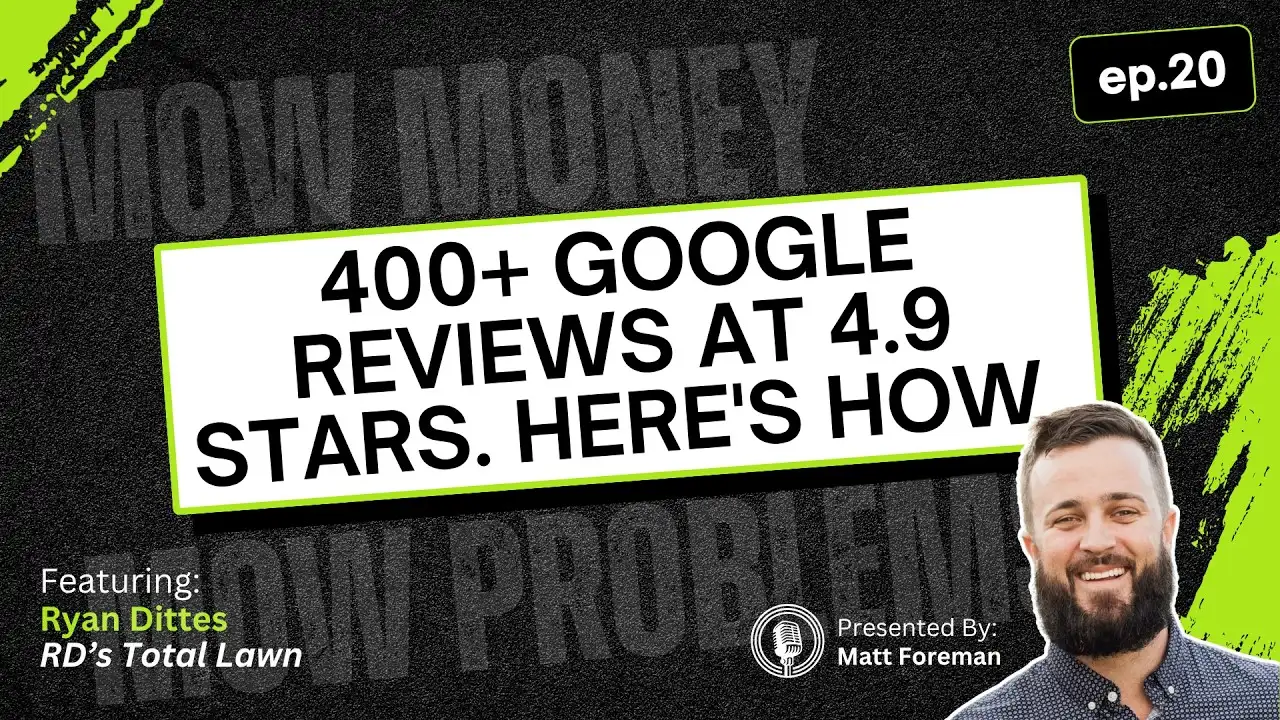
Ryan Dittes started RD's Total Lawn in Langhorne, PA, in 2018 with a push mower, a string trimmer and a backpack blower, while still working full-time at Coca-Cola. He spent seven seasons building the company on nights and weekends before making the leap to run it full-time. On episode 20 of the Mow Money, Mow Problems podcast, he walked through how that side hustle grew into one of Bucks County, PA's most recognized residential lawn care brands: around 15 employees and a Google review profile most companies would envy.
His biggest lesson has little to do with equipment or pricing. Branding and reviews are both long games that only pay off if an owner keeps showing up for years, and the fastest way to stop drowning in missed calls is to hire help before the breaking point, not after it.
Key takeaways
- Branding takes years to pay off. Ryan didn't feel brand recognition start to "snowball" until around his sixth or seventh year in business.
- Four hundred-plus Google reviews came from asking, not software. RD's Total Lawn reached roughly 300 reviews with nothing more than a direct request after every job.
- Mowing and fertilizer and weed control are different growth problems. Mowing is limited by labor and equipment capacity; fertilizer and weed control is limited by lead volume and sales.
- Office staff turned leads from a flood into a system. Hiring help for phones, pricing and follow-up let Ryan move from reacting to every call to working on the business itself.
How did Ryan Dittes build RD's Total Lawn before going full-time?
He started small, priced low to get the first yes, and let word of mouth do the rest. In 2018, Ryan began mowing lawns on the side with a push mower, a string trimmer he already owned, and a backpack blower. His first year, part-time, he ended with around 20 mowing clients, picked up mostly through Facebook and Nextdoor posts. He says customers said yes largely because he "priced them completely way too low." In those early days he was doing everything himself: the sales, the mowing, the customer conversations.
He kept his full-time job at Coca-Cola for seven seasons while running the business on nights and weekends, building it to the point of having crews and full-time staff before he ever went full-time himself. What started as mowing-only grew once he had the manpower: mulch installs, bush trimmings and yard cleanups came first, then, once he went full-time in his seventh season, fertilizer and weed control.
Today, now in his ninth season, the company's work spans lawn mowing, landscaping, and fertilizer and weed control treatments, with around 15 full-time and part-time employees, two office staff, and a supervisor hired this year.
Why does Ryan Dittes treat branding as a long game?
Because the payoff didn't show up until around his sixth or seventh year in business. Early on, Ryan had no wrapped truck and no consistent logo, just word of mouth from doing good work. As the company grew, he leaned into what he calls a "big fish small pond" approach: going heavy on branding in one dense area rather than spreading thin.
Every vehicle gets wrapped. On the episode he mentioned "getting our 10th vehicle wrapped," on top of box trucks and enclosed trailers, all logoed. Yard signs mark his work, and spray signs mark completed treatments. The goal, in his words, is to have "the RD, the green hair guy" visible everywhere he can be.
That branding shows up directly in his lead data. Checking Google Search Console, Ryan sees a meaningful share of branded search: people typing the company's name directly rather than a generic "lawn care near me" query. He also keeps his own face on the company's social media because it's his name on the business and he enjoys being out there: "we're big enough to deliver, but small enough to care." His summary of the whole approach: "Branding is a long game. It's not like overnight."
How do you delegate when you've worn every hat in the business?
One hat at a time, roughly in order: field work, then office work, then operations, then sales. Ryan says he's worn every hat in the business. A couple of years back he was personally answering phones, texts and emails. Last year, with no operations manager, he was handling routing, customer issues and estimates himself. This year he hired a supervisor, Mike, to take that over, which has taken a major load off his plate.
A business coach gave him a simple frame for the owner's job at a high level: "Cast the vision, build the team, don't run out of money." He also keeps another line in mind, one he picked up from elsewhere in the industry: "sell the work and hire people to do the work."
Today, Ryan describes his role as mostly removing obstacles for the team and, this year specifically, sales: trying to generate more leads, not for mowing and landscaping, which he calls healthy and growing, but for fertilizer and weed control, which he wants to scale.
What's the difference between scaling a mowing division and a fertilizer and weed control division?
Mowing and landscaping growth is mostly an operations problem; fertilizer and weed control growth is mostly a sales problem. Ryan is active in industry peer groups for both sides of the business, and he notices the conversations are completely different.
| Division | What limits growth, in Ryan's experience | What his peer groups mostly discuss |
|---|---|---|
| Mowing & landscaping | Labor and equipment capacity for the routes already booked | Hiring and getting more done with the crews on hand |
| Fertilizer & weed control | Lead volume and the sales process behind it | Generating leads, following up, and closing |
Ryan brought in roughly 700 leads for fertilizer and weed control in a single year, which he calls a strong number, but he says the division still has far more capacity to deliver than it has leads to fill it: one technician can treat far more properties than a mowing crew can cut in the same time. Mowing, by contrast, is close to maxed out with his current equipment and crew size, which is why his focus this year is squarely on generating more fertilizer and weed control leads rather than more mowing work.
Why does Google outperform Facebook for lawn care leads?
Because Ryan has invested heavily in his Google presence and, by his own admission, hasn't cracked Facebook yet. Google is his number one lead source by far. Facebook is a different story: "I probably just put money in the paper shredder," he said of his ad results so far, adding that it's "definitely not something we've perfected."
On the show, Matt pointed out that the two channels attract different kinds of searchers. Google captures people who are already typing in exactly what they want, which tends to convert well. Facebook users are scrolling, not searching, so getting their attention usually takes a strong, specific offer, such as a free first service tied to signing up for an annual program. Matt also noted that, in his experience across the green industry, Facebook leads generally close at a lower rate than Google leads, though they can arrive in much higher volume.
For Ryan, that makes Facebook "low hanging fruit" he hasn't picked yet: a channel other owners in his peer groups are using well, and one he plans to figure out next.
When did hiring office staff change the business?
When his own response time to customers became, in his words, "horrendous." A few years into running the business, Ryan was personally handling every incoming call, text and email on top of fieldwork, often catching up late at night. "This is like not fun. This isn't fun anymore," he said of that stretch. Customers were waiting days for a reply.
He hired his first office employee, Analisa, roughly two to three years ago, and a second office employee this year. Between the two of them and an answering service, less than 2% of incoming calls go to voicemail; a person answers almost every call. The office team handles:
- Phones, texts and emails: all incoming communication
- Pricing: measuring a property and sending a quote, often within a couple of hours of a request
- Setting up new customers, including getting a card on file
- Outbound follow-up calls
- Entering completed jobs into the company's software so routing and dispatch can take over
The change let the business move from reacting to every incoming lead to also following back up on leads that haven't converted yet. Asked if it had been worth it, Ryan's answer was short: "Definitely."
What's the system behind RD's Total Lawn's 400+ Google reviews?
Ask every happy customer, every time, and don't wait on software to do it for you. RD's Total Lawn has earned more than 400 Google reviews at a 4.9-star average. Asked for the secret, Ryan was direct: "If there's any secret sauce, it's just ask." He says the company reached roughly 300 reviews with no review software at all, just a simple question after a job: "Were you happy with service? ... Would you mind leaving us a review? It would really mean a lot to us."
- For a stretch, Ryan built review requests into his own Saturday routine, looking back through the week's completed jobs and sending a text or email to each one.
- He's used QR codes the crew hands out so a happy customer can leave a review on the spot.
- He's offered a small cash incentive to the crew: "if you get a Google review and your name's in, I'm going to throw you 10 bucks."
The payoff goes beyond the star rating. A strong review profile makes new customers comfortable putting a card on file, because, in his words, they're thinking "this company's not going to burn me." It also buys grace when something goes wrong. Fixing a mistake has "cost me thousands of dollars" at times, he said, but he considers it worth it, both because it's the right thing to do and because long-term reputation outweighs a short-term save. For the inevitable bad review that shows up anyway, Matt's advice on the show was simple: "pour 30 good reviews on top of it."
The operator takeaway
Ryan Dittes didn't build RD's Total Lawn with a marketing budget or a growth hack. He built it with years of underpriced lawns that turned into word of mouth, a brand he put on every truck and sign long before it paid off, an office team hired the moment his own response time started to slip, and a review system that is really just a habit of asking. As he put it, describing the business in one line: "We grow it and we mow it."
Want a brand and a review engine that both compound?
We build the marketing system that helps lawn care companies turn good work into recognizable branding, steady reviews, and faster follow-up on every lead.
Want this done for you? See our lawn care marketing.
Frequently asked questions
How did Ryan Dittes build RD's Total Lawn before going full-time?
He started in 2018 with a push mower, string trimmer and backpack blower while working full-time at Coca-Cola, mowing lawns nights and weekends. He priced his first clients low to get the yes, ended his first year with around 20 mowing clients, and grew mostly by word of mouth before going full-time in his seventh season.
What is the best way to get more Google reviews for a lawn care business?
Ryan Dittes says there is no secret software, just asking. RD's Total Lawn reached roughly 300 reviews by simply asking happy customers by text or email if they would leave one, and for a stretch he built review requests into his weekly routine after jobs were completed, sometimes with a small incentive for the crew.
Why does Ryan Dittes treat branding as a long game?
He wraps every truck and trailer, puts up yard and treatment signs, and keeps his own face on the brand's social media, but says the payoff built slowly. Branded search, customers typing the company name directly, only became a noticeable lead source around his sixth or seventh year in business.
What's the difference between scaling a mowing division and a fertilizer and weed control division?
Ryan Dittes says mowing and landscaping growth is mostly an operations problem of hiring crews and routing efficiently, while fertilizer and weed control growth is mostly a sales and lead-generation problem, since one technician can treat far more properties than a mowing crew can cut in the same time.