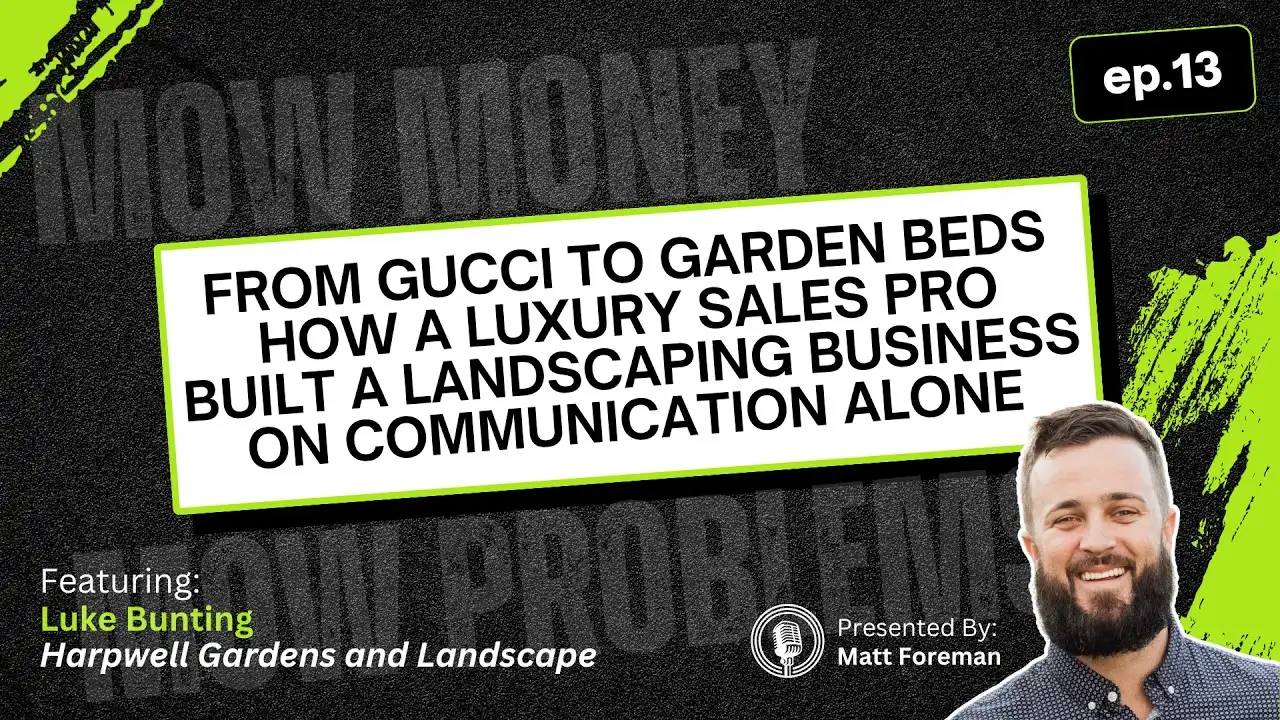
Luke Bunting owns Harpwell Gardens and Landscape in Broomall, PA, in Delaware County just outside Philadelphia. He came to the trade sideways: a music business degree, years working in plant nurseries, stints at big corporate landscape and lawn companies, almost two decades in bicycle industry sales, and a run selling luxury goods at Gucci. On episode 13 of the Mow Money, Mow Problems podcast, he told host Matt Foreman that none of that time was wasted, because his sales background built HarpWell's reputation around something a lot of landscaping companies struggle with: actually calling people back.
Now in its third year, HarpWell runs three crews and has shifted from paid lead platforms toward mostly referral business. Luke's story is a case for treating communication and continuity as the product itself, not an add-on to the installs, mowing and maintenance HarpWell sells.
Key takeaways
- The person who quotes the job is the person who shows up to do it. Luke built that continuity into HarpWell from day one, and says it's a big part of why customers trust his crew.
- Position in the gap between the big players and the one-truck operator. HarpWell targets clients too small for the large corporate landscape companies and underserved by a single guy with a mower, giving even a small job the same attention as a much bigger one.
- A paid platform can build a business before referrals do. Yelp supplied 40 to 45 percent of Luke's business in his first two years, driven by answering every inquiry within 24 hours.
- Hiring through your own crew beats job boards. Luke runs a referral spiff system with his existing team after Indeed and Facebook job ads brought hires who didn't work out.
How do you build trust fast in a landscaping business you just started?
Make sure the same person who quotes the job is the one who shows up to run it. Luke's sales background shaped how he set up HarpWell from the start. In his words, "the person that's showing up to the person that answers the phone is the same person that's going to show up to give you the quote or the proposal and walk the property with you." He is also on site at some point on every job, whether for the whole project or to set up his crew before or after.
That continuity extends to the whole team. HarpWell doesn't discuss money with crew members, but Luke makes sure everyone on a job is walked through what's happening, so any customer can ask any guy on site what's going on and get the same answer. "It takes a lot of work," he said, but it's part of why people hear HarpWell has a crew that understands the job and keeps booking it.
Who should a landscaping business actually target?
The gap between the big corporate players and the one-truck operator. Luke describes the Philadelphia market as split between landscape companies doing a million dollars or more with hundreds of mowing properties and installs a year, and what he calls "the hack," a guy with a truck, a trailer and a push mower. HarpWell was built for what's in between: smaller accounts in Delaware County that deserve the same high-touch treatment as a bigger client, even if the job is a modest one.
That positioning, plus Luke's constant presence as the owner who quotes and often works the job himself, is what he credits for HarpWell becoming "gangbusters" by its third year. Customers get a company that treats a smaller property with the same care a wealthier client's larger install would get elsewhere.
How did Yelp and Google Business Profile build a landscaping business before referrals did?
By answering every inquiry within 24 hours, not by the platform doing the selling. Luke's first two years ran largely on paid Yelp, which he still pays for, mostly reactivating it each season, starting around July and August with a push on fall cleanups. "a good 40 to 45% of my business came from that," he said of those first two years, and the rule that made it work was the same discipline from his sales days, responding within 24 hours.
Google Business Profile came next and now brings in steady work too, with the same approach: posting photos, keeping information current, and responding quickly. HarpWell also keeps its Facebook page updated. Luke tried Angi for a year and called it "a terrible option," while Yelp, he says, kept bringing in new customers that eventually turned into referral business.
| Channel | Luke's experience |
|---|---|
| Yelp (paid) | 40 to 45 percent of business in years one and two; reactivated seasonally |
| Google Business Profile | Steady work now; kept current with photos and fast replies |
| Kept active and up to date | |
| Angi | Tried for a year; called it "a terrible option" |
| Referrals | Now the primary source as HarpWell enters year three |
How do you run three crews without the owner on every job?
Split by function, and keep the owner's standard visible on every one. HarpWell runs a mowing crew, a full landscape install crew, and a maintenance crew of Luke plus one other person covering around 30 accounts: weeding, trimming, mulch touch-up and annuals, the "reactionary things" too small for the install crew to take on.
Growth is deliberate. This year's focus has been equipment and staffing: another truck, another trailer and more mowers, aimed at making the crews he already has more efficient. Next year's plan is to add one more landscape crew and about half a mowing crew, with a longer-term goal Luke described as adding a crew and a truck every year.
Should a landscaping business offer mowing, or stick to installs?
It depends on whether you value the upsell more than the margin. HarpWell launched as an install-only company. Grass cutting "was not even a thought," Luke said, but customers kept asking if HarpWell cut grass, and he eventually bought used mowing equipment rather than keep turning down work. Now mowing and the vehicles that support it are, in his words, "really the only overhead we actually have," and he openly questions the math: "I'm questioning do we need to cut grass." He puts the real question plainly: "is this worth it ultimately?"
The case for keeping it is the same one Matt raised on the episode: mowing is the foot in the door. A client having only their lawn cut isn't searching for an installer when a landscaping project comes up, they call the company already on their property. Luke has seen it happen directly, including a mowing client who moved houses mid-season and asked HarpWell to follow her to the new address. That is the trade-off every landscaping owner weighs when a customer asks, "do you cut grass as well?"
How do you hire reliable people in a tight labor market?
Go through the crew you already trust before you go to a job board. Luke's current approach: ask his own guys if they have a friend or cousin who needs work, with a cash bonus if the referral lasts three months and another payment if they make it to six. "I've had the most success with that by far," he said. Indeed and Facebook job ads brought people in last year, but those hires didn't work out as well.
The result is a landscape crew that's mostly friends in their early twenties who get along well, which Luke worried might backfire but says has instead made the job site more enjoyable for the crew and more visible to customers who see a team that works well together.
What's the lesson from a landscaping company's worst customer?
When a client won't let your crew work, address it directly, even if you have to do it twice. Luke booked around a dozen jobs over a recent winter, all of which got pushed into spring on top of the new work already coming in. One of those jobs combined clearing land ahead of another company's asphalt work, a timber retaining wall, and planting arborvitaes on a hillside to form a berm, work that would normally spread out over time but had to be consolidated into an ideal three days.
It took seven. The client was, in Luke's description, a "while you're here" type who stayed on site, nitpicked every detail and made the crew second-guess work they knew how to do. Luke had to stop him and have a direct conversation twice before the job wrapped. "It was rough. It was rough. And luckily we're done," he said.
The operator takeaway
Luke Bunting's story is a reminder that a landscaping business doesn't have to out-crew or out-spend the biggest companies in its market to win. HarpWell grew by picking a clear lane between the corporate players and the one-truck operator, answering Yelp and Google inquiries within 24 hours before referrals existed to replace them, and keeping the same face on every job from quote to completion. As Luke put it, nothing in his plan has mattered more than "the person that's showing up to the person that answers the phone" being one and the same.
Want to be the company homeowners already trust?
We build the marketing system that helps landscaping companies get found, get responded to fast, and turn reviews and referrals into a full schedule: a website that converts, local SEO, reviews and follow-up that doesn't let a lead go cold.
Want this done for you? See our landscaping marketing.
Frequently asked questions
How did Luke Bunting grow Harpwell Gardens and Landscape in its first two years?
Mostly through paid Yelp, which brought 40 to 45 percent of his business in years one and two. The key was responding to every inquiry within 24 hours, a habit Luke carried over from his sales career.
Should a landscaping company offer lawn mowing?
Luke Bunting's experience shows it cuts both ways. HarpWell started as an install-only company and added mowing because customers kept asking for it, and Luke still questions whether the margin is worth the overhead. The case for keeping it is that mowing clients call the same company first when a bigger landscaping project comes up.
How do you hire reliable landscaping crew members?
Luke Bunting hires through his own crew with a referral bonus system, paying a bonus when a referred hire reaches three months and another at six months. He says it has worked far better than posting jobs on Indeed or Facebook.
What size landscaping jobs should a company focus on?
Luke Bunting built Harpwell Gardens and Landscape to serve the gap between large corporate landscape companies and a single operator with a truck and a trailer, giving smaller accounts in his market the same high-touch service as larger ones.