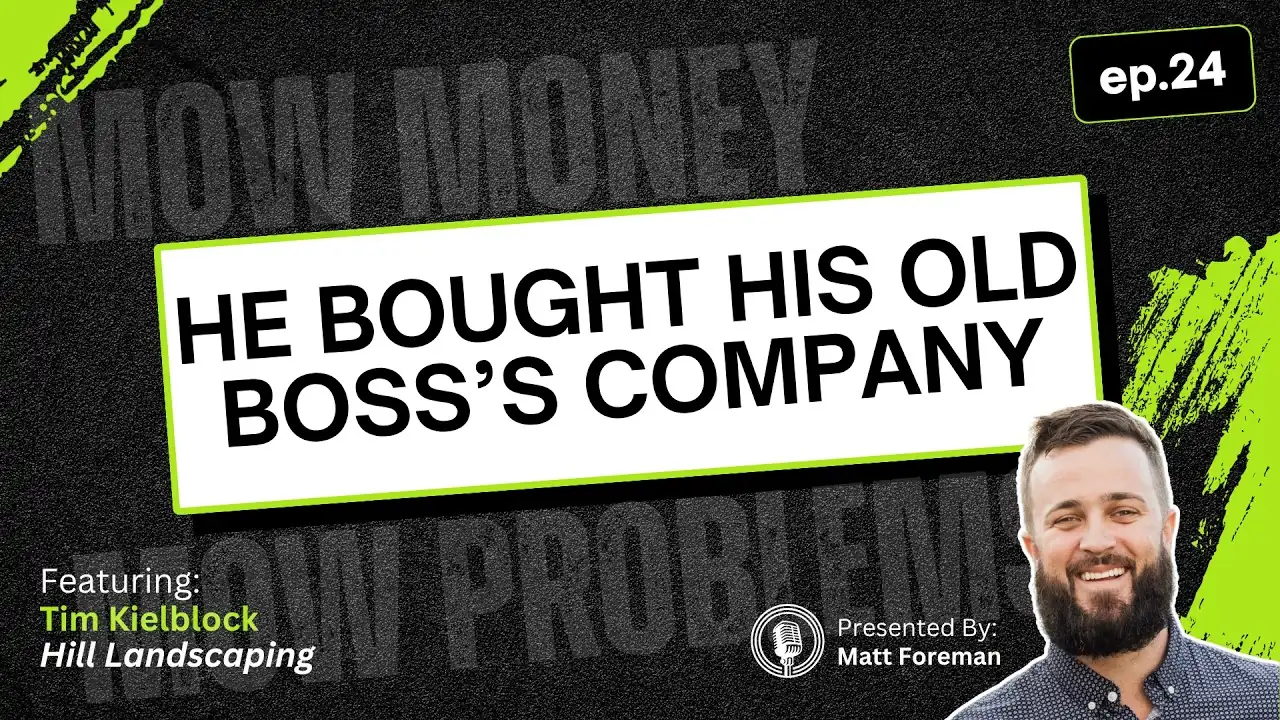
Tim Kielblock started on a Hill Landscaping crew at 18, left to work as a mechanic, built a small lawn company on nights and weekends in 2020, and in 2023 took ownership of Hill Landscaping, the Flemington, NJ company Eugene Hill founded in 1984. On episode 24 of the Mow Money, Mow Problems podcast, he talked through what it takes to carry an established name forward and grow it on purpose.
His answers are practical and specific: why he kept the name, why mowing is the door and not the business, the flat-rate contract that steadied his cash flow, and the equipment that paid for itself in a single season.
Key takeaways
- An established name is a marketing asset. Tim kept the Hill Landscaping name, its Google Business Profile and its five-star reviews, then refreshed the logo and website instead of starting over.
- Maintenance pays the overhead; design-build pays the profit. Mowing is how a company gets invited back for the patio.
- A flat monthly maintenance contract makes cash flow predictable, even in a dry month when crews barely mow.
- Equipment that saves hours pays for itself. Tim's mini excavator was covered by the gross revenue of the four jobs that convinced him to buy it.
How do you take over an established landscaping company without losing its customers?
Keep what people already recognize, and be open about what changed. When Tim took over, he kept Hill Landscaping as the company name because, in his words, it "was such an established name" in Hunterdon County, NJ. The Google Business Profile and its five-star reputation came with it, and four seasons later the rating is still five stars.
He didn't hide the change, either. The way he describes it, the handoff worked because it was handled in person and in writing:
- The previous owner took him around in person to meet the managers at the commercial accounts.
- Every residential client got an email about the new ownership.
- Tim's own customers heard that the combined company could now take on landscaping and hardscaping, not just lawns.
Then he put his own stamp on it: a new logo and a new website, with the familiar name intact. He calls it "a passing of the torch." Even the trucks help. One of Hill's dump trucks has been rolling around Flemington since 2008, and people know it on sight.
The marketing lesson for any owner: recognition takes years to build, so think hard before throwing it away for a fresh brand nobody has heard of.
Can you run a landscaping company you're not on site every day?
Only with structure in place before you need it. For his first few years as owner, Tim still held a full-time job as a campus manager at Rutgers University, and ran Hill around it. He's blunt about what made that possible: "I put structure in place right away to make sure people were in charge and things were covered."
That meant naming a lead foreman, a Hill veteran of about 25 years, to run the day-to-day and own the landscape work, with another crew leader who has been with the company for more than 30 years. Customers are encouraged to talk to the foremen directly, and the crew runs on shared apps rather than on the owner's memory.
In spring 2026, with calls steady and the schedule booked well into June, Tim left Rutgers to run Hill full time. The structure he built for an absent owner is the same structure that will let the company grow past him.
Should a landscaping company keep mowing?
Yes, as a door, not as the business. Tim is clear about the split: maintenance "pays our bills and overhead," and landscaping is "where we make our profits." Design and install work is where the real jumps in cash flow come from.
At Hill's size, he can't chase the lowest mowing prices. Solo operators and two-person crews will always undercut a company carrying payroll and overhead. But mowing keeps Hill on the property, and that matters: "When they want that patio, they're going to ask you."
So he has deliberately kept mowing small. Hill mows about 26 lawns, not 200 or 300, and Tim plans to move residential mowing to full-service only. His reasoning is about risk as much as margin: "You get a dry July, I don't know what your income looks like" when the whole company depends on mowing volume.
How does a flat-rate maintenance contract smooth out cash flow?
It turns a weather-dependent service into a predictable monthly number. Tim restructured Hill's residential maintenance into an eight-month contract, April 1 through November, at one set price billed automatically on the last day of each month.
| Included | How Tim describes it |
|---|---|
| Spring cleanup and mulch | Handled in April, and customers are told so up front |
| All mowing | Billed the same in a dry month, when lawns might only get cut twice |
| Mid-season pruning | Part of the set price |
| Fall cleanup | A major cleanup, or at least leaves blown away from the house and mulched into the yard |
| Weeding | Crews pick weeds before they leave a property |
He didn't force it on anyone. Plenty of customers said no, but 12 to 15 said yes, and those accounts now sit on top of Hill's commercial contracts as income the company can forecast. Tim says customers like it because it's "worry-free." The one thing it demands is communication: tell people the spring cleanup happens in April, so nobody calls on April 15th wondering where you are.
What changes when the phone stops going quiet after April?
You start planning months ahead instead of weeks. Before, Tim says, calls rushed in through March and early April and then died off. This year they kept coming well into May, and the schedule filled into June. That changed how he runs the business: "I'm not just looking at the week ahead. I'm looking at next month, the month after that."
He tried a lot to get there: brochure pages at golf clubs, a local mailer, and teaching himself Google and Facebook ads. What made the difference, he says, was Google visibility. Hill works with Lawn & Land on its marketing, and Tim credits "a dedicated marketing team that knows how Google works" for the steadier calls.
The calls changed, not just the volume. He's hearing less from "postage stamp" lawns and more from homeowners who found Hill at the top of Google and want a full landscape revitalization or hardscape project. HOAs have started asking Hill to bid on maintenance, too, which is pushing Tim toward more commercial and HOA work. And because spring is booked, he's scheduling hardscape into dry July, when planting slows down. That's the same pattern we describe on our landscaping marketing page: a strong spring is what fills the summer.
When does new landscaping equipment pay for itself?
When it saves hours on work you already have lined up. Tim's rule is to look at the jobs in front of him, not at the sticker price. Two examples from the episode:
- A sod stripper. On a bed along a walkway, Tim and two of his crew stripped the sod, loaded it into the mini skid steer and had the area ready for stone in about 15 minutes. By hand with a spade, he estimates an hour or two.
- A mini excavator. Even with a mini skid steer, digging out patios was slow. He financed a mini excavator, and the gross revenue from the four jobs that convinced him to buy it covered the machine.
His point is that better equipment doesn't have to mean higher prices: "You can keep your prices kind of competitive, but you're getting it done so much quicker." Faster jobs mean getting paid sooner. One of his crew members said a walkway Hill finishes in about a day and a half would have taken three weeks of shoveling at his previous employer.
How do you keep a landscaping crew?
Pay, workload and tools, together. When Tim took over, every veteran employee stayed, and since then he has lost only two new seasonal hires. His approach:
- A pay floor. Nobody makes less than about $20 an hour, even on a mowing crew.
- A real weekend. He tries not to work the crew on Saturdays.
- Reasonable days. He aims for 8 to 10 hours, and he didn't build the company around volume.
- Tools that make the work less grueling, which is retention as much as productivity.
When it's time to add a crew, Tim's plan starts with leadership: move his lead foreman into a role overseeing two crews, then hire to fill in beneath him. Promote first, then hire.
The operator takeaway
Tim Kielblock's story is a reminder that growth in landscaping is rarely one big move. It's keeping the name people trust, putting structure in place before it's needed, using maintenance as the door to better work, pricing for predictability, and buying the equipment that lets a good crew finish faster. As Matt put it at the end of the episode, Tim is "investing in the company, investing in your team," and that is what makes the next stage likely.
Want calls that keep coming after April?
We build the marketing system that keeps a landscaping company's spring full and its summer booked: a website that converts, local SEO, Google ads and the follow-up that closes the work.
Want this done for you? See our landscaping marketing.
Frequently asked questions
How did Tim Kielblock keep Hill Landscaping's customers after taking over?
He kept the established Hill Landscaping name, Google Business Profile and five-star reviews, met every commercial account manager in person with the previous owner, emailed every residential client about the new ownership, and then refreshed the logo and website rather than rebranding from scratch.
Is mowing profitable for a landscaping company?
For a company with payroll and overhead, mowing rarely competes on price with solo operators. Tim uses maintenance to cover overhead and keep Hill on the property, so customers ask Hill when they want a patio or a landscape installation, which is where the profit is.
How does a flat-rate seasonal maintenance contract work?
Hill's residential contract runs from April 1 through November at one set price, billed automatically on the last day of each month. It includes spring cleanup, mulch, mowing, mid-season pruning and fall cleanup, so revenue stays predictable even in a dry month.
When does landscaping equipment pay for itself?
When it saves real hours on work you already have lined up. Tim's mini excavator was covered by the gross revenue of the four jobs that prompted the purchase, and his sod stripper turns a one-to-two-hour hand job into about 15 minutes.