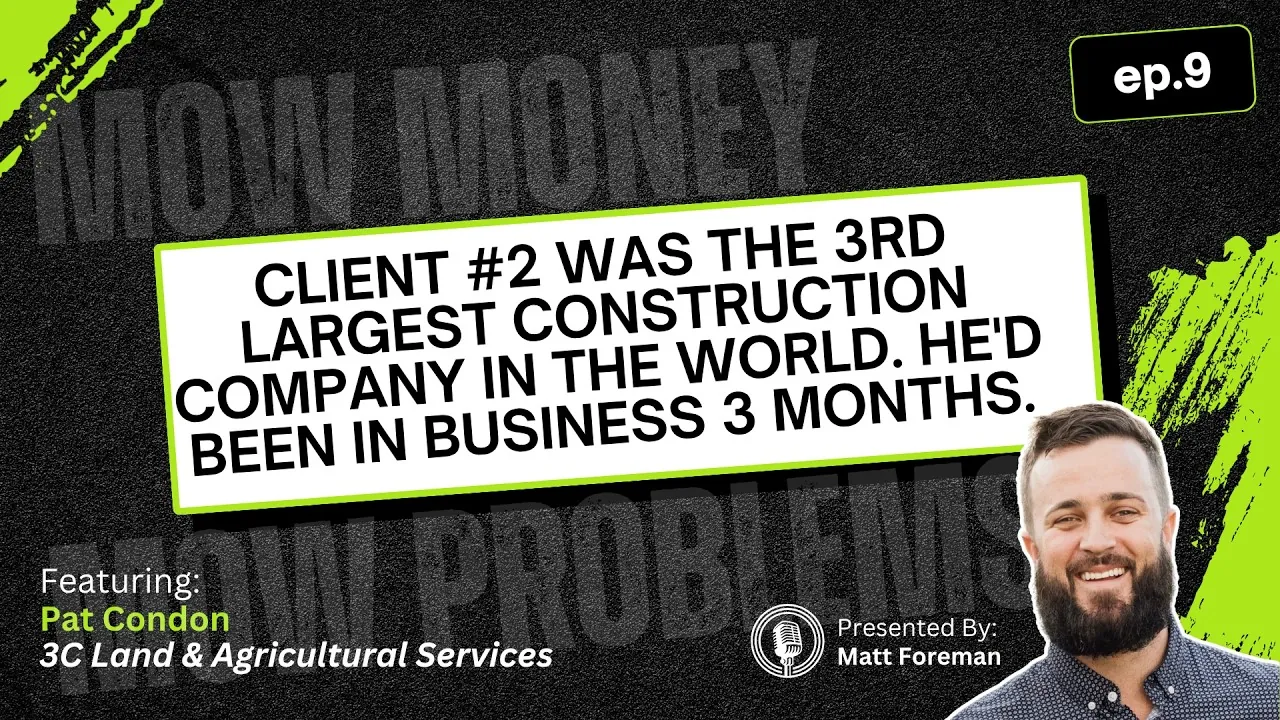
Some green-industry companies win by becoming broad. Others win by becoming unmistakably specific. On episode 9 of the Mow Money, Mow Problems podcast, Pat Condon of 3C Land & Agricultural Services showed what the second path looks like: a business built around large properties, land management, drainage, clearing, and pasture improvement.
That kind of company does not need to sound like every other landscaper in the market. It needs to make the right buyer feel, quickly, that this is not a basic mowing crew or a generic landscape contractor. It is a specialized partner for land that has real operational, environmental, and infrastructure stakes.
Pat's story is a useful case study for any operator who has built genuine expertise in a niche. Here is what it teaches about turning that expertise into clearer positioning, stronger search visibility, and better-fit leads.
Specialized companies need specialized positioning
When a company serves acreage, ranches, rural properties, agricultural land, drainage projects, land clearing, and vegetation control, the marketing has to do more than list services. It has to explain why the company is built for a different kind of property owner.
The buyer is not only asking, "Can you do the work?" They are asking whether the company understands the land, the equipment, the timing, the risks, and the long-term impact of each decision. That is a much higher trust threshold than a simple maintenance visit.
A focused marketing strategy helps a specialized operator turn that expertise into clear positioning, stronger search visibility, and better-fit leads.
Niche services should not hide behind generic language
Many land management and agricultural service companies accidentally flatten their own value. They use broad phrases like "landscaping," "property services," or "outdoor solutions" when the real advantage is much more specific.
For a company like 3C Land & Agricultural Services, the stronger story is precision land management: drainage, grading, clearing, pasture care, invasive species control, large-acreage mowing, and rural property improvements. Those details help the right prospect self-identify faster.
A green-industry website should make the specialty obvious before the visitor has to dig.
The best leads come from clear disqualification
Specialized businesses do not need every lead. They need the right leads. That means the website and content should clarify who the company is best for, what property types it serves, what project sizes make sense, and what problems it is built to solve.
This is especially important for land and agricultural work. A five-acre property owner with drainage issues, overgrowth, pasture problems, or invasive vegetation is a different buyer from a homeowner looking for weekly mowing. Trying to speak equally to both can weaken the message.
Good positioning does not only attract. It filters. It saves the team from wasted estimates and makes strong opportunities easier to recognize.
Local SEO should match how rural buyers search
Search behavior changes when the buyer owns acreage or manages working land. They may search for land clearing, culvert installation, pasture improvement, excavation, drainage, forestry mulching, vegetation control, or agricultural services near a specific region.
That means local SEO needs to be built around the real vocabulary of the buyer. Service pages, blog content, Google Business Profile categories, image names, internal links, and location pages should all reinforce the services the company actually wants more of.
If the SEO strategy only says "landscaping," it misses the higher-intent searches that specialized buyers use.
Equipment and technology are trust signals
Specialized land work often requires specialized equipment. GPS-guided applications, drone mapping, forestry mulching equipment, grading tools, excavators, sprayers, and large-property mowing capabilities are not just operational details. They are proof points.
Buyers with large properties want confidence that the company has the tools and judgment to do the job correctly. Marketing should explain the role of that equipment without turning the page into a spec sheet. The point is not to show off machinery. The point is to show that the company can plan and execute complex work.
That proof belongs on the website, in project photos, in service pages, in case studies, and in follow-up materials.
Education helps buyers understand complex work
Land clearing, drainage, pasture improvement, and invasive species control are not always simple purchases. Property owners may know they have a problem but not know the best sequence of work. Should they clear first? Grade first? Test soil first? Control invasives first? Add drainage before improving the land?
Educational content helps prospects make sense of the decision. It can explain process, timing, risks, compliance issues, seasonal windows, and the difference between short-term cleanup and long-term land improvement.
That kind of content supports search, but it also supports sales. A prospect who understands the work is usually a better prospect.
Follow-up matters when projects are bigger
Large land projects often involve more consideration than a simple service request. The buyer may need to walk the property, compare options, budget for phases, coordinate access, or plan around weather and land use.
That makes lead nurturing and follow-up important. A specialized company should not let high-value opportunities disappear because the next step was unclear. Follow-up can include estimate reminders, educational resources, seasonal timing reminders, and clear calls to action.
For niche operators, the sales process should feel as organized as the field work.
The operator takeaway
Pat Condon's 3C Land & Agricultural Services story is a reminder that specialized growth works best when the business stops trying to sound general. The more specific the company is about its work, property types, equipment, region, and outcomes, the easier it becomes for the right buyer to recognize a fit.
For green-industry operators, that is the lesson: do not hide the thing that makes the business different. Build the website, SEO, content, reviews, and follow-up around it.
Turn your specialty into your strongest growth lever
If your company has built real expertise in a niche, your marketing should make that obvious to the right buyer. Let us look at how your website, SEO, content, and follow-up can reinforce the work you actually want more of.
Want this done for you? See our land clearing marketing page.
Frequently asked questions
What can landscaping companies learn from Pat Condon's 3C Land & Agricultural Services story?
The biggest lesson is that specialization can become a growth advantage when the company clearly explains who it serves, what problems it solves, and why its expertise is different from a general landscaping provider.
Why does niche positioning matter for land management companies?
Niche positioning helps attract better-fit leads and filter out work that does not match the company's equipment, expertise, service area, or project model. It makes the business easier for the right buyer to choose.
How should agricultural service companies use local SEO?
They should build local SEO around high-intent services such as land clearing, grading, drainage, pasture improvement, vegetation control, and large-acreage mowing, along with the specific regions they want to serve.
Why should equipment and technology appear in marketing?
Equipment and technology can be trust signals when they show the company is prepared for complex work. The marketing should connect those tools to better planning, efficiency, precision, and long-term property results.
Episode transcript
Read the full transcript
The key to success is biting off more than you can chew and then figuring out how to chew it. And that hit me pretty hard because, you know, I'm thinking to myself like, yep, that's about it. Honestly, man, if I was if I wasn't netting $2 million in revenue next year at this time, I'd be a failure because it's all there to be had. >> Mow Money, Mow Problems. That's right. Man, well, everybody, welcome back to the Mow Money, Mow Problems podcast.
It's the podcast dedicated to the trials, triumphs, and insights of green industry business owners. I'm your host Matt Foreman, and today we got a very special guest with Pat Condon of 3C Land and Ag Services out in Fort Pierce, Florida. Pat, dude, so pumped to have you. >> Thanks for having me, man. Likewise, likewise. I could be happier and prouder, quite frankly, to be with you guys and and really looking forward to the podcast and getting to chat and tell my story and get to know you all a little bit better. >> Yeah, man, and and you got a story.
Uh there's a there's a lot about you. Um I mean, I've been lucky enough to to spend a few months learning a bit more about you, and obviously I barely scratched the surface. We can see here that you obviously live on an amazing property. You have your own horses. You got all your own all your own equipment, all your own gear, man.
And yeah, it seems like you're doing some pretty amazing stuff. So, I would love to know how do you how do you get to where you're at? I know it's going to be a loaded question, but how do you get at at least started in the green industry? >> Man, so I'll tell you, the green industry, in whatever facet that may be, is something that I've wanted to make a career since I was 5 years old. I went to school at the University of Florida. My degree's in agriculture.
I got business, and then I have a minor in construction. You know, straight out of school, I I wasn't really sure what I was going to do. I didn't really know which direction I wanted to go. I'd always had a great interest in cattle. I'd spent some time as a kid or growing up, you know, working cows with some some guys from this area particularly that taught me a lot about cowboying and you know, and I was you know, so I was kind of confused as to exactly what direction to go.
And then I had an opportunity present itself when I was 22 from a friend of mine from UF who grew up in Fort Lauderdale in town and who knew me well and gave me the opportunity to interview for a job in orthopedic medical device sales. So orthopedic medical device sales I knew nothing about. I had heard, you know, through the grapevine that medical sales could be lucrative and this that and the other, but you know, I was an ag guy through and through. And I still am and I and I and I never wasn't throughout, you know, over the last 15 years, but I really didn't have much interest in medicine, but you know, I was convinced time and time again, hey, your personality's you know, suited very well for this. Well, so after about I think it was about 10 interviews, I ended up getting the job.
And when I got the job, they the company I was working for at the time was Biomet Orthopedics and and they about 3 years later they became Zimmer Biomet Orthopedics, which was the largest orthopedic implant company in the world. But they wanted to put me down in in Miami-Dade County, which is you know, very the epicenter city of South you know, the the metropolitan area of South Florida. And I just respectfully declined that I said, listen, I there's no way. I said if if if you really want me to take this job, I need to be on the Treasure Coast of Florida, which is where I'm located currently, which is Stuart to Sebastian essentially and then west to Okeechobee area and it's a lot more rural. It's it's it's it's honestly it's it's might as well be two different states, but nonetheless you know, ironically the guy who hired me who had the distribution at the time, he said, you know, well, I just acquired the Treasure Coast as a part of my territory, but we've had zero representation there.
Ever. And I said, well, give me a shot. And he's like, well, you don't know anything. You don't know anything about orthopedics, you don't know anything about your sales, you're you know, a young kid. I said, well, I mean, if you like me that much, just give me a shot.
And so he he gave me a shot and he gave me a little tap on the butt when I walked out of the office and said, go get them. He said, next year, a year from today, you're going to be 100% commission. Let's see what you can do. And so, you know, I walked out of his office and I I moved up here permanently and and started to try to figure it out. I didn't have a mentor, I didn't have a a senior rep to rely on or anything like that.
And And as you can imagine, orthopedic surgery is not you know, it's not something that's basic to learn. You know, surgeons take 15 years of schooling and all that to to get to the point they're at. And the only other avenue to to really get is know as much about orthopedic surgery as as let's say a surgeon does is to do what I did for almost 15 years. And anyway, so it was it was about 7 years of really really really struggling. I mean, just grinding and then thinking to myself, you know, and this is in my early 20 you know, my 22 to 20 eight, I'd say, where I was I was questioning myself daily.
You know, can I do this? How How am I going to possibly eclipse the senior rep who who had been in the territory for 30 years, who owned 90% of the business. And I'll give him a shoutout, Paul Golden is his name. Um ended up becoming a good friend of mine. He He was in orthopedics for the glory years and and and did very well.
He He owned that market. I mean, owned it. No one in the history of 30 years had been able to go into that market and even penetrate it by anything. I mean, he it was Stryker dominated. And I can recall there was one evening where I was in the back hallway of St.
Louis Medical Center putting some trays It was like 9:00 on a Saturday. And Paul Golden, who didn't speak to competition, looks over at me and he goes, "Pat." And I was shocked that he even knew my name, you know. And he's like, "You've got something here that's special." He's like, "I've been doing this for a long time, and I've never been threatened or felt like there was anybody that could potentially take business from me." He's like, "You're that guy. Don't ever stop doing what you're doing. Keep doing exactly what you're doing." And I you know, I was kind of baffled because I was like, man, he's like telling me that I'm a threat to him essentially, but also encouraged me to keep going, you know.
And and and I remembered that statement for for years. I mean, for years. You know, sure enough, when I when I relinquished the territory back to the company about 2 years ago now, I was doing $40 million in revenue. I had 90% market share in my territory, which was four counties. And Paul Golden retired because I took all the business.
So. >> Nice. Well, damn. >> You know, that that was that was my story there in orthopedics, man. It you know, it was There's a lot more to it than that, but it it was a it was a very very challenging um what you know, experience for me for sure. But but learning the principles of how to run a business because I was running my own. I was running you know, I was working for a large corporation as an independent contractor, but I you know, I was responsible for at the end there up 200 surgeries a day on some days.
You know, I had to manage the you know, huge team of employees. And And that industry, which differs greatly from this this industry, which is I'm still learning, is that you can't make a mistake in orthopedics. I mean, like perfection is the expectation, and it took me a while to get used to getting back into the real world where you know, if something is a few minutes late, it's not someone's life or death on the line. >> Mhm. >> You know, once again, even though they're completely separate industries, I think the lessons that I I learned and the things that I became comfortable with, which main thing is being comfortable being uncomfortable. I mean, I was forced to go in there and you know, do my job and sell product to surgeons who had been operating longer than I'd been alive. And and you know, explain to them why my product was better than what they were using.
And you know, that was a terrifying thing to do for many years. But once you figured it out, once I figured it out, and once you get it down and you understand your cadence and how to do things, it actually became almost simple. And I didn't even realize that I had the skill set that I had really until after I left. And you know, I started you know, 3C uh a little over a year and a half ago or actually a little bit less than a year and a half ago, honestly. Um you know, and I'm just walking into government prime contractors built you know, job sites and and handing out business cards and talking to PMs and and it just you know, it it like I said, that that experience in orthopedics really it just sharpened my my sales blade to the point where you know, these sales conversations are not intimidating to me and and and it's been a way in which I've been able to really make a mark early, you know, moving the needle.
So. >> So, man, you've just been what like what a what a massive transition in in terms of industries though. So, the start of 3C I guess it always it it comes down to I mean, uh you take the leap of faith. What was client number one? And how'd you get him? >> So, let's see. Client number one was was a a girl named Kayla, Kayla Richmond actually.
And she had about 10 acres in Fort Pierce here that she had her pasture renovated. Um that was severely overgrazed, covered in oak trees, no shade or no uh no sunlight. And she was wondering why her pasture grasses weren't growing and it was full of weeds. And uh actually a friend of mine a very good friend of mine, she had posted on a Facebook Treasure Coast equine group that she needed someone to help renovate her pasture and and a friend of mine, Cassandra Crouch, who I've known on Facebook for many years. On Facebook.
Yeah, she just she just tagged me and uh I reached out and and went out and you know, did a herbicide application, but you know, was dealing with a very difficult problem and one that I've dealt with many times since then, you know, which is, you know, people who own five-acre parcels, maybe 10-acre parcels that have horses. I don't want to generalize here, but it's it's a it's a it's a very it's a specific type of person that just can't accept the fact that they're like when I tell them, you need to let your pasture rest because you you're going to you're never what's going to happen is your your horses are going to graze all your grass down to nothing and you're going to have nothing but weeds left and we're going to be doing the full pasture renovation, meaning burning down everything and starting from scratch. And uh it's it's it's problematic because honestly, I would say eight out of 10 of those people do not they just can't even fathom that, you know, and it's like you have to supplement your horse if you want your pasture back, you have to supplement your horse feeds. She was my first client um you know, and I killed a bunch of her weeds and and uh and you know, the real problem was that she had no no sun. Uh she had I think four gosh, I can't remember the number of maybe it was 50 uh mature oak trees in a seven-acre pasture that were just shading out all of her grasses.
So, I told her I said, "Hey, listen, we got to we either eliminate some of these oak trees, thin them out, you know, or you know, you got to find someone else somewhere else to put the horses for a little bit, you know, 6 months while you give your pasture a chance to recover and then, you know, fertilize and give it the proper protocol post recovery so that you never, you know, rotational grazing, supplementing with more hay, so you don't get to the state you're at. And um yeah, that was that was the first customer and customer number two was the Sugar Corporation, which is like third largest construction company in the world. >> Okay. >> And that was for a huge uh a huge herbicide application project that spanned the entirety of a of the C-23 24 Sneed header uh section of the Everglades restoration project. And um you know, so I I applied herbicide selectively, well, both non-selectively and selectively to um in totality, it was 4,700 acres or so. >> Mhm. >> And that was uh job number two. >> Yeah. >> So pretty right off the rip >> So >> Yeah, you know, yeah, you got it. >> Something I know about you is like you have you have a ton of equipment, which not cheap equipment. >> Correct. >> started in that? Like what's the uh cuz I mean, do you do you buy the equipment and say okay, the jobs are going to come? Do you get the jobs then buy the equipment?
How did you approach that? >> That's that's a very, very good question, Matt. That's a very, very good question and I'll tell you, I wish I had approached it differently in hindsight. So, you know, throughout my career previously, I so money saved, I mean, and um you know, not a tremendous amount, but I did have to, you know, I was working in medicine, so a lot of you know, half of my income went to the government, but I spent because I was so heavy on you know, I got my commercial applicator's license right at right right away. And I you know, because I was looking for ways to differentiate myself from just the everyday guy that can ride around with a you know, a pickup truck and a trailer and a skid steer and call themselves a land clearing guy. So, I leaned heavy, you know, I did a bunch of research and I really leaned into the precision agriculture side of things, meaning you know, precision agriculture is is a term that is broadly used to describe many different aspects of of technology that's now used for different things within the agricultural or land management world, right?
So, it could be anything from drone mapping to prescription-based herbicide and fertilizer applications, GPS map you know, map tracking, auto guidance on on machines to make them more efficient in terms of you know, how many passes you have to make. Everything is logged, data is especially when it comes to like herbicide application for example, this is a big one. All your application data is logged, it's it's all your your environmental factors are logged and these are all things that you know, I found very quickly that the government organizations and you know, specifically the government organizations, but also even large private land owners um they they want to see that. They want to see that you know, you said you did what you say you know, you there's there's tangible evidence that you did what you said you were going to do it. And it's also very beneficial thing to me as well because you know, it helps me manage my input costs, right?
If I'm doing I can do a drone multispectral drone scan. For example, let's say I'm for round numbers on a 100-acre pasture and there may be four different soil types. That drone scan coupled with the soil samples that I take I can map you know, use the extrapolate the data out for both of them and create a a variable rate prescription for the fertilizer application which is going to give whatever the crop that you're planning like so let's say I'm planning a hay field for example and I'm planning we'll just use one varietal. You know, we'll say bermudagrass, okay? That's generally a a grass that's planted in a in a damper moisture soil than others, but for bermudagrass let's say we're doing a 100 100 acres of bermudagrass.
Well, I can go ahead and do a pre-planting drone scan and that drone scan will give me the vegetative health indices, you know, how the current vegetation is doing. It'll give me a soil profile based on the moisture, the density, and the uh uh moisture, density, and temperature of the soil. It gives you a topographical scan, so you can cup, you know, map in DJI Terra, which is the program I use. Once you take all that data and you put it together, you can really get a good idea of what types of soil you have, and then where the water is moving on any given property, and what you need to do to mitigate that or change or you know, improve water flow or, you know, create, you know, if you've got standing water, you know, do different things to manage the water flow on a property and what you are growing, you know, whatever crop, whether it be cattle to hay to vegetable, you know, whatever. So, I'm able to use all this this technology that is available that's that's been widely used in mainly the Midwest, and Florida's 50th out of 50 states to to adopt it.
And I have That's a phrase that I've said a lot of times. But Florida is the largest agricultural state east of the Mississippi. So, if you think about that, I mean, we're the last state to adopt precision agriculture or precision technology of any type, which has proven to increase yields, has proven to reduce costs, has proven to create, you know, compile data that will be able to be used not only on that particular rancher, farmer, landowner's parcel, but other parcels. And as we collect data overall, right, we're able to determine, hey, you know, on this particular weed, let's say whitehead broom, which is a new weed that's been become very problematic in our area, you know, I can when I'm data logging, I know exactly what volume of what herbicide cocktail I applied at what time, what the humidity was, what the temperature was, wind speed, this, that, and the other. And through that data compilation, we're able to kind of extrapolate that out based on post-application results and determine, "Hey, you know, maybe it's more effective to use this treatment when your average humidity is is X or your your temperature or your soil temperature, you know, so it's a data collection, but it's also primarily for my customers.
The data collection is going to be for the long term is obviously going to be great because it's going to continue to improve the what the technology can do, but in the short term, what it does is it it allows first to cover the full spectrum of services that that a private landowner may need efficiently, effectively, give them tangible documentation evidence that the job was done right and with actual numbers and maps that show exactly the areas applied. And then through economies of scale, because I'm capturing, let's say, you know, like there's a lot of instances now, more so than ever, with the people moving to Florida, you know, where there's these pet parcels of land that are anywhere between 5 and let's say 500 acres, more likely 5 to 40 acres are what these people are buying, but a lot of these guys are families are from either, you know, metropolitan South Florida or out of the state or they're investors, and they don't know I mean, they they're not they they buy a piece of land, they they see it, but they don't know anything about invasive species, about how to treat them, about what wetlands are, and and upland preserve areas, and all these different things that we do, you know, to make sure that they stay within compliance with the water management district, and also to just keep their property as high in value as it as it can be by maintaining it to the highest level. And doing so, like I said, with these methods that show them tangible, real evidence, you know, via, you know, a drone, like I said, drone scanner, whatever it may be, you know, as the younger generation or or people, you know, I say younger generation, I mean, I'm 40, but but uh you know, just the the old guard, like my dad, for example, he's 80-something years old. You show him something in technology, he's going to like throw it in the garbage. But, you know, people a couple you know, even in their 50s and 60s now, they're starting to get it, and they know, and I've had lots of conversations over the last year with legacy cattlemen um that are very well aware of the fact that things are changing rapidly.
And if they don't get on board, they're going to get left behind. So, it's uh I picked a good time, I believe, to really lean on this business model, and and I've been able to capitalize thus far on the model that I created and and how I'm able to capture all those different segments of the uh scope of work needed by the customer. >> So, what was your first piece of equipment though that you got? >> The first piece >> that I purchased for the business? >> For the business, yeah. Because, I mean, I figured that would be a tough barrier of entry, let's say somebody listening to this podcast wanting to get into the land clearing space. I can imagine it looks intimidating just from the amount of equipment and and the amount of investment that you have to make when you take that leap of faith that, "Hey, this is what I want to do." So, like what what what did you do, and then what would you recommend? >> Man, I'll tell you. That is a problem that I'm I'm currently I would say that that is probably my most significant issue right now.
So, the biggest barrier to entry, I would say, is the capital expenditure, you know, that it the amount of money that the equipment costs to do the jobs, right? >> Mhm. >> Let's just give you a just a basic skid steer. I'm not talking about a dedicated forestry mulcher, I'm talking about a skid steer, right? So, and we'll use a a Kubota, for example. Like a new Kubota 97-3 bare, without any implements, is $105,000, okay? My Lamtrac 6160, that's a half a million dollar machine and I bought that and that's used.
Now, does it have an extreme amount of capability? Absolutely. Can I clear acres and acres of land with it on a daily basis? Absolutely. But, it drinks about $1,200 in diesel a day. >> Double that. >> Well, that's that's that's it today's prices.
So, >> Okay. >> You know, I'm it's all that's so it's I said $1,200, right? Not $1,200 a gallon. Now, it's it takes 100 you know, so I had to fill in the ga- the fuel tank twice on that thing. So, it's just it's an extremely expensive piece of equipment to run. Now, if you are in the dedicated land clearing business and you are just going through and you have DOT contacts, let's say, or or contracts with for you know, FWC or the Forest Service where you they want you to go I mean, that machine is designed to go in and just I mean, I could walk it through the woods and just take down everything in front of me.
So, that piece of equipment I'm in the process of buying. I'm buying I'm I'm actually it's a friend of mine's who's selling it to me. So, I'm basically I basically took over payments on it. I got lucky there. But, the you know, the maintenance on it is insane and and and but initially, the first couple things that I bought truthfully, Matt, were were herbicide application rigs because when I started the business last year was January 1st.
I don't think I don't believe I did my first job until April, if I'm not mistaken. So, it hasn't even been a year. Oh, it's about a year now, okay? So, that I did my first job as 3C Land and Agricultural Services. Um and we were getting right into, you know, spraying summer herbicide season.
So, I and so I I bought a Polaris Ranger XD 1500, which is uh which I don't know if you're familiar with, but it's a it's side-by-side, but it's Polaris is very it's got the uh payload and and and and um towing capacity of a a 1-ton pickup truck, essentially like my 3500 Chevrolet. And I sure put that to the test, I'll tell you. I uh I I bought it. I put a 100-gallon skid sprayer in the back of it and then uh created like, you know, I had a actually had another friend and and who's now a friend, another local mechanic from Okeechobee, who kind of believed in me and what I was doing and was able to really I mean, he he did a lot for me. And if it weren't for him, I might not be here as well, but he um he custom fabricated some some different boom options, so I could do fence lines very efficiently with my Ag Leader unit, boomless options for broadcast application.
And then I bought a 300-gallon Bestway Ag spray tank, tow-behind spray tank, that I put a 35-ft folding boom on for broadcast applications. With what do we call boom buster tips on the end, so he's got like a 55-ft swath with swath with with 300-gallon tank capacity. So, on this big South Florida water management job that that I was describing to you earlier, I was able to cover, you know, cuz you need to be able to cover acreage, significant acreage in a small amount of time given Florida summers and the rain and all the different things that occur that that's laid out, so that was my first big like purchase purchase and I and I bought that outright, and then I um granted, like I said, I'd saved a little bit of money when I was working. And then I bought a second one of those machines very quickly afterwards because I realized the capability of it and how many different different applications there were other than herbicide that I could use it for. And so I have I bought two of those, and then once again, just being heavy on that herbicide application, I ended up building buying {slash} building a um a uh platform spray buggy for wetlands restoration projects.
And there's a lot of those that come come about. Actually, I'm I'm in the process of bidding one now. Where the state Florida, you know, South Florida Water Management and/or FWC or you you know, FDACS, Florida Department of Agriculture, they regulate you know, what type of vehicles can be inside of these these environmentally sensitive areas. And and fortunately, um buggies uh wheeled buggies are allowed to be able to you know, there's a lot of stuff you can't access uh via you know, side by side or whatever. And then the chance of tearing up the wetlands is much higher than if you have big floater tires on a buggy.
So, then I went and bought a buggy. Um used it quite a bit last year. It was a very very useful tool. Uh mounted a 300-gallon tank. Had it custom fabbed on there.
Um so, you know, those were my first three big equipment purchases. And then a John Deere 6155 tractor in addition to my Kabota that I already I already owned. Uh that Lamtrac forestry mulcher. Chandler fertilizer spreader and manure spreader. Um gosh, what else?
There's more. Uh two equipment trailers. Um I sold all my I sold all of my ca- well, most of my cattle. I'm getting back into the cattle business now. But but I sold most of my cattle.
So, I sold my last stock trailer. You know, I was kind of just like selling equipment that I had to to acquire more equipment. And you know, I I had all this upside, right? Like I had so much going in me and I could see the the the gaps, the holes, the the the need for my services. You know, I I could I could have a conversation with somebody.
And and by the end of the conversation, that that project manager, let's say that had been working in the in the industry for 35 years, was looking at me like, "Dude, you're doing something that nobody else has done before." And I'm like, "It's not that revolutionary. I just was thinking." I was like, "Man, there's really nobody that's like just Why don't they Why don't people try to capture, you know, more of the spectrum of services that these guys need and keep it under one roof? Why Why pass off simple jobs that that, you know, you can do with the with the right backing and capital and equipment, of course?" But none of it is is is it's all within the same general scope of work, right? Like it's not like I'm going from, you know, land management to uh you know, electric you know, installing high-voltage electric. Right?
It's like as long as it's within that land management, you know, landscaping and hardscape like it's all within that same scope of work and and it's all and and and it all kind of intertwines and once you develop a relationship with these decision-makers, um you know, which uh I've really tried hard to to to make a priority in my life in general. Like once you have that relationship, they're going to call you and and ask you what you can do for them and you know, if you if you if you ta- say no, um you know, I've been a big ask for forgiveness, not permission type guy my whole life. >> Mhm. >> And I saw something yesterday that said, "The key to success is biting off more than you can chew and then figuring out how to chew it." And that hit me pretty pretty pretty hard because, you know, I'm thinking to myself like yep, that's about it. I mean, it's like I know in my heart of hearts I know what I'm capable of and it's just like yeah, a lot of people would would never leave the security of what I was doing to kind of to start a venture like this, but man, I I got to be honest with you, man. I couldn't be happier. I mean, it's stressful, don't get me wrong.
It's stressful, but it is uh it's certainly fulfilling. >> So, what has been in this first year, like what's been the most like humbling thing for you? Like got any like disaster stories? >> Haha. Oh, yeah. Yeah, yeah, yeah. Um Well, nothing like disaster stories like I didn't mulch up a human being with the mulcher or anything like that.
That's good. Yeah, yeah. No, not nothing nothing catastrophic like that, but just um you know, really learning the bidding process of some of these larger scale jobs and not fully understanding the all the variables associated with this bid process. Because >> I think that would be a huge one for most new companies that you guys are just always under undercutting yourselves and >> Yes. >> without even knowing. Yeah.
Yeah, what happened there? >> I lost my ass on two or three big jobs last year. You know, and it's like you're caught in this dichotomy, right? Because you know, you can like I can go sell the business, right? If I could sell this this wetlands restoration project, for example, that I was talking about earlier. You know, I had never done a full-scale wetlands restoration project.
I mean, I had sprayed some wetlands over the course of the years for buddies, you know, on hunting you know, on their hunting leases and and you know, whatever, but like we're talking about a full-scale wetlands restoration, you know, combing through 260 acres of of wetland preserve that's monitored by South Florida. So, my little 3C at the time, couple months old, got won the bid. And I matched the former um company's price. And I thought it was low, but yeah, at the same time I was like, you know what? We'll just power through it.
We need the exposure. We need this job. I need to be able to prove to myself and others that that we're capable of doing jobs of this scope. Well, we pretty quickly realized that the the amount of exotic non-native vegetation in this place was, I mean, tremendously more than we on our initial, you know, kind of walk-through were able to see. And um and I was in there for a long time.
I mean, I was watching I mean, I would not joke, but I would think about it on a daily basis towards the end of last summer. I'm like, "Man, I'm sending these crews out here to go spray. I might as well be burning $5,000 a day, you know, just watching like this just But, then again, I you know, I'm the type of guy and I'll always be like this and and you know, this might be for some of your other listeners, some of your other business owners, you know, they might look at me and shake their head and slap me on the wrist, but you know, I you know, and I know for a fact this has got me in trouble before, but just my conscience and what I say I'm going to do, like it's so hard for me unless there's a very legitimate reason. And don't get me wrong, I'm I'm not willing to to say no if there's a legitimate reason, but if I quoted you a price and my quote was to fulfill a certain commitment, which is to get you in compliance with South Florida Water Management District, and I realized halfway in the project that ain't going to happen at that price and the the HOA director was unwilling to submit a change order. She was playing hardball.
So, I made the decision as a business owner. I said, "You know what? I'm young, I'm new in business. I don't want the reputation as the guy who just goes in and half-asses a job and doesn't complete it." So, I I did and you know what happened? In turn, all the wealthy landowners in that neighborhood now use me exclusively for all their herbicide application, all their pasture remediation and all you know, I've got like 10 projects going on.
So, but all there's a win behind every loss. You learn from every loss, right? And as long as you don't make those mistakes over and over again. I mean, you know, I tend to like to think to myself I don't make them ever again. I can't say that's true 100% of the time, but if you're conscious and you're consciously thinking about every little detail of what you're doing and why you're doing it.
And you know, once again, this business is different than what I used to do, but there's equally as as complex like nuance concepts when it comes to bidding these jobs, especially at scale. But because there's so many variable factors that could change your input cost or your time spent on the job or all these different things on in drastic ways. So, that that has been something that's that I lost my ass on and I'm I'm getting much better at bidding accurately and and wording things and speaking to these decision makers in a way in which they're used to being spoken to by my predecessors and people that do similar things and let them know like, "Hey, I'm no longer the new guy on the block, although I am. My name has started to gain some traction. People are starting to see my work and respect it.
And I'm no longer having to come in and say, "Hey, I'll just do this at whatever the last contractor did because I need the exposure." So, yes, bidding jobs at the appropriate rate and then also, like I said, making sure that you take into account every possible variable that could change that. Yeah. >> Um Okay, so obviously we're we're not we're not going to be underbidding um or at least we're going to be continuing to get better. And obviously like as you grow, your reputation grows, your experience grows. I'm sure that you're you're going to be able to to command uh an even better price. Um Have what's what's your 3 to 5-year picture look like in terms of your company?
Like what do you want to be like what do you want your company to be? What do you want your role to be uh in your involvement? Um what does it How different does that look like in 3 to 5 years versus today? >> So, it's interesting that you asked that. I I I've got, uh, I've got several 3 to 5-year projection plans that I I've structured, but I'm I won't even open them up cuz I'll I'll just explain to you. So, So, you know, what my So, I'll start with my role, okay?
So, I've I don't want to dumb it down as simple as this. And and and but I but I but I but I truly believe that it really is this simple, okay? I have a handful of buddies who are phenomenal operators of equipment who could easily learn how to do all the aspects of what I do as an operator, but have no interest in ever running a business. They just want to go, work their ass off, maybe run a crew, be a team lead, and and they do a good job. They're great communicating with customers, yada yada yada.
I need to do everything I can to get out of the field other than the sales interactions, obviously, and manage the business from a higher level, right? Work on government contracts, work on these HOAs, work on meeting with people in high places that make big decisions, FPL, which Florida Power & Light. You know, there there's there's not, gosh, that's not arrogant. There's just not a lot of me's out there. And and and and these these corporate guys, they want to hear a story told in a certain way. >> Mhm. >> And what I I can have a conversation about this modern technology that's going to benefit them tremendously and save them money.
And here is why. And I've got white paper data to prove it. And I can show you how when I'm bidding your job, I'm bidding it as a vegetation management proposal. I'm not bidding it as a herbicide application. I'm careful about how I word things on these bigger projects because when I bid when you bid something or when you explain something to a customer, especially on these larger scales where you're like, guys like not I'm not just going to come in and spray your herbicide and wait for the guy behind me to do the mechanical treatment with the mowing.
I said, I'm going to do the mowing, too, because that way I've got eyes on it at all times. We can catch anything before it gets too prolific. If we're there behind doing the mechanical well and the herbicide treatment. You know, so like where I need to grow I'm I'm getting off track here. When I where I need to be and then and let's say 3 to 5 years, hopefully 3 years, is in the CEO position managing the business from the highest level and then have, you know, I hopefully in 3 years I have three to four running crews.
And then in 5 years, 5 to 7 years, man, you know, ideally I would like to be the dominant company in this space in in the five to seven counties that surround me. And um, you know, I think it's all very possible. Um, as a matter of fact, I know it's possible. Um, there's really nobody that's doing what I'm doing and and the the advantage that the guys that are doing similar things are is that they have, you know, a a fell a family that has a significant amount of money to, you know, purchase equipment and and and fund them and all that and you know, you know, quite frankly, I'll say fortunately for me, I don't. And everything you see here, everything I have is stuff that I've earned.
I I bought I you know, I bought this house when I was 26. Um, so, you know what? Like I'm not disappointed that I don't have someone to lean on for that. But, I think that with the traction that I've gained thus far in the in the various segments, by the way, of of like between large private land owners, commercial government and private contractors, and then commercial work. I've touched every segment and I've been in business for a year and every single job I've done has been received with in in extremely high regard.
So, I think, you know, I've got a whole pitch deck I put together today, Matt. It's it's it's pretty comprehensive and and I've got a few people that are very interested in in potentially investing in and I know what that number that I need is to make this happen. And with one office full-time dedicated office person, one full-time operations manager, couple more crucial pieces of equipment to hold me over in the short term, and me just being able to go out and do what I do, honestly, man, if I was if I wasn't netting $2 million in revenue next year at this time, I'd be a failure because it's all there to be had. I just can't I can't go get it as quickly as I want to because I'm waiting on this cash flow, you know, it's like So, so that's where I'm at. You know, but that's part of being a young business owner and and I'm finding that out, you know, quickly is that you know, you see a lot of guys out there that do not so great work, have kind of shitty reputations, but they're still working.
And it's like, man, how the hell is that guy still at work? Well, because he's got the access to the equipment, his mom and dad have money, they you know, he can do this that and the other and it's like, you know, I'm I'm trying to eclipse that and trying to trying to change the narrative all together without offending the legacy cattleman and and land owners. So, that's another big factor, right? It's like in South Florida, man, these cracker cowboys, which is what we call ourselves and they call themselves, they are the most stubborn sons of guns you'll ever meet in your life. I mean, they won't even vaccinate their cattle the way modern vaccinations work that are proven.
I mean, they do it everything's old school. So, so penetrating using the the comprehensive scope of care coupled with the data accumulation and using modern technology to increase the efficacy, efficiency, and overall cost input reductions to the customer while benefiting me through like I said economies of scale being able to capture all those different segments has been a business model that I know is going to I mean, it's worked. It's it's been well received. You know, these customers aren't communicating with 10 different subs. They're communicating with one person.
Everything is organized. You know, so the model makes sense and it seems so basic to me. I mean, it's really not a complex business model, right? There's other examples of this business model in many other industries. I just didn't realize that it didn't exist here.
Um and I saw an opportunity to capitalize and and you know, like I said, I'm a big asker for forgiveness, not permission. I just went, man. I just went and I said, "Hey, figure it out, you know?" That's my rabbit. >> One thing that I I've loved kind of following your journey with is how good you are at finding and adopting like new technology. I work with a lot of people in the green industry and I mean, our owners aren't called to be the most tech-savvy. You don't have to be.
But you two are to be and you're really good at at like I said, not just using it, but even finding this new technology. What's what's kind of been the latest thing in terms of technology that you're most excited about? Is it anything related to AI? I know you got drones and all that stuff. So, like what's the thing right now for you that you're like diving all in on? >> So, I got to be honest with you, man.
I had slept on AI forever. And I'll tell you I don't know how I like >> How you did anything without it? >> What's that? >> How you did anything without it? >> Well, I don't I just started off I started using it to do some automated stuff. And then I just started like dive a little bit deeper into it into some of the more like complex platforms that are able to like you know, like combine chat GPT and claw you know >> Mhm. >> And son of a gun dude, like it's like I'm like dude, if I was in college again and I could just like freaking snap in a couple things and they spit out this report for me. Man, I still managed to graduate from UF somehow. Don't ask me how.
I was Captain Morgan the entire time, you know, but but gosh dang like I I'm like to myself I was like, you don't even have to do anything anymore. You just have to give it a little bit of info and you know, one of the things I've used it for recently which has been phenomenal is I'll use program called Land ID. I don't know if you're familiar. It's a it's an app. But it but it's a it's it's a very handy app.
So it basically gives you individual parcel information and let lets you overlay they have a bunch of a contour mapping options and and then overlay like for example like if I'm clearing a fence line, right? So I can walk that fence line and based on my position and or GPS coordinates I can tell that overlay a fence right in that area. I mean all sorts of sorts of things. But what I can do is I can take that screenshot of that parcel and it has all the parcel information parcel ID and then upload that into whatever AI platform I'm using and say hey can you create me a proposal on what the input cost based on my current price it cuz all my I have a you know, sales spreadsheet with all my pricing on it and everything. Based on my current pricing, can you create me a a proposal to take this 100-acre former watermelon field that needs X, Y, and Z based on the topography, you know, desk level graded, you know, but you know, post soil test results, lime application potentially, you know, all the different input costs that go into it.
And it'll spit out a freaking report that looks like, you know, it's like so professional and it's like >> like you spent hours on it. >> Yeah, dude. And I did. I did. I spent hours on all that stuff, man. Like I I I don't tell anybody anything good for it.
Like, you know, but but it but it does I mean but man, I'm being honest with you, man. It's like it's almost like cuz I I write well to begin with. I've always been able to write pretty good. And uh but sometimes I'm just like, holy crap, dude. Like >> Yeah. >> How was this possible?
Like I would have to have spent so much time doing, you know, I've done the research and I've got the data compiled, but still I mean it's And the way they integrate with each other and like how I can do automated tasks with my CRM and emailing and responding to things and and it's just getting more and more. Every time I log in to something I use a program called Jen Spark. I don't know if you've heard of it. >> Nah, that's a new one for me. >> Yeah. It's so it's like Perplexity. >> Yeah, have you Have you heard of Perplexity? >> So it's it's very similar to Perplexity. Although the Jen Spark might be spying on me.
I'm not sure. I got these pop-up windows that started popping up recently. I don't know what that stuff that's about. But uh But but it's very comprehensive, man. And um you know, ChatGPT was the first thing I ever even dabbled in and it was great for a lot of reasons.
I mean, it does a lot. But it doesn't really remember It does if you have the business version, but it's just it's very it's limited. So when you can mix the all like the big ones together that are that are better at different things, I I the the proposal like like pictures and you know, like just like taking you know, like honestly, I'll be straight up with you. Like job site pictures, right? So, pre post mid job pictures.
I'll send that I'll take that picture and I'm like, man, there's dirt right there. Let me send that sucker in and have nano banana or whatever the the the deal is. >> Yeah. >> And I'm like, hey, can you make this look like that bald spot's got grass? Uh where the you know, my my employee spun the skid steer around and dug out a hole. >> Yeah. >> And you know, 2 minutes later I got a freaking grab beautiful grass pasture. It's like, jeez Louise, man. Like but it's just little stuff like that.
Like I just would have you would have never had the ability to do that in years past and the automation stuff is something that I'm really looking forward to diving deeper into, especially as a owner operator who's responsible for so many aspects of the business. The more that I can automate, the better in terms of like you know, and then obviously you guys are are playing a big part in that, too, in terms of like the marketing and and you know, with the lead connector app and all that. You know, so yeah. So, AI is exciting, but man, there's so many other things that are exciting, too, man. Like the drone technology stuff.
It's exciting that's disappointing at same time because I've got probably two of the most handy enterprise level drones that you can own. And they're both DJI and there's a lot of litigation, a lot of craziness going on around DJI drones right now. And I certainly cannot use them on any government jobs, which sucks. Now, the private land owner stuff, yes. But who knows what the future holds because you know, there we don't know.
But the bottom line is that I own them and they're the best on the market and they're like a quarter of the price of an American drone of of lesser quality. So, you know, I'm really leaning on that too because because you know, now that I've got DJI the advanced DJI Terra package which cost me gosh, I don't know how much money it cost, but now that I'm able to map these and do these 3D or 3D oblique models coupled with multi-spectral imaging my like all these different things and you know, yes, it's it's a little bit time on a computer and doing some modeling, but but when you hand that package over to a a landowner and I'm not talking about like a guy that owns an acre, I'm talking about you know, 40, 50, 60 acres of land clearing or wetlands or whatever. You know, or you send them a file that they can manipulate in 3D. I mean, the effect that that has on that customer is something unlike I've experienced, you know, elsewhere, right? Because they're looking at their property and they and often times they're older, right?
They're on on that on that acreage and not some young kid and their minds are just blown by the fact that this is even possible and I'm like, no, this is a little this is a 3D model of what your property looks like. And then I can go from there and I can say, "Listen, let's take a look at I will mark out the areas that you want cleared and I'll be able to note that in my machine so I will only clear these specific areas that you want and and it's all based on water flow, water levels, you know, stored water like so you can really be precise with what you're doing. When it's not just this old redneck, "Hey, I'm going to go in there and just grab you know, mow your whole place down." You know, so yeah, people are starting to realize like, "Holy this this technology exists and 3C Land and Ag is the company that's the that's really the only company that's that's got it, that's pushing it and that knows about it, that can have an educated conversation about it." It hasn't hit here yet, which has been hugely advantageous to me and my business. >> Yeah, let's go, man. I'm I'm super pumped to watch you cuz yeah, you are you said this earlier, there's there's not a lot of paths out there. You're definitely very impressive in everything that you touch.
So, it's been an honor that you you even chose the to partner up with us on on this and it's it's been really cool getting a chance to know you. Um Okay. So, if there's somebody listening right now, whether they're in a corporate job or not, and they're considering getting into land clearing, um what would you say to them? Would you Would you encourage them to do it? Would you caution them?
Would you say don't >> That's That's kind of a loaded question. This is what I will say. If you have Okay. So, if you're in corporate America, I feel for you. I will never go back.
I spent 15 years working for a huge corporation and I won't say on the podcast what I told the CEO of the company, but I left, but it was not very nice. And you know, I I I really truly feel like, you know, and I'm not saying all, but a lot of big corporations, they just, you know, no matter how much I was successful, no matter how much I achieved, no matter how much I provided them, they just don't care about you. And And I knew I realized that I had a skill set that was that was different, you know, towards the end there. And I was like, why am I doing this to make all this money for these guys that don't give two craps about me? And so, I left.
But, that being said, I'm not the average bear, right? Like, my wife, for example, polar opposite of me. And which causes tremendous not attention, especially right now, because she's worried about like, you know, the dirty carpet in the kitchen. I'm like, I can't even wrap my head around like that being the problem, right? Cuz I have so many things on my So, if you are highly driven, highly focused, understand, and you came up in a corporate position in which you had to sacrifice a tremendous amount of your own personal time that was extremely difficult to to learn or or to navigate, and you were successful in that regard, and you realized like, "Hey, this is the most important thing in my life right now, and I have to make sacrifices." And now that's where the balance or lack thereof comes in.
It's like, "How far do you push it?" Because, you know, you don't want to lose your family. You know, and there's so many stories out there of guys that are just so driven and hungry to get the business. I can say that for myself, quite frankly, and and I'm I'm being just completely candid. You know, I I have a feeling like if I let my foot off the gas for a second, it could all come crumbling down. So, I have to constantly be working, but but my answer, to answer your question, would be if you are a highly driven, motivated person who is truly confident, and when I say truly confident, I mean truly confident.
I hired and fired a lot of people over the course of my time with Pigs. They when I interviewed them, they told me they were willing to work all these hours and that they they could learn anything and blah blah blah blah blah. I mean, I can't tell you how many were gone in a month after realizing like how hard it was. It just takes a special person that that is willing to take a You have to be a risk taker because there's no other way that you would ever be successful in a venture like this that costs as much money as it does. You have to be able to lean on your resources, the people you know, and you really have to sell yourself to your friends and your resources to your family, too.
It's all a sale. Even though I don't want to treat it that way and I don't think of it that way. I really don't, but it which what you're doing is you're selling yourself. You're selling your ability to complete, you know, or to to execute on this plan that you have presented in a way in which it's going to your what you'll you'll you'll break even at X amount of years and then ROI year three through five will be this and you have to do it based on factual data, based on, you know, what you know you're capable of and then find ways to put the people in place around you. That is I'll tell you that is one of the biggest things that I learned in in in business in general.
And I I was bad this way early on in my former career. I was so unwilling to let go of the reins. And I know this is something that's common in in business and and it's been talked about a million times, but I mean, I was a control freak, man. And I just I would go behind my guys in orthopedics to make sure that they And it wasn't again, the stakes were very high, but I still did it. And then finally I reached an epiphany.
I'm like, I can't do this. Can't I have to let them fly. Like I have to let them go because if I can't let this guy go, how am I going to let the next guy go? And then I like So, you just have to be able to just And then the other thing is hire hire slow and fire fast. The first inclination that someone gives you they're not going to work out for whatever that is, you got to get you got to move on.
Trust me. Trust your gut. As Yeah, as hard as it is to do sometimes cuz you need the help, those people can be far more damaging to your organization than helpful and you know, I'll tell you stat you know, finding good people right now is not easy. You know, our general our the generation behind us, Matt and I you and I are probably pretty close in age, but like I mean, I hired lots of early to mid 20-year-old post undergrad college kids over the last handful years and I mean, the entitlement, the the the demands for making X amount of dollars a year and like just wanting to go home at a certain time this that and the other and it's like like you have no clue what it takes to build a business. That you don't like they they just don't even But I would say most of them.
There's certainly unicorns out there, but it's just like the unwillingness to even think outside of the little bubble of a of a world that they live in >> Mhm. >> and expect you know, their employer to like reward them tremendously financially for nothing with no experience, you know, and and what else? So So finding employees has been been a challenge. Overall working capital, I need another $3 million in equipment, man. I that it's a it's just a fact. I mean, I'm growing at a rate where I'm committing to jobs and I'm having to sub a lot of stuff out that I could keep in house.
Um but I don't have the equipment to do it currently cuz I've spent over a million dollars on equipment last year. So you know, I have I have fortunately I have access to a lot of equipment through friends that that I that I've been able to really really take advantage of and and they've been phenomenal to me. But I can only do that for so long. My conscious will only let me do it for so long and and um I'm in the process of uh putting this proposal together and and I've got enough interest in what I'm doing, the way I'm approaching it, you know, what my track record record has been thus far. Shoot, once we get this marketing campaign launched, I mean >> You're moving at the speed of lightning industry, man.
You're doing some incredible stuff. >> Yeah. Yeah. I mean, it's I'm I'm really looking forward to the marketing campaign. Um you know, it will That's going to what that's going to do is that's going to give you know, so so a lot of those large parcel land owners, you know, the big ranches and stuff, you know, what we talked about is, you know, a lot of times they have their own means for most part, but but these large parcel land owners that are much more frequent than I even knew. >> Um >> Those are the people that don't know anything, and generally speaking, have the funds to pay for it because they just bought, you know, 50 acres at $100,000 an acre or whatever it is. Or more than that.
You know, like so you know, that's Those are the customers that you can go in and you and someone like me, you know, who can speak the way I can whatever, and especially if you're from down south, I could talk the talk, do my thing. But but every single one of those turns out to be a a super positive interaction, and you know, oftentimes, you know, I hope too many people don't watch this, but you know, as a cattleman, these people own grazing land, and they want to get their their greenbelt, their ag exemption. Well, that what they'll do is they'll ask a neighbor like, "Hey, who you know, they don't know how to do it." And so they'll ask a neighbor, "Hey, who who's got cows on your property?" And the neighbor will be like, "Oh, it's, you know, J- you know, Jacob Larson, whatever. Big cattleman." Well, those guys don't give two shits about, you know, Mary Smith's 70 acres. They just know, "Hey, there's grass over there.
I'm going to turn my cows out. I'm not going to fix her fence. I'm not going to fix her gates. I'm not going to pay to spray her pasture." So, I put this whole proposal together where if I have after the initial treatment, you give me your grazing rights, I'll take care of your pasture in in perpetuity. Now, >> Amazing. >> that earns me income multiple ways.
One, cattle prices are as high as they've ever been. And number two is drought insurance. And I don't know how much you know about drought insurance, but it is it's almost hard to believe it's real, but there's a ton of Are you laughing because you know about it or do you Are you familiar with >> no. It's I could I could see like the gears turning when you're ready to talk about it and and what it says. >> I mean, I almost feel like I'm committing a crime by speaking on it, but it but but And I'm also very disappointed in myself because I had a hundred head of cattle for many years and I never collected it. And I know people that are making three, four million million dollars a year on drought insurance.
So, anyway, so I'm not going to take this too long, but basically all it is is a policy against the average annual rainfall for the year and it pays out quarterly and it hits eight out of every 10 years. So, two out of 10 years you may have to pay your your policy back or your uh your down payment or whatever your initial investment. Now, if you can't don't have the money to do that at the end of the year, which often times is 10 or 20,000 dollars, how much? You just roll it over to the next year because the odds are so high that you're going to hit the next year that and you have don't come out of pocket at all. It's not like I have to hand them give them 10,000 again.
So, I have a buddy of mine that I was talking to him last night and he took out a 20,000 dollar policy this year. He's made 37,000 dollars on it. She won and that's paying back the 20. So, that's he made 57. >> Oh, wow. Okay. >> So, I mean, I've man, >> It's all about real money. >> Real money. >> So, so that's a whole another little just as as an aside, just kind of way to capture some of these, you know, little recurring forms of revenue that could absolutely help, you know, boost the business and and provide working capital. >> Awesome.
Well, Pat, we got a lot to talk about, man, and I'm really looking forward to doing running around to with you. Uh really getting into the >> Dude, let's do it, man. We we live like a hop, skip, and a jump away from each other. >> and there's there's no doubt in my mind that you and I are going to go share a drink very, very soon. Um but we're going to call it a wrap today. Uh like I said, we got a lot to talk about in the very near future, and I'm excited to to to run this back with you.
Um but for now, that's going to be a wrap on this episode. So, Pat, you are the man. Thank you for joining me. >> I'll do it. >> Keep it in Matt, honestly, brother, you've been >> You guys have been great. You guys have been beyond great. I can't even begin to describe to you how how how happy I am being a part of your team and um you know, I just appreciate you taking me on as a as a younger, newer company and believing in me uh because I know that's not something you've typically done in the past.
Um so, just that itself means a lot to me, man, and I I want you to know that how much I appreciate it and I know that once we get this thing rolling and and and, you know, there's a few little pieces of the puzzle that just need to connect, and then you know, I foresee our stresses being not the ones they are now, but you know, stress levels change over time, and they become how in the hell am I going to get all this work done, you know, like so so, it's it's the future is very bright now. It's very, very bright. And I'm certainly to happy to work with you guys, so. >> It is It is my pleasure and honor, Pat. So, thanks, man. >> Likewise, man. >> I'll definitely be in touch very soon. Uh we're going to wrap it up today.
Thank you everybody for joining. If you got some nuggets or anything that you think anybody else would be able to take away from this, please feel free to share and definitely encourage anybody that is watching this to be on the lookout for the next time uh Pat and I connect uh and go over everything. Thanks a lot, Pat. >> My pleasure. >> Yeah, yeah, get the plug in there, man. See you. >> See you.
Transcript is auto-generated from the episode audio and lightly formatted, so wording may vary slightly.