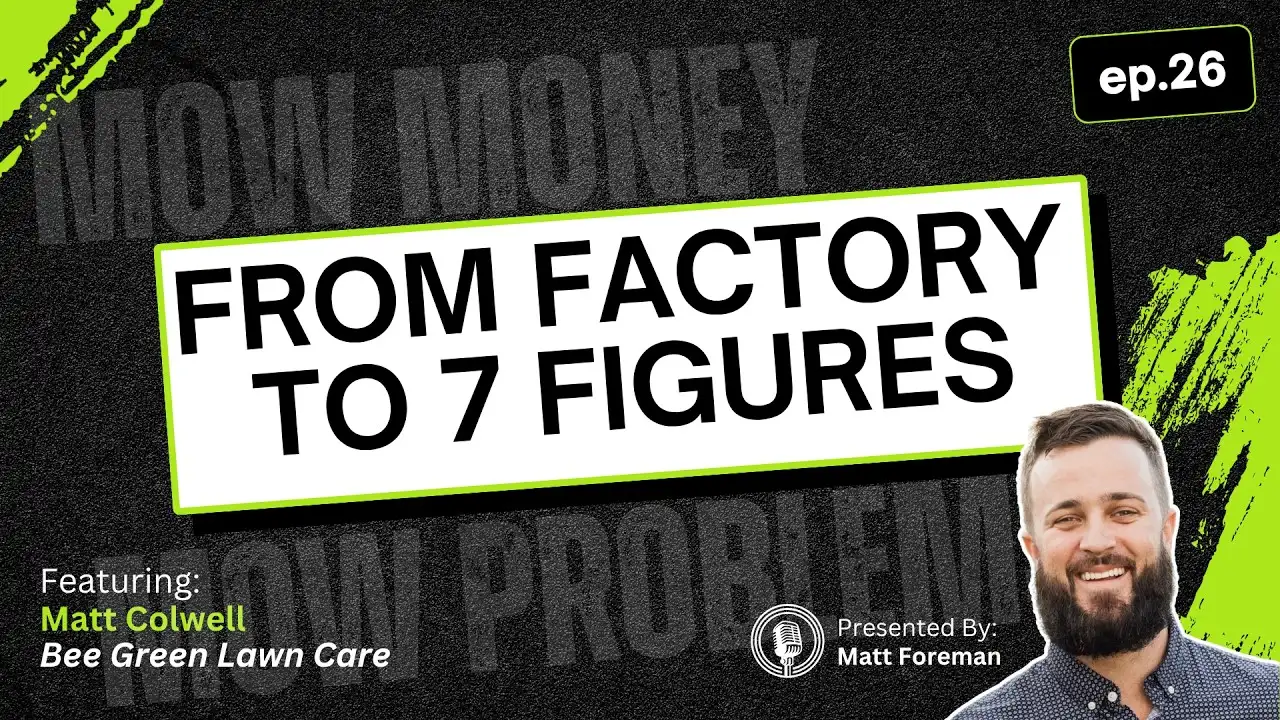
Matt Colwell runs Bee Green Lawn Care & Pest Control out of Carmel, IN, just north of Indianapolis, offering lawn care, tree and shrub treatments, and pest control across the Indianapolis, IN metro area. On episode 26 of the Mow Money, Mow Problems podcast, he walked through how he moved from a landscaping and hardscape contracting business into lawn care, and what actually keeps a seasonal, recurring-service business healthy once the phones are ringing.
His answer centers on two things: who you let on the team, and how plainly you treat every client. Hire for character over resume, price every service a client might need instead of just the one they called about, and tell people the truth about what a lawn actually needs, even when it is not the answer they want to hear.
Key takeaways
- Hire for character, not resume. Matt would rather bring on someone who has worked through a real setback and is turning their life around than someone with a clean history and no heart for the work.
- Retention follows honesty, not promotions. Bee Green's retention runs around 98%, and Matt's view is that clients who leave over cost mostly come back once they compare service elsewhere.
- Treat organic as a hybrid, not a pitch. About 20 to 25% of Bee Green's clients choose organic lawn care, and the company doesn't push either direction; the real strategy is a dense enough turf that weeds barely get a foothold.
- Quote every service on every call. A client who calls for one estimate, say pest control, gets priced for lawn care, tree and shrub, and pre-emergent too, a la carte, so they know everything the company offers before they decide.
How did a hardscape contractor end up running a lawn care company?
A labor problem, not a business plan, forced the move. Before Bee Green, Matt ran a landscaping and hardscape contracting business building retaining walls, drainage systems and paver patios for builders and HOA communities. The work was steady, but keeping the business staffed got harder every year: skilled crew members retired, moved out of state, or left to start their own companies, and replacing that many experienced hands became the real threat to the business.
The turning point came through a referral relationship. Matt had been subbing and referring lawn care work to a friend who ran a lawn care company. When that friend eventually sold the business, Matt realized he was handing away work he could be doing himself. Over the following off-season he studied agronomics and horticulture through courses at Purdue University and earned Indiana's state licenses in lawn care, tree and shrub, and pest control, then launched the new division the following spring.
Should a lawn care company offer organic treatments?
Treat it as a hybrid program, not an either-or pitch. Matt is upfront that there is no organic product that kills weeds selectively the way a traditional herbicide does. So Bee Green's organic approach is really a turf strategy: "we want to build a thick dense turf so that you don't have weeds," thick enough that the crew can spot-treat the few weeds that do show up instead of spraying an entire yard.
Bee Green offers soil conditioners and amendments under either program and lets the client choose, without pushing a direction. Usage has stayed fairly steady at about 20 to 25% of clients on organic, and some clients move back and forth between programs within the same season depending on how the lawn looks. Matt is skeptical of suppliers who price organic products at a premium simply because the word "organic" is on the label; he tests new products on his own properties before recommending them, and products that do not perform get dropped regardless of what they are marketed as containing.
How do you quote lawn care, tree and shrub, and pest control without underselling yourself?
Price every service you offer, every time someone calls about one. At Bee Green, a call about any single service turns into a quote for all of them. If a prospect calls asking about pest control, the office also prices lawn care, tree and shrub, and pre-emergent: "everything that we do, you get a price for it."
Matt's reasoning is simple: clients routinely tell his office they didn't realize the company did other things. Services stay a la carte rather than bundled into set packages or tiers, so a client picks exactly what their property needs, but they can't pick what they don't know exists. Pricing every service on every call is how Bee Green raises what a given client spends with the company over time, without selling anything the client didn't ask to hear about.
What actually drives client retention in a lawn care business?
Quality work and straight talk, not discounts. Matt describes Bee Green's retention as "we're like 98% retention," and his process when someone does cancel starts with a phone call to find out why; in his experience, it's almost always about cost. He'll acknowledge the trade-off honestly rather than talk down a competitor, but he does tell departing clients that "about 90% of people that leave us come back to us," usually after they discover the calls don't get returned and the lawn doesn't look the same somewhere cheaper. As he puts it, with lawn care, "you get what you pay for, if you will."
Matt is just as direct about expectations going in. New clients hear upfront that results take time: "we don't sell magic." A lawn's condition built up over years, and in his words, people living in "a microwave society" sometimes need a program that works more like a slow cooker. Office staff and crew members take the time to talk with clients in person rather than rushing to the next stop, which Matt treats as part of the service, not an interruption to it.
How do you budget for a lawn care business's slow season?
Start planning for winter on day one of the season, not in the fall. Bee Green typically starts treating lawns in early March and budgets for winter from that very first week: every new piece of equipment and its payment gets weighed against what the company needs to set aside for the months with little to no income, roughly December through February.
Bee Green is only in its second year of sending prepay letters again in January, after having stopped doing them for a while. Matt isn't a fan of the mechanics: a prepay discount of 3 to 4%, plus a 3 to 4% card-processing fee on top when clients pay by credit card, works out to a combined 7 to 8% cut off the top before the season has even started, on margins he says are already thin. Hourly field crew work is scaled back in the off months, but office staff stay salaried, and Matt says he pays himself the same amount year-round rather than drawing less in the winter.
How do you keep company culture and quality as the business grows?
Hire for character first, then let people do the job their own way. Matt says experience can be taught, but character can't: "if you're not a good person, I really don't want a whole lot to deal with you." That means he's open to candidates who have been through real setbacks in their past, as long as they're turning things around and want a place where the work is appreciated.
The bigger lesson, looking back over his time running crews, is about letting go. Matt used to insist a job be done exactly his way, down to which direction an edger moved. Looking back, his advice to himself would be: "Let people around you do what you hired them to do." Now, when something goes wrong in the field, he wants his team to come to him with solutions they've already tried rather than just the problem, so the company runs on more judgment than just his own.
What does industry consolidation mean for an independent lawn care company?
When a local company sells to a larger group, service often gets worse, and that's where independents win the client back. Private equity and franchise consolidation are reshaping home-service trades broadly, not just lawn care, and Matt gets unsolicited calls from firms interested in buying Bee Green. His take is that a sale or a franchise rollup doesn't guarantee a worse experience for the client, but it often changes who actually answers the phone.
| What changes | Independent, locally run | After being bought and folded into a larger group, as Matt described it |
|---|---|---|
| Who answers the phone | Local office staff who know the property | An out-of-state call center, in Matt's example, Arizona |
| Getting a service issue handled | Direct to the owner or a known manager | A service ticket gets created, then filtered down to a local manager |
| Where the client often ends up | Stays with the independent they already trust | Calls Matt's company once service slips |
Matt has also been on the other side of that decision. He turned down a mosquito control franchise years ago after learning the franchisor had no real stake in which products or methods he used: "I don't care what you use." That told him the incentives weren't aligned, so he stayed independent rather than pay into a system that wasn't going to help him improve. He says he would consider acquiring smaller companies himself, mainly from owners ready to retire, "I would absolutely purchase my company today," he said of the kind of fit he looks for, where the books and the client relationships are sound.
The operator takeaway
Matt Colwell's story is a reminder that a seasonal, recurring-service business is won on the basics: hire people with character and let them own their part of the job, price every service a client might need rather than just the one they called about, tell clients the truth about timelines, and plan for the slow months before they arrive. None of that requires scale or outside capital, just discipline applied every season.
Want clients to know every service you offer?
We build the marketing system that helps lawn care companies get found for every service they provide: a website that converts, local SEO, reviews and follow-up that keeps clients coming back.
Want this done for you? See our lawn care marketing.
Frequently asked questions
Does Bee Green Lawn Care offer organic lawn care?
Yes, as a hybrid alongside its traditional program. About 20 to 25% of clients choose organic, and the company's organic strategy focuses on building a dense enough turf that weeds rarely take hold, since no organic product kills weeds selectively the way a traditional herbicide does.
How does Bee Green Lawn Care keep client retention so high?
Owner Matt Colwell credits consistent quality work and honest communication. Retention runs around 98%, and when a client does cancel, usually over cost, he follows up directly because he finds most of those clients return once they compare service elsewhere.
Why does Bee Green Lawn Care price every service on a single call?
Because clients often don't realize the company offers lawn care, tree and shrub, and pest control together. Pricing all of them on every call, a la carte rather than in set packages, lets a client choose what fits their property instead of missing out on a service they never knew existed.
How does Matt Colwell view private equity buying up lawn care companies?
He sees it reshaping home services broadly and says a sale or franchise rollup doesn't automatically mean worse service, but it often changes who answers the phone, sometimes to an out-of-state call center. He has turned down a franchise opportunity himself and says he'd consider buying smaller companies when the fit is right.