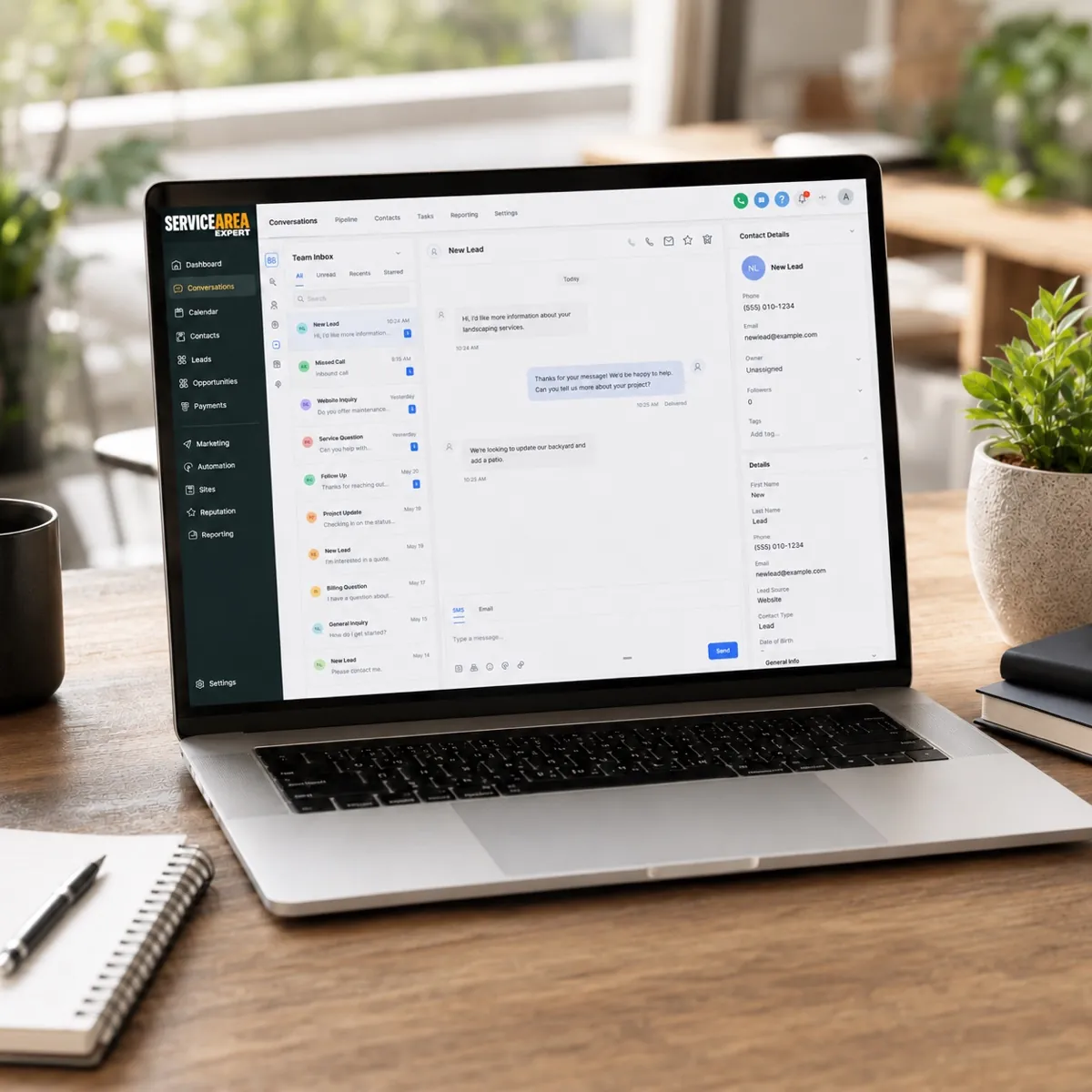
Five focused hours each week can keep proof, reviews, follow-up, content, and measurement moving without turning marketing into another full-time job.
Quick answer: the five hours that matter
A landscaping business can keep marketing moving with five focused hours each week: 60 minutes capturing jobsite proof, 45 minutes requesting and responding to reviews, 60 minutes following up with open leads, 75 minutes publishing and repurposing content, and 60 minutes reviewing the scorecard and planning next week's priorities.
This is not a magic schedule. It is a floor. It gives busy owners a realistic weekly rhythm for the work that too often gets ignored until the phone slows down.
Marketing gets easier when it becomes a route, not a rescue mission.
Before the timer starts: pick the scoreboard
If the five hours are spent chasing likes, random posts, and vague brand awareness, the system will feel busy and still underperform. Start by deciding what the week is supposed to improve.
For most lawn and landscape companies, the scoreboard is qualified pipeline: calls, estimate requests, booked appointments, proposal follow-up, sold jobs, and review growth. That keeps the work tied to revenue instead of noise.
Track these every week
- Qualified calls and forms by source.
- Booked estimates and no-shows.
- Open proposals that need follow-up.
- Reviews requested, reviews received, and reviews answered.
- Photos and videos captured from active jobs.
- Content published to the website, Google Business Profile, email, and social channels.
- Sold work by service, source, and service area.
If those numbers are not visible, start with a simple CRM and follow-up system. You cannot improve what nobody is tracking.
Hour 1: capture proof from the field
Landscaping companies are surrounded by marketable proof every day: clean edges, finished patios, drainage fixes, seasonal color, mulch installs, crews in uniform, tidy trucks, happy clients, and properties that look better than they did that morning.
The mistake is waiting for a perfect project. Capture the normal work. Buyers want to see whether the company is real, competent, consistent, and proud of the details.
Use a simple capture list
- Three before photos.
- Three after photos.
- One 20-second walkthrough video.
- One crew/process clip.
- One detail shot: edging, joints, plant material, lighting, drainage, cleanup, or finish quality.
- One quick note: service, city, problem solved, and result.
YouTube's official guidance for creating Shorts makes short-form capture accessible from the mobile app, and Shorts can now run up to three minutes according to Google's three-minute Shorts guidance. For landscapers, that means a jobsite walkthrough does not need a production crew. It needs a phone and a repeatable habit.
For a deeper field-content system, use the video marketing playbook for lawn and garden services.
45 minutes: request and respond to reviews
Reviews are not a side quest. They influence trust, close rate, map-pack performance, and how confidently buyers move from research to inquiry.
Google's review tips for Business Profiles recommend reminding customers to leave reviews and replying to reviews. Google also provides a way to create a review request link or QR code, which removes friction when the job is complete.
Weekly review workflow
- Pull completed jobs from the past week.
- Send review requests to satisfied clients while the work is fresh.
- Personalize the request with the service and project detail.
- Reply to new positive reviews with specifics.
- Flag reviews only when they violate policy, not because they are inconvenient.
- Save strong review quotes for service pages, ads, proposals, and follow-up emails.
Google's review management guidance notes that verified businesses can reply to reviews on their Business Profile. Do it. A thoughtful response shows future buyers that someone is paying attention.
Hour 3: follow up with open leads and proposals
Most landscaping companies do not have a lead problem as often as they have a follow-up problem. Someone asks about a patio, drainage issue, maintenance contract, or seasonal cleanup. The first conversation happens. Then the lead drifts because the team is busy.
This hour is for pipeline recovery. Open the CRM, call the warmest opportunities, send useful follow-up, and move every lead to a clear next status.
Follow-up blocks to run weekly
- New leads: confirm they got a response and have a next step.
- Open estimates: answer questions, add proof, and ask for a decision timeline.
- Stale opportunities: send a helpful seasonal or project-specific check-in.
- Past clients: identify upsells, recurring work, reviews, referrals, and seasonal reminders.
- Bad-fit leads: close them out or redirect them so they stop cluttering the pipeline.
Use lead follow-up to deliver value, not just "checking in." Send a relevant project photo, a maintenance tip, a timeline reminder, a financing note, or a service page that answers the buyer's actual question.
Hours 4 and 5: publish and repurpose useful content
Content does not need to start from a blank page every week. The jobsite proof from hour one should become the raw material for website updates, Google Business Profile posts, social posts, short videos, email snippets, sales follow-up, and FAQs.
Google's guidance on helpful, reliable, people-first content is the right standard: create content that helps people, uses real expertise, and is not made only to manipulate rankings.
A weekly content repurposing stack
- One Google Business Profile update with a project photo and service area.
- One short video for YouTube Shorts, Instagram Reels, Facebook, or TikTok.
- One website update: project gallery, service page proof, FAQ, or blog section.
- One email or CRM snippet for open leads and past clients.
- Three social captions pulled from the same project story.
- One internal note: what objections or questions came up this week?
Google's Search Essentials also points back to using words people search with, crawlable links, and helpful content. For a landscape company, that means plain service language, local context, project details, and useful answers. Not keyword confetti.
For structure, pair this with the lawn care blogging and guest posting guide and the social media strategy playbook.
The 60-minute Friday scorecard
The last hour keeps the system honest. Without measurement, the weekly routine can turn into a content treadmill. A quick scorecard shows what produced conversations, what helped close work, and what should be fixed next.
Google Analytics lets teams create and modify events to measure actions that matter, and Google's key event documentation explains how important actions can be used consistently across Analytics and Ads. That matters because landscaping teams need to measure estimate requests, calls, booked consultations, and other real buying signals.
Friday scorecard questions
- Which leads came in this week, and from where?
- Which service pages or campaigns assisted the best opportunities?
- Which open estimates need one more proof point?
- Which reviews or photos should be added to the website?
- Which service area or service type produced the best fit?
- What is the one marketing task that must happen next week?
Keep the scorecard short. If it becomes a spreadsheet museum, nobody will use it when the season gets busy.
A sample weekly schedule
Monday: 30 minutes
Review new leads, open estimates, and the week's active jobs. Pick the projects worth documenting.
Tuesday: 60 minutes
Capture field photos and short videos. Ask crews or project managers to send proof before they leave the site.
Wednesday: 75 minutes
Send review requests, reply to new reviews, and update the best open proposals with relevant proof.
Thursday: 95 minutes
Publish or schedule content across the website, Google Business Profile, email, and social channels.
Friday: 40 minutes
Review results, clean the CRM, assign next week's priorities, and close the loop on any stuck leads.
When five hours is not enough
Five hours a week is a strong baseline for an owner-led or small-team marketing rhythm. It is not a replacement for a full growth system when the business is ready to scale.
If the company needs stronger SEO, better Google Ads, a rebuilt website, CRM automation, reputation management, creative, or reporting, the owner should not be duct-taping everything together at 10 p.m. forever. That is where a partner makes sense.
Outsource when
- The weekly rhythm keeps getting skipped.
- Lead quality is unclear or declining.
- The website does not convert paid or organic traffic.
- The business needs route density or higher-ticket project demand.
- Reporting cannot connect marketing work to booked estimates and sold jobs.
- The owner's time is worth more in sales, hiring, operations, or client relationships.
The five-hour system still matters after outsourcing. It gives the agency or internal marketer better raw material: proof, feedback, photos, sales context, and operational truth.
Bottom line
The five-hour weekly marketing blueprint works because it focuses on the activities that compound: proof, reviews, follow-up, content, and measurement. It is simple enough to repeat and practical enough to survive a busy season.
Do it every week for 90 days. The work will not feel flashy. Good. Flashy is usually where marketing goes to get expensive.
Want the weekly marketing work handled without babysitting it?
We can review your website, lead follow-up, content, reviews, ads, CRM, and reporting, then show what should be fixed first.
Want this done for you? See our CRM & automation service.
Frequently asked questions
What is the 5-hour weekly marketing blueprint for landscapers?
It is a simple weekly operating rhythm for landscaping companies: capture proof from the field, request and respond to reviews, follow up with open leads, publish or repurpose useful content, and review performance so the next week gets sharper.
Can five hours a week really improve landscaping marketing?
Five focused hours can make a difference when the work is consistent and tied to qualified leads. The point is not to replace a full marketing department; it is to stop neglecting the highest-leverage activities that compound over time.
What should a landscaping business do first each week?
Start by capturing proof from current jobs and organizing lead follow-up. Fresh project photos, short videos, review requests, and open estimate follow-up usually create faster business impact than brainstorming another big campaign.
How should landscapers track weekly marketing work?
Track qualified calls, estimate requests, booked estimates, reviews requested, reviews received, content published, lead source, service requested, and sold work. A CRM or simple weekly scorecard keeps the system honest.
When should a landscaping company outsource marketing?
Outsource when the owner or team cannot consistently execute the weekly system, when growth requires stronger SEO, ads, website, creative, CRM, or reporting, or when the opportunity cost of doing it manually becomes too high.