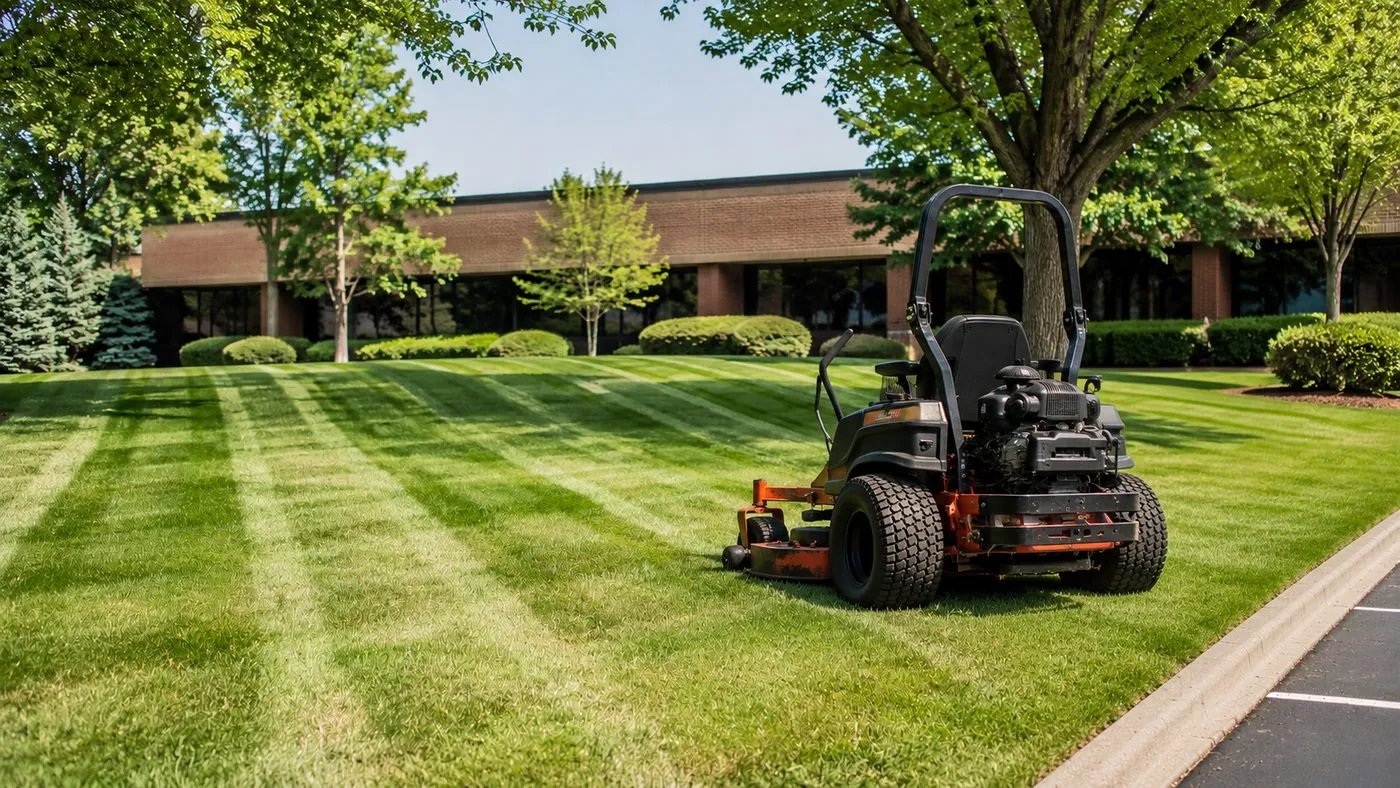
Every neighborhood has one: the guy with a pickup and a push mower who knocks on doors offering to cut grass for cash.
If you run a real landscaping company, the question is not how to match his price. It is how to make homeowners see you as the obvious professional instead.
Key takeaways
- Professional landscaping companies do not compete on price, they win on presence.
- A claimed and optimized Google Business Profile drives local search and controls your first impression.
- Flyers dropped around an active job site turn work you are already doing into new business nearby.
- A clear, mobile-friendly website proves credibility to everyone who finds you.
- Run all three consistently and recognition compounds into premium pricing and referrals.
Why do informal competitors create a real problem?
There is nothing wrong with starting small. But once you have built a serious operation, those informal competitors create a real problem: they undercut your pricing and muddy the difference between a pro and a side hustle.
The answer is not to drop your rates or talk down the competition. Instead, the companies that win focus on three moves that clearly communicate professionalism, reliability, and local presence.
None of them require a big budget. What they require is consistent execution and attention to detail, the same things that separate professional work in the field.
Professional landscaping companies do not compete on price. They win on presence. Three moves can make you the obvious choice over every guy with a truck in your market.
Move 1: Have you claimed and optimized your Google Business Profile?
Your Google Business Profile is your digital storefront, and it is often the very first impression a customer has of your business.
Yet plenty of established landscaping companies have either never claimed their profile or are sitting on a thin, half-finished listing that makes them look smaller than they are.
Claim your digital real estate
The first step is claiming the profile if you have not already. It is free, and it controls how your business shows up in Google Search and Google Maps when people look for landscaping in your area.
Without a claimed, accurate listing, you can appear with missing photos, wrong information, and no way to respond to reviews. That looks unprofessional, and it pushes customers toward whoever did invest the time.
The elements that actually matter
A strong profile includes:
- Complete business information written in the plain language customers use when they search
- Professional photos, since landscaping is visual
- Before-and-after shots of finished projects
- Images of your crew and equipment that show scope and quality
- Regular posts and active review management
Win the local search
Google Business Profiles drive local rankings, especially for searches like "landscaping near me" or "lawn care." A complete profile with good reviews and steady updates tells Google your business is active, legitimate, and relevant nearby.
That visibility is exactly where you pull ahead of informal competitors, who almost never invest in being found online. Strengthening it is the core of local SEO.
Move 2: Are you marketing the neighborhoods you already work in?
Digital marketing is essential, but do not overlook targeted physical marketing in the neighborhoods where your crews are already on the ground.
Distributing flyers around an active job site turns the work you are already doing into new business in a tight geographic area.
The psychology of local presence
When neighbors see professional landscaping work happening on their street, it sparks natural curiosity about who is doing it.
That is the moment to introduce yourself to nearby homeowners who are already watching your professionalism firsthand. A flyer dropped during an active job carries far more credibility than random door knocking, because the recipient can look down the street and see your work for themselves.
Timing and execution
The key is timing. Hand out flyers while you are actively working in the area, when your equipment, crew, and finished results are all visible.
Focus on the immediate neighbors who can see your current project. They are the most likely to be influenced by watching the work in progress, and that project often surfaces landscaping needs they had been putting off.
Professional presentation
Your flyer should reflect the same standard as your work. Use clean design, high-quality photos of completed projects, clear service descriptions, contact information, and any relevant licensing or insurance details.
The quality of your marketing materials tells homeowners what to expect from your crews. Give them one clear reason to act now, such as a free consultation, so the flyer prompts a call instead of getting filed away.
Move 3: Does your website actually do its job?
Your website is where every other marketing effort converges. Whether someone finds you through Google, social media, a referral, or one of your neighborhood flyers, they will usually visit your website before they reach out.
That makes it one of the clearest dividing lines between a professional operation and a casual one.
Answer the three questions fast
Your site has to answer three things immediately: who you are, what you do, and where you work. None of that should require hunting through pages or fighting confusing navigation.
Detailed service descriptions, service-area information, company background, team introductions, and obvious contact methods set you apart from competitors who rely only on a phone number or a social media inbox.
Show the work
Landscaping is visual, so let high-quality project photos carry the load. Organize a portfolio by service type and include before-and-after comparisons that show the transformation you create.
Professional photography communicates quality in a way text never can, and it helps homeowners picture the same result on their own property, which makes your pricing easier to justify next to a bargain operator.
Build trust and make it work on a phone
Add the elements that establish credibility: customer reviews, certifications, insurance information, and years in business. Team profiles, company history, and community involvement help homeowners feel comfortable inviting you onto their property.
Most homeowners will find you on their phone, so your site has to load fast and display cleanly on mobile. Make it easy to reach you with multiple contact options such as a phone number, a contact form, and online scheduling. A purpose-built website ties all of this together.
How do the three moves compound together?
These moves work together. Your Google Business Profile drives local search visibility, your website proves credibility, and your neighborhood marketing turns visible job sites into concentrated local awareness.
Run all three consistently and recognition builds over time. As more neighbors see your flyers, find you online, and land on a professional website, you become the recognized landscaping company in your service area instead of just another option.
That recognition is what earns premium pricing, customer loyalty, and referrals, and it is exactly what informal competitors cannot replicate. When a homeowner searches, they find your optimized profile and real website, not the guy who never built any online presence at all.
Where to start
| Order | Move | Why start here |
|---|---|---|
| 1 | Google Business Profile | Free and pays off in local search almost immediately |
| 2 | Neighborhood flyers | Turns every active job site into local awareness |
| 3 | Website | The hub that reflects the quality of your work |
The industry will always have informal competitors selling on price. But homeowners who value quality and reliability choose the businesses that look the part, and these three moves are how you become that business. If you want help executing them, book a strategy call.
Make your company the obvious professional choice
If you are tired of competing with every guy with a truck, let us look at how your business shows up: your Google Business Profile, your local presence, and the website homeowners land on before they call. On a quick call we will show you where the gaps are.
Want this done for you? See our landscaping marketing page.
Frequently asked questions
How do I compete with cheaper, informal landscapers?
Do not match their price or talk them down. Compete on presence and proof. A claimed Google Business Profile, professional marketing in the neighborhoods you already work in, and a clear website make you the obvious professional choice, so the comparison stops being about price.
Why does a Google Business Profile matter for a landscaping company?
It is often the first impression a customer has of your business, and it drives local search visibility for searches like "landscaping near me." A complete profile with photos, accurate information, and active reviews makes you look established, while an unclaimed or thin listing pushes customers toward competitors.
Does neighborhood flyer marketing still work?
Yes, when it is tied to a visible job site. Neighbors who can see your crew, equipment, and finished work in person are far more receptive than they would be to random door knocking, because the flyer reinforces proof they have already seen.
What does my landscaping website actually need to do?
It should immediately answer who you are, what services you offer, and where you work, then back it up with project photos, trust signals like reviews and insurance, and an easy way to make contact. It also has to load and work well on a phone, since that is where most people will find you.