A patio and outdoor kitchen is not a same-week sale. The lead who filled out your form on a Tuesday night is also pricing a kitchen remodel, a vacation, and two other bids, and most of what gets written about design-build sales covers one piece of that process (a proposal template, a 3D render, a CRM workflow) without ever connecting the pieces into one process a crew can actually run.
This article puts the whole arc in one place: how to qualify a lead before you drive out, what a buyer needs to see at the design presentation, how to structure a deposit that is both fair to you and legal where you work, whether financing is worth offering, and the follow-up cadence that keeps a six-figure proposal from going cold. The specifics below come from a working hardscape contractor's published process, a landscaping marketing company's CRM workflow, a state contractor licensing board, and the two financing platforms contractors actually use, read directly off their own pages on October 13, 2026.
Key takeaways
- A design-build sale commonly runs weeks between the first call and a signed contract, so the process has to survive silence instead of forcing a same-week close.
- Qualifying by phone or message, with a price range built from photos and square footage, before you schedule a site visit keeps in-person consultations for leads with a real shot at closing.
- Some states cap what you can legally collect as a down payment. California limits it to $1,000 or 10 percent of the contract price, whichever is less, so check your own state's contractor licensing board before you finalize a payment schedule.
- Financing platforms such as Wisetack and Hearth now plug into the CRMs contractors already use and turn a $45,000 project into a monthly payment inside the sales conversation.
What does a design-build sales process actually look like end to end?
Six stages: qualify the lead, run the site visit, present the design, send a proposal with financing attached, collect a legal deposit, and follow up until it is signed or dead.
Most guides to this trade cover one of those stages well and skip the rest. A CRM vendor writes about the proposal. A design software vendor writes about the render. Nobody connects qualify to close, so contractors end up running a process that is strong in one spot and leaking leads everywhere else.
It helps to remember why the process has to be this deliberate. In joint research from the National Association of Landscape Professionals and the National Association of Realtors on outdoor remodeling, homeowners reported a typical Joy Score of 9.7 out of 10, and 37% hired a professional for the entire job. Their top reasons for starting: 35% wanted to add features and improve livability, 24% wanted to replace worn-out surfaces, and 18% said it was time for a change. Those are emotional, discretionary reasons, not emergencies, which is why a buyer can sit on a $45,000 decision for weeks without saying no.
A design-build project can run several weeks between the first call and a signed contract, and additional weeks before a crew ever breaks ground. A sales process built for a same-week close will quietly lose most of those leads to silence. The sections below walk each stage in order.
How do you qualify a design-build lead before you drive out for a consultation?
Confirm scope and budget in writing first, then earn the in-person visit.
Michael Pletz, a hardscape contractor whose consultation process is profiled on How to Hardscape, keeps his intake form short on purpose: name, city, budget, a short project description, and photos. Nothing more, because every extra field is a reason someone abandons the form.
From there, the lead gets prequalified before anyone schedules a truck. The team confirms scope by phone or message, reviews the photos, gives a price range built from those photos and an approximate square footage, and asks directly whether an in-person consultation makes sense. That reply can be a single template: photos, square footage, a range, and a yes-or-no question. Lead source gets tracked for 30 days so the owner knows which channel is actually producing jobs, not just form fills.
The effect is that every site visit on the calendar already has a realistic budget match. A homeowner expecting a $15,000 patio never gets a visit built around a $45,000 design-build scope, and the crew's limited consultation hours go to leads with a real shot at closing. This is the kind of structured intake a CRM handles automatically once it is set up, which is the same discipline behind CRM and lead follow-up automation for green-industry companies.
What does the buyer need to see at the site visit and design presentation?
A guided walk from the big idea to the specifics, not a stack of material samples dropped on the table.
At the site visit itself, confirm the layout, walk the realistic product families for the budget, point out site issues like drainage or access before they become change orders, and give placeholder pricing so the homeowner has a ballpark before the full proposal arrives.
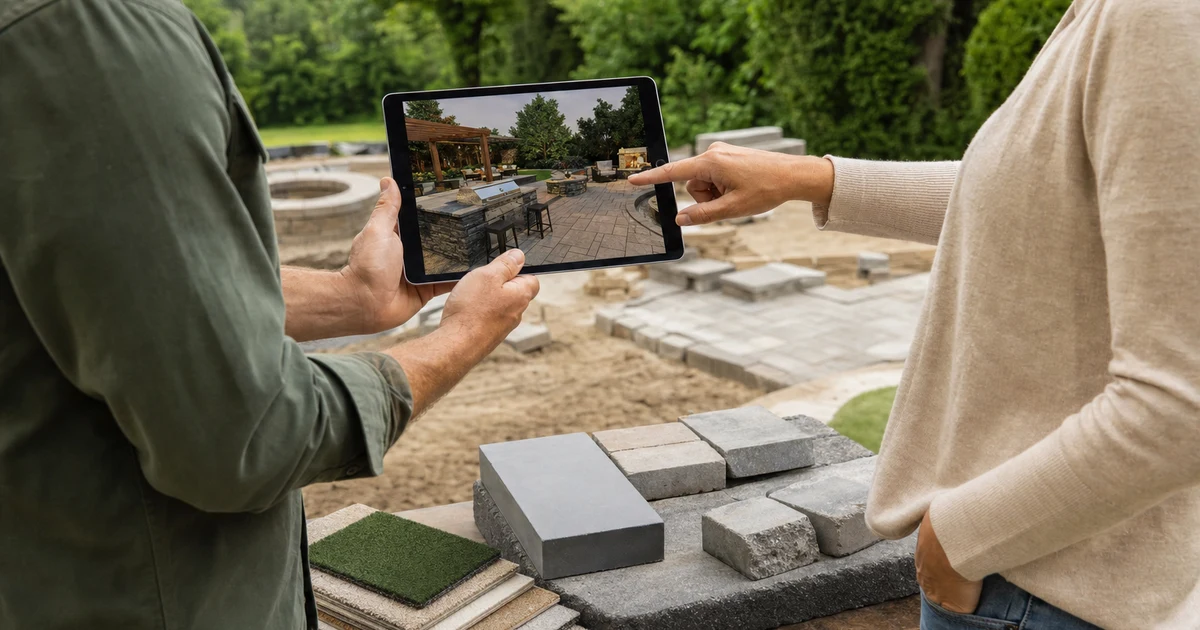
Structure Studios, a design software vendor that works with contractors on how they present, publishes seven presentation habits worth borrowing regardless of which software you use. Prepare the day before and confirm the appointment, and make sure both decision-makers are in the room, since a spouse who is absent from the presentation is the hardest objection to overcome later. Start the walkthrough from an indoor vantage point in 3D, showing the view a homeowner will actually have from their kitchen window, before moving outside to the details. Lead with a conceptual plan rather than a finished board of material choices. Letting the homeowner choose some materials themselves builds ownership that a fully decided design never creates. A reduced plan on a $10 foam board, or a tablet loaded with past project photos, works as well as expensive presentation equipment. For a homeowner who cannot read a 2D plan, converting it to 3D, and adding their own furniture, vehicle, or pets to the render, turns an abstraction into their actual backyard.
Those renders do not stop working after the sale. Paired with a photo of the finished build, they become the project gallery that shortens the next buyer's decision, on your website, your Google Business Profile, and your service pages. We cover what to do with that proof in more detail in our guide to hardscape design software.
How should you structure the deposit and payment schedule?
Enough up front to secure the job, then payments tied to completed work, and the ceiling is often set by state law, not by you.
Pletz's published structure uses roughly a 10% deposit on signing, progress draws through the build, and a final holdback of roughly 15% retained until the job is complete, with production planned around a fixed number of recovery days a week so the schedule does not drift. The logic: enough committed to secure the crew's time, nothing collected for work or materials that have not actually shown up yet.
That last point is not just good practice in some states, it is the law. California's Contractors State License Board reminded contractors in a November 22, 2022 industry bulletin that under Business and Professions Code sections 7159 and 7159.5, a home improvement down payment cannot exceed $1,000 or 10% of the contract price, whichever is less, and every subsequent progress payment is capped at the value of materials and work actually completed at that point. The contract itself must carry specific boldface language disclosing the cap. Collecting payment for work not yet done is a misdemeanor there. Deposit limits and required disclosures vary by state, so confirm the rule with your own state's contractor licensing board before you print a payment schedule, especially if you work across state lines.
Should you offer financing, and does it change the sale?
Financing turns a project a homeowner might shelve into a monthly payment they can say yes to in the room, and two platforms now serve this trade directly.
Wisetack, read directly off its own site on October 13, 2026, lists landscaping among the home-service trades it serves, alongside fencing, roofing, and tree services. It charges no prepaid finance charges or participation fees to the consumer, offers terms from 3 to 120 months with APRs from 0% to 35.9% based on the buyer's creditworthiness, and integrates with the CRMs contractors already run, including Jobber, Housecall Pro, JobNimbus, and BuilderPrime.
Hearth, also read directly off its own site the same day, lists landscaping as a served industry alongside decks, fencing, and pools. It offers customer financing and personal loans through its lending partners, with no per-loan dealer fees charged to the contractor, across three tiers (Hearth Pro, a Pro plan with added AI features, and an Enterprise plan with a dedicated account manager). Both platforms gate their actual pricing behind a sales conversation, so get the full cost structure in writing before you commit to either one.
The sales value is less about the platform and more about the moment: showing a monthly payment next to the cash price during the design presentation, not after, keeps the conversation moving instead of stalling on a five-figure number.
What follow-up cadence actually keeps a six-figure proposal from going cold?
Automated, staged touches that outlast the homeowner's attention span, not a single "just checking in" email.
Landscape Leadership, a landscaping marketing company, documents a CRM-driven workflow built on HubSpot that is worth copying regardless of which CRM you run. After the consultation, an automated, service-specific email sequence with branching logic and custom delays keeps the prospect engaged with relevant case studies and reviews while they compare bids. The proposal itself is a customized digital document, auto-filled from CRM data, with embedded video and case studies rather than a flat PDF. For larger design-build jobs, the presentation gets scheduled through a calendar link paired with an email that lists exactly who should attend and what they should bring. After the presentation, tasks get created automatically to revise and resend the proposal and to answer any questions that came up. Unsigned proposals trigger an automated reminder on a fixed cycle, commonly every 10 days, and the team gets notified the moment a proposal is signed so production can start without a manual handoff.
None of that requires a specific platform. It requires deciding the cadence in advance and letting automation run it, which is what CRM and automation built for this trade is actually for: every lead captured once and followed up automatically instead of depending on someone remembering to call back.
A worked example: a $45,000 patio and outdoor kitchen, start to signature
Here is how that arc looks on a specific job. The numbers are an illustration built from the practices above, not a universal formula.
- Day 1: A lead lands through the website form: name, city, a $35,000 to $55,000 budget range, "backyard patio and outdoor kitchen," and six photos of the yard.
- Day 1, same day: A reply goes out with a price range built from the photos and an estimated square footage, plus a direct question: does a 10-minute call make sense this week?
- Day 3: A phone call confirms scope, access, and timeline. A welcome packet (company overview, install methods, past projects) goes out by email.
- Week 1: Site visit. The contractor measures, walks paver and built-in grill options, flags a drainage issue near the proposed grade, and gives placeholder pricing.
- Week 2: Design presentation. The 3D render opens from an indoor vantage point before moving outside. Both spouses attend. They are shown two material directions, not a finished board, and choose one together.
- Week 2, after: A proposal goes out through the CRM with a fixed scope of work, an embedded project video, and an estimated monthly payment through a financing partner shown next to the cash price.
- Day 10 after the proposal: An automated reminder fires because the proposal is still unsigned.
- Week 5: The contract is signed. A $4,500 deposit (10% of $45,000) is collected per the written payment schedule, with the remaining payments tied to materials delivered and work completed. The production calendar is communicated and the crew is booked for the following month.
Five weeks from first contact to signature, with two scheduled touches (the site visit and the presentation) and the rest handled by templates and automation. That is the pace a design-build sale actually runs at, and it is why a process built to survive five weeks of mostly silence outperforms one built for a same-week close.
Fill the top of this process with the right leads
A strong sales process still needs leads worth running it on. We build the search presence, ads, and follow-up systems that put design-build homeowners in front of your team in the first place, so the qualifying, the presentation, and the follow-up cadence above have something to work with.
Want this done for you? See our outdoor living Google Ads service.
Frequently asked questions
How long does a design-build sales process usually take?
Plan for weeks, not days, between the first call and a signed contract, and more weeks or months after that before the crew is on site, since material lead times and scheduling sit on top of the sales cycle. A process built around automated follow-up survives that gap. One built for a same-week close quietly loses leads to silence.
How much of a deposit can I legally collect?
It depends on your state, so check your own contractor licensing board before you set a number. California caps a home improvement down payment at $1,000 or 10% of the contract price, whichever is less, with required contract disclosures, under Business and Professions Code sections 7159 and 7159.5. Other states set their own limits.
Is financing worth offering on a design-build project?
It is worth evaluating, because it turns a five-figure number into a monthly payment the homeowner can agree to in the room instead of going home to think it over. Platforms like Wisetack and Hearth both list landscaping as a served trade and integrate with CRMs contractors already use, but get the full fee structure from either one before you commit, since neither publishes complete pricing without a sales conversation.
Should I charge for the design, or is it part of the sales process?
Practice varies across the trade. Some contractors give a placeholder price and a conceptual design for free to earn the proposal, then charge for a full detailed plan if the homeowner wants one before signing. Either way, the render should never be a one-time expense. Paired with a photo of the finished build, it becomes proof that helps close the next sale.
What is the single biggest reason a design-build proposal goes cold?
Silence after the presentation. A homeowner comparing bids and a kitchen remodel will not chase you down. An automated reminder cycle on unsigned proposals, commonly every 10 days, combined with a notification the moment one is signed, keeps the deal moving without relying on someone remembering to follow up.