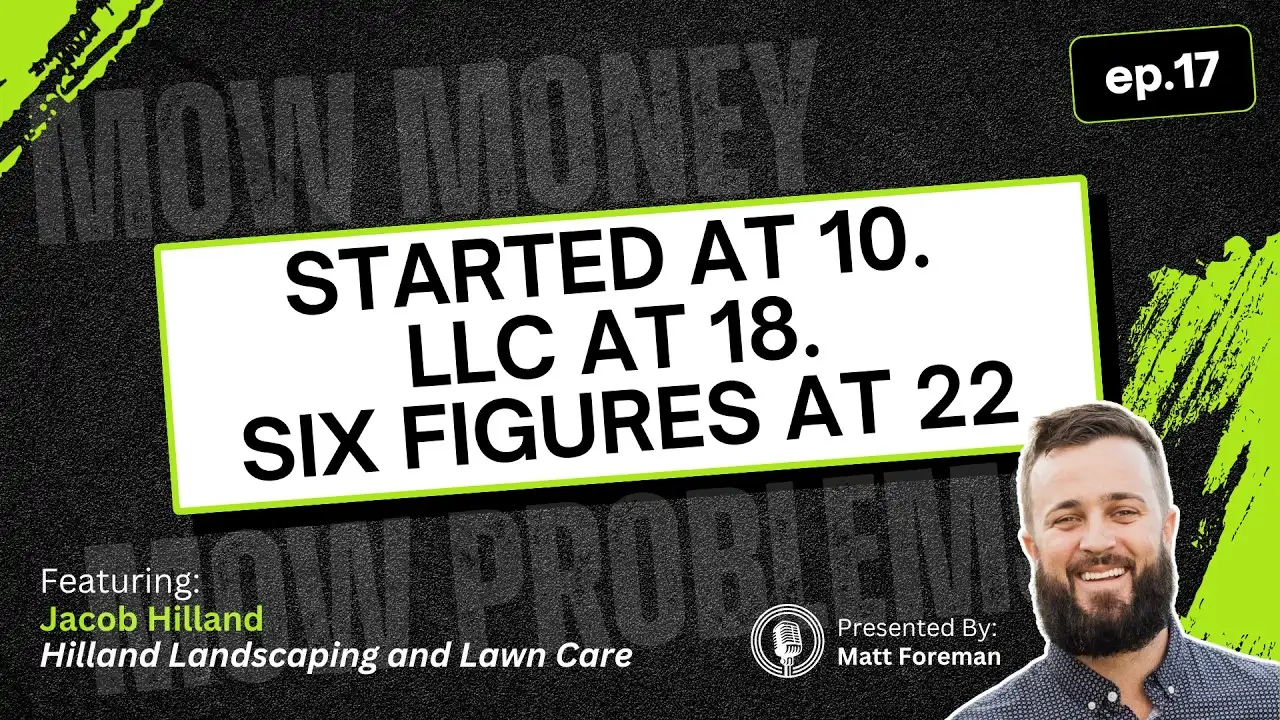
Jacob Hilland started mowing lawns at age 10 near Bryan, TX, in the Bryan-College Station area, with a push mower his grandfather pulled off the side of the road and taught him to rebuild. By 22, he is running two crews at Hilland Landscaping and Lawn Care, bidding six-figure design-build projects, and offering a full menu of outdoor services without hiring for most of it.
On episode 17 of the Mow Money, Mow Problems podcast, Jacob walked through how a kid's side hustle survived high school, a COVID-era boom, and the skepticism that comes with looking young on a job site, and became a company built on referrals and a deep bench of subcontractors. He also explained why he is still trying hard to get off the mower himself.
Key takeaways
- He started with a free mower and no bills. Jacob mowed his first lawns at 10, kept most of his early earnings because he had no real expenses, and did not register an LLC until the month he turned 18.
- His company runs on two sides: lawn maintenance and landscape construction. Subcontractors handle fertilization, tree work, gutters and fencing, which lets a small crew bid jobs a much bigger company would need extra payroll to staff.
- Being young cost him real money. At 18, he underbid a landscape construction project by tens of thousands of dollars against its true market value, after ignoring a warning sign his own father had already spotted.
- Drainage is one of his most repeatable, profitable services because most competitors in his market do not grade or tie it in correctly.
How did a push mower off the side of the road turn into a landscaping business?
It started with a 10-year-old, a free mower, and a grandfather willing to teach him to fix it. Jacob's grandfather found a discarded push mower, showed him how to clean and rebuild the carburetor, test the spark plug, and keep the equipment running, then put him to work mowing for neighbors near Bryan, TX. His first job was an acre lot that had gone two to three months between mows. At his height at the time, the grass came up to his chest, and the job took 12 hours spread over two or three days with a 21-inch push mower.
His parents drove him to jobs before he had a license, and the business grew through plain word of mouth. By 14, neighbors who hired him to mow started asking for light tree trimming, shrub trims, and mulching, and he said yes. "A lot of times they just want to hire you to do that," he said, which is part of why lawn maintenance has stayed such a strong entry point into the industry.
Why did COVID turn a mowing side hustle into a real company?
Demand spiked right when Jacob was positioned to catch it. COVID hit during his junior year of high school, when classes went fully online. Homeowners stuck looking at their own yards all day started hiring for yard work, and a teenager charging less than an established company suddenly looked appealing. "The cheap kid like me were in high demand," Jacob said, for the kind of client who would not have paid, or hired, a bigger company before.
That stretch is when he hired his first full-time employee and began buying his own trucks, trailers, and mowers. As Jacob described it in June 2026, Texas law does not allow someone to register an LLC until age 18, so he operated informally through high school and filed the month he turned 18. Registration rules vary by state and can change, so check current requirements with your state's secretary of state before following that timeline.
What does it cost a young contractor to look young?
Unspoken bias, and sometimes a client who tries to take advantage of it. Jacob said clients rarely say it to his face, but he can tell when someone treats him differently because he looks like a kid. "They look at me and it's like, oh, well, he's probably been doing this for two years," he said, even when his experience runs longer than competitors twice his age.
The clearest example came at 18, on a landscape construction job he now calls one of the worst of his career. Jacob bid the project at about $20,000; he later estimated its real market value at somewhere between $40,000 and $60,000. His father had been asked to bid the same client's property years earlier and walked away after the client bragged about forcing a flooring crew to redo an entire floor. Jacob noticed the same red flag and bid anyway. The job stretched from a planned four weeks to six or seven, change orders piled up without a clear process for pricing them, and newly planted hollies died during a historic regional drought after the client's own irrigation contractor, who had sole responsibility for watering them, overwatered them instead. About half the hollies were lost, and the client still wanted Jacob to replace them, even though irrigation was never his crew's job on that property.
His takeaway: price a red-flag client high enough that they walk away, or hold your ground on who is responsible for what once a piece of the job belongs to someone else.
How do you offer a full menu of outdoor services without growing your headcount?
Split the company into two sides, and sub out anything a specialist does better. Hilland Landscaping and Lawn Care's lawn side offers full-service lawn maintenance: mowing, bed maintenance, monthly irrigation audits (Jacob holds his own irrigation license), overseeding, and hydroseeding. Fertilizing is subbed out entirely. "It would take a lot of research and training and time to get to the point where we could do as good as they do," Jacob said of the company he uses.
The construction side has grown from mulching and planting into stone edging, water features, drainage, hardscape patios and walkways, fencing, and even pergolas, with Jacob recently sending a six-figure bid for a pavilion. Tree work and gutters are subbed out, and he consults an arborist on tree-related questions. The company does not build pools.
He treats subcontractor relationships in tiers:
| Sub tier | What Jacob expects | How he described it |
|---|---|---|
| Top-tier specialist | The best in the market, priced accordingly, and good for the relationship because they stand behind mistakes | His gutter subcontractor, whose installs carry a lifetime warranty |
| Standard trade sub | Solid work most of the time, but thin enough margins that a bad redo can be more than they can absorb | Some of the concrete crews he uses for flatwork |
Either way, Jacob treats a sub's mistake the same as his own crew's. "My belief is it's the same as if we were doing it," he said, because the client sees Hilland Landscaping and Lawn Care's name on the invoice, not the sub's.
How do you find and vet subcontractors you can trust with your name on the invoice?
Mostly through networking, not a formula. Jacob meets potential subs at local business owner groups and through referrals: if a yard looks good, he asks the homeowner who did the work and calls that company directly. A local Facebook group for contractors is another go-to; posting a single need, such as a skid steer operator for dirt work, can bring about 10 responses.
Vetting happens by trying a new sub on a lower-stakes job first and paying attention to how they communicate before committing to anything bigger. Fit matters as much as skill: Jacob mentioned a fence subcontractor whose crew smokes on site, which is fine for most jobs but would bother some clients, so he reserves that sub for properties where it will not be an issue.
Why is drainage one of the most profitable, repeatable services in his market?
Because most competitors in his area do not do it correctly. Jacob says drainage is one of his favorite services because, once a crew is trained on the process, it repeats reliably and the margins hold up. He is blunt with clients who ask him to tie new drainage into an existing system installed by a cheaper competitor: "I pretty much 95% guarantee that once we do that, it's not going to work right," because the existing lines are usually sloped wrong or already clogged.
Drainage and gutters go together in his view. A property without gutters concentrates water across the whole roofline instead of a handful of downspouts, which makes any drainage fix far more extensive.
What should the owner be doing instead of driving the mower?
Networking, growth, and mentoring, but Jacob is not there yet. His honest answer, as of the recording, was that he was personally filling in on the mowing crew while he hired a new crew lead. "When I'm on a truck mowing 50 hours a week, I can't focus on growth," he said.
His plan once that position is filled: get the mowing side to a full five-day week, tighten routes and improve margin as volume builds, then grow the landscape construction side into one larger, better-trained crew instead of two thinner ones, so more people can land on a big job at once rather than a small crew dragging it out. Longer term, he wants his crew leads, and eventually a dedicated salesperson, running customer relationships while he focuses on connections, systems, and mentoring.
The operator takeaway
Jacob Hilland's story is a reminder that a landscaping company does not need a decade of experience or a big crew to take on serious work. What it needs is a system: subcontractor relationships strong enough to put the company's name behind someone else's work, a two-sided business model that matches the right crew to the right job, and the discipline to recognize a red-flag client before signing the bid. Jacob is still working to get himself off the mower, but the parts of the business built to run without him, the subs, the referral pipeline, and the growing list of services, are already doing their job.
Want more of the right jobs to find you?
We build the marketing system that helps landscaping companies get found for the high-ticket work: a website that converts, local SEO, reviews, and follow-up that turns the right kind of lead into a booked estimate.
Want this done for you? See our landscaping marketing.
Frequently asked questions
How did Jacob Hilland start Hilland Landscaping and Lawn Care?
He started mowing lawns at age 10 near Bryan, TX with a free push mower his grandfather taught him to repair, grew his client base through word of mouth and parents driving him to jobs, hired his first full-time employee during the COVID-era boom in high school, and registered the LLC the month he turned 18.
Why do landscaping customers push back on young contractors?
Jacob said clients rarely say it directly, but some treat a young-looking contractor differently and assume less experience than they actually have. He has also had a client try to take advantage of his age on a major underbid job, which he now avoids by pricing red-flag clients very high or declining the work outright.
How do you vet subcontractors for a landscaping business?
Jacob finds most subs through networking, local business groups, and a contractor Facebook group, then tests a new sub on a lower-stakes job before trusting them with anything bigger. He also matches the sub to the client, since not every sub's crew or work style fits every property.
Why is drainage considered a profitable landscaping service?
Jacob said drainage is repeatable and holds its margin once a crew is trained on the process, and most competitors in his market install it incorrectly, tying into poorly sloped or clogged existing lines instead of fixing the underlying problem.