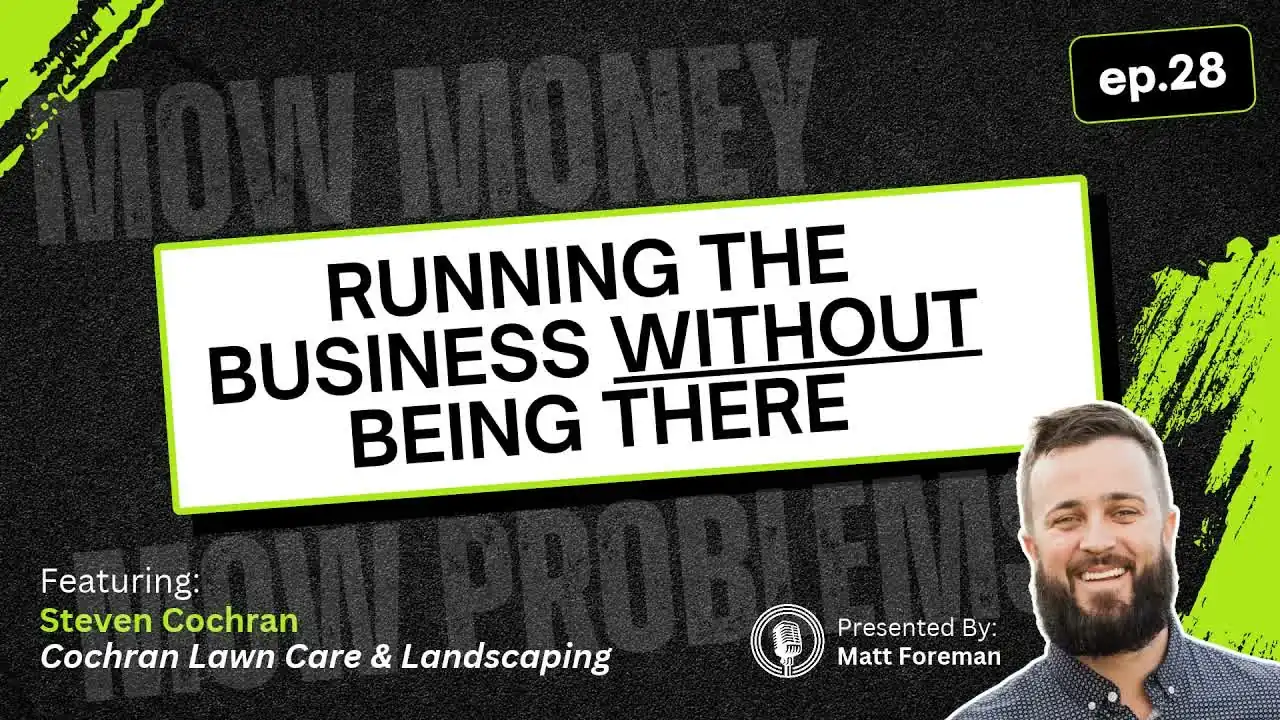
Steven Cochran runs Cochran Lawn Care and Landscaping in the Hampton Cove and Owens Cross Roads area near Huntsville, AL, and he does it while working 48-hour shifts as a career firefighter. On episode 28 of the Mow Money, Mow Problems podcast, he explained how a company that services roughly 200 homes a week keeps moving when the owner can't answer the phone.
His answer is people and systems: a leader hired for judgment rather than lawn experience, training that lives on video instead of in his head, and routes built on referrals so tight the mower drives from lawn to lawn.
Key takeaways
- Hire for leadership, teach the trade. Steven's foreman came from warehouse management with zero lawn care experience and was running the crew within 8 to 12 months.
- Put your standard on video. A training portal on the company website shows every new hire how Steven wants edging, trimming and blowing done before they ever touch a mower.
- Quality work plus one happy client can build a neighborhood. In one subdivision, Steven went from 2 clients to 28 in three years, mostly through referrals.
- Put every service in your name. Clients assume a landscaping company mows, but not that a lawn care company does landscaping.
How do you run a landscaping company when you're gone 48 hours at a time?
You hire someone who will act like it's their company, and you let them. Steven's rule for his foreman since day one: "Your name's on the side of this truck. I'm not here." Rain, broken mowers and schedule changes are the foreman's to handle.
The surprise is who he hired. His foreman came from warehouse management at Dollar General, with "zero experience with outside stuff, nothing, no lawn care, no landscaping." What he did have was leadership and a business mindset. Steven's view: "You can teach anybody to cut grass. You can't teach someone how to run a business and act like it's your business." Within 8 to 12 months, the new hire was in charge.
It took years to get there. Steven has had foremen who were great at getting work done but "horrible at managing people," and it hurt the company culture. The difference now, in his words, is that he isn't paddling the boat alone: two or three people are paddling in the same direction.
How do you get your quality standard out of your head and into the crew?
Write it down, film it, and make new hires prove it before they move up. Cochran Lawn Care and Landscaping has an employee portal on its website with training videos, some filmed by Steven and some short, practical YouTube videos he picked out. New hires learn the company's way to edge, trim and blow, and they have to master those three before they get on a mower.
- Steven's own videos map a real client's property: where edging starts, the order of the lines, where trimming and blowing begin.
- Curated videos cover things like hooking up a trailer and the difference between heat stroke and heat exhaustion, which matters in a North Alabama summer.
- An employee benefits package spells out what the company provides (PTO, a paid trip to the GIE trade show, outings) and what it expects: show up on time, check your truck, no callbacks.
New hires also get a two- or three-day trial alongside the foreman to see the pace before anyone invests more payroll and paperwork. As Steven puts it, some people decide quickly that "this ain't for me," and that's better found out early.
What can a landscaping company borrow from a firehouse?
Checklists that make every crew accountable for being ready. At the fire department, every morning starts with a truck check: pull the truck out, run the lights, engine and pump, and go through every compartment for anything missing or damaged.
Steven brought that to his crews. Every morning, they complete a checklist in Jobber before leaving: truck checked, tools on board, materials loaded, cooler and ice packed. He's taking delegation further, too. Starting in January, each foreman owns the supplies for their division, from trimmer line and edger blades to a broken shovel or a mower tire, so the owner isn't the one counting parts. The goal, he says, is for the crew "to work the least amount as possible and make the most money."
What actually grows a lawn and landscape client base?
In Steven's experience, quality work and client relationships beat every paid channel he has tried. He's run postcards, door hangers, Facebook ads and Google ads, and his read is that each works "somewhat," depending on the job. His first postcard run brought roughly $9,000 to $10,000 in one-time spring cleanups but only two lawn care clients; the second brought seven or eight lawn care clients and few cleanups.
What really moved the needle was referrals inside high-end neighborhoods:
| Neighborhood | Then | Now |
|---|---|---|
| One Hampton Cove subdivision | 2 clients, three years ago | 28 clients |
| A second subdivision | Not stated | 40 clients, so close together the mower drives lawn to lawn |
Much of that came from clients posting about the company on their neighborhood's social media board. One client posts four or five times a year, and each post brings three to five new clients. Steven thanks clients who refer, including a $100 referral credit. The result is very tight routes: about 90 individual clients in Hampton Cove, roughly five miles from his shop.
He keeps those relationships going through Jobber: two-way texting, a client portal with past messages and invoices, an AI receptionist, and a quarterly email about what's coming up, like pruning and mulching.
Why should a lawn care company put "landscaping" in its name?
Because clients won't assume you do it otherwise. Steven started as Cochran Lawn Care and later added landscaping to the name, and he's glad he did. Even so, a long-time client told him this year that she didn't know the company did landscaping. His take: clients "understand that landscaping is lawn care, but they don't think that lawn care is landscaping."
His plan is to tell clients directly, adding a list of services to the year-end client gift. Matt suggested a related idea on the episode: a branded gift card, such as $250 off a landscaping or hardscape project, that lists what the company installs. It reminds every lawn client that the company does more, and gives them a reason to call.
How do you keep a crew working through the winter?
Year-round contracts, so the slow months still pay. Steven won a year-round HOA contract by walking into an HOA he used to service as a foreman for his previous employer and reintroducing himself; the HOA was unhappy with its current company and gave him the work. He wants more, with one caution: many HOA contracts renew year to year, with a short decision window in mid-October for a January 1 start.
He also offers year-round contracts to clients with larger, mature properties. Leaves, sticks, winter check-ins, mowing, pruning and mulching get divided into 12 monthly payments, typically $450 to $600 a month. A few of those, he notes, bring in two to three thousand dollars a month through the winter. Last winter, with less work to go around, he rotated three crew members at 28 to 30 hours a week rather than lay anyone off.
What's the lesson from a subcontracted patio gone wrong?
Vet your subcontractors on the exact kind of work you're hiring them for. Steven subbed out a paver patio to someone he knew from high school who did great flagstone and border work. Steven had never actually seen one of his paver patios. The finished patio was uneven enough that Steven made him take it back up, and Steven absorbed about $3,000 to make it right. The client still recommends him because of how he handled it.
His rule now: "Vet your subs. Go to the job sites. See their work." A good flagstone sub isn't automatically a good paver sub.
The operator takeaway
Steven Cochran's story shows that a lawn and landscape company can grow with an owner who isn't there every day, as long as the standard lives somewhere other than the owner's head. Hire leaders, put the training on video, borrow checklists from wherever they already work, and let quality work and happy clients build the routes. As he puts it, nothing has beaten "the quality of work and the relationships that I have built with the clients."
Want more clients to know everything you do?
We build the marketing system that helps lawn and landscape companies get found for every service they offer: a website that converts, local SEO, reviews and follow-up that keeps clients coming back.
Want this done for you? See our landscaping marketing.
Frequently asked questions
How does Steven Cochran run his company while working as a firefighter?
He hired a foreman for leadership rather than lawn care experience, gave him full authority while Steven is on 48-hour shifts, and built systems so the crew doesn't depend on him: training videos, a written employee benefits package and a daily truck checklist in Jobber.
How do you train a new landscaping crew member?
At Cochran Lawn Care and Landscaping, new hires watch training videos on an employee portal, learn the company's standard for edging, trimming and blowing, and must master those three before moving to a mower. They also start with a two- or three-day trial alongside the foreman.
What is the best way to get lawn care clients?
Steven has tried postcards, door hangers and paid ads, and says each works somewhat depending on the job. What grew his business most was quality work and client referrals, especially clients posting about the company on their neighborhood social media boards.
How do year-round lawn and landscape contracts work?
Steven bundles a year of services for larger properties, including leaves, winter check-ins, mowing, pruning and mulching, and divides the total into 12 monthly payments, typically $450 to $600 a month, which keeps revenue coming in through the winter.